I’m the soldier who saw the S.O.S. on the diner window. I watched her “father” slap her. I called the cops. They checked his papers and told me to leave. His papers were perfect. Then the 3-year-old girl leaned in and whispered 4 words to the sheriff that changed everything.
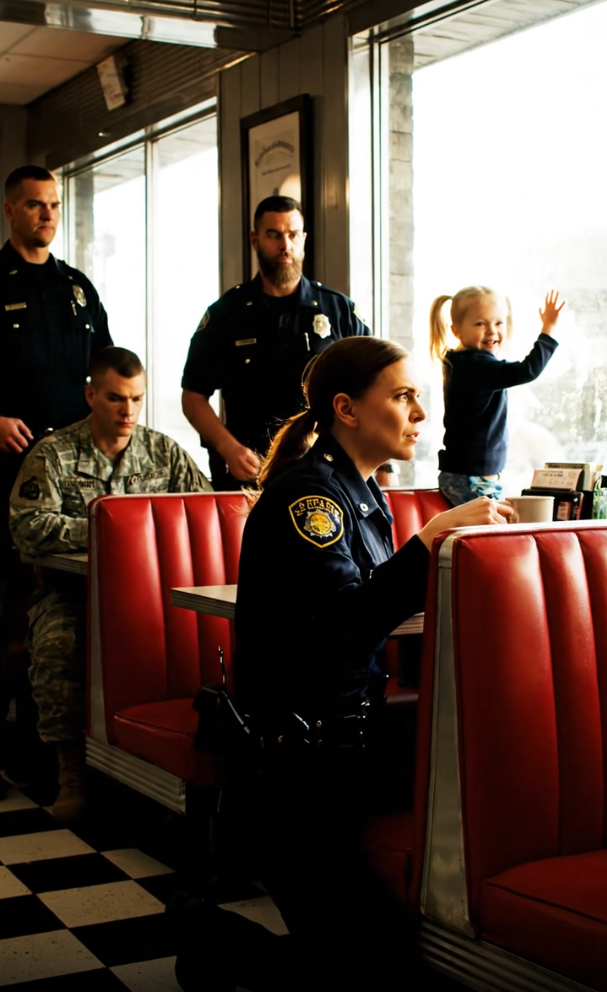
The two deputies and the sheriff walked in. The lead officer, the sheriff, was a woman with eyes that didn’t miss a thing. Her name tag read “MORALES.” The manager, his face still pale, just pointed.
The man, “Steven Carter,” performed a miracle.
“Good morning, officers,” he said, his voice dripping with relief. “Thank God you’re here. This soldier,” he jabbed a thick finger right at me, “has been harassing us. He tried to give my daughter candy, and when I told him no, he started threatening me. I think he’s having some kind of episode.”
My blood pressure spiked. An episode? He was flipping this. He was flipping this on me.
The deputies looked at me, still standing by my booth, arms crossed. Then back to him.

“That’s not what happened,” I said, my voice flat. I was a Sergeant. I would not be intimidated. “He struck the child. Across the face.”
“I disciplined my daughter,” the man snapped back, his voice righteous. “She has a severe allergy, and I’ve told her, repeatedly, not to take food from strangers. He wouldn’t back off. He was aggressive. Now, if you’ll excuse us, we’re on our way to Phoenix to see her mother.”
It was plausible. It was so terrifyingly plausible.
“We’ll need to see some ID, sir,” Sheriff Morales said, her voice a perfect, neutral calm.
“Of course. Happy to,” the man said, all cooperation. He reached into his jacket, pulled out a worn leather wallet, and produced a driver’s license. Steven Carter. Then, he reached into an inside pocket and pulled out a folded set of papers. “Here’s her birth certificate. Emily Carter. And our custody agreement. I have full custody. Her mother and I… we had a difficult separation.”
He even managed to look sad. He was a performer.
One of the deputies took the papers. He walked over to the window, pulling out a small flashlight, checking the watermarks, the print. He read it, read it again, and then walked back to Morales.
He nodded. “They look legit, Sheriff. Everything matches.”
A wave of cold dread washed over me. It was so cold it made me nauseous. Had I misread everything? The S.O.S.? The slap? Was this just a brutal, heavy-handed father, and I had just humiliated him?
The deputies were relaxing. Their shoulders dropped. They were starting to look at me like I was the problem. Like the guy said, a soldier with an “episode.”
“Sir, maybe it’s best if you just head on out,” the deputy said to me. His voice was polite, but it was an order. “This seems to be a family matter.”
“No,” I said. My voice was quiet, but it cut through the hum. “No. Check the marks on her wrist. Look at her shoes. One is a sneaker, one is a sandal. What kind of father doesn’t notice that?”
“Son, I think you’ve done enough,” the deputy said, taking a step toward me, his hand gesturing to the door.
“Wait.”
Sheriff Morales held up her hand. She hadn’t taken her eyes off the little girl. Not once. The girl was still hiding her face in the man’s chest, her tiny body trembling.
Morales had seen what I’d seen. She’d seen the handprint. She’d seen the mismatched shoes. And she’d seen the way the girl flinched—an involuntary, practiced flinch—every time the man moved or spoke.
She ignored me. She ignored the deputies. She ignored the man. She knelt, getting her eye level below the child’s, making herself small. Her voice, when it came, was pure honey.
“Sweetheart,” she said, so gently it barely made a sound. “My name is Linda. I’m a police officer. Are you okay? Is this your daddy?”
The entire diner, every trucker, every family, was frozen. The only sound was the low, electric hum of the milkshake machine.
The little girl, “Emily,” slowly… so slowly… lifted her head.
She looked at the man, “Steven Carter.” He was smiling at her. A cold, tight, terrifying smile that didn’t come anywhere near his eyes. He gave her a tiny, imperceptible shake. “Tell the officer, Emily. Tell her who I am.”
The girl’s eyes moved from his. She looked at the papers in the deputy’s hand. She looked at me, and I was holding my breath so hard my lungs burned.
Then she looked back at Sheriff Morales.
She leaned forward. Just an inch. So close that her tangled hair brushed the sheriff’s cheek. The diner held its breath.
And she whispered four words.
Four chilling, world-shattering words that made Sheriff Morales’s blood run cold.
“He’s not my daddy.”
The change was instantaneous. It wasn’t a decision; it was a reflex. The air in the diner didn’t just thicken; it solidified.
Sheriff Morales didn’t stand up. She didn’t hesitate. She stayed low, creating a barrier with her own body as she scooped the little girl off the man’s lap and into her own arms, pivoting away from him in one fluid motion.
“Deputy, cuffs,” she said. Her voice wasn’t honey anymore. It was forged steel.
“What? You’re crazy!” Steven Carter—or whatever his name was—shouted, his face contorting from “concerned father” to pure, unfiltered rage. He lunged. He wasn’t lunging for the girl; he was lunging at the sheriff.
But I was already moving.
My training, my adrenaline, the 36 hours of exhaustion—it all focused into one single point. I wasn’t a soldier anymore; I was a wall. I met his lunge with a forearm to his chest, driving him back hard into the laminate of the booth. The sound was a thud that shook the table.
The deputies swarmed. The smooth, calm “father” was gone. In his place was a snarling, violent animal, screaming obscenities, fighting with a desperate, terrifying strength. But there were three of us, and in seconds, he was on his stomach, his hands cuffed hard behind his back.
“You can’t do this! She’s mine! The papers! Check the damn papers!” he bellowed, his face mashed against the linoleum as they hauled him to his feet.
He was still screaming as they dragged him out the door, past the flashing red and blue lights, and shoved him into the back of a cruiser.
Inside the diner, it was silent again, broken only by the sound of the little girl’s crying. She wasn’t wailing anymore. She was sobbing, clinging to Sheriff Morales’s uniform like a lifeline.
A paramedic, who had arrived with the deputies, was already kneeling, checking her. The red handprint on her cheek was already darkening, blooming into a sickening bruise.
“She’s… she’s okay,” I stammered, the adrenaline finally draining out of me, leaving me shaking so hard I had to sit down in my own booth.
Morales looked at me, her eyes dark, still holding the girl. “Let’s get her to the station. And you,” she said to me, “I need your statement. You did good, soldier. You did real good.”
At the station, the whole nightmare unraveled with horrifying speed.
They put the little girl in a quiet office with a juice box and a coloring book. Away from the man, away from the uniform, she finally told them her real name.
“It’s Lily,” she whispered.
They ran the man’s fingerprints. The name “Steven Carter” evaporated. His real name was Steven Holt, 41. He had a long history of assault and, crucially, a warrant out of Texas for child abduction.
The birth certificate was a high-quality forgery, good enough to pass a glance, but missing the official, raised state seal. The custody papers were fakes, printed on good paper, but signed with a name that didn’t exist.
The database lit up. A missing-person alert for a Lily Henderson, age 3, from Amarillo, Texas.
Kidnapped from a rest stop two weeks prior. Her mother, Rachel Henderson, had gone inside to pay for gas. She was gone for less than ninety seconds. When she came back out, the car door was open, and Lily was gone.
Holt, it turned out, wasn’t a random opportunist. He was a stalker. He had targeted Rachel online for weeks, posing as a social worker, trying to get information on Lily. When she blocked him, he’d found her anyway. He’d learned her routine. He’d waited for that one-second lapse in vigilance.
My stomach churned. That slap. The “allergy.” It was all control. He was taking her to Mexico, where she would have vanished forever.
The FBI’s Albuquerque field office was notified. “We’ve got the kid alive,” Sheriff Morales said into the phone, and I could hear the emotion thick in her voice. “Yeah. She’s safe.”
The call to Rachel Henderson, they told me later, was the hardest and best call Sheriff Morales had ever had to make.
Two days later, I was asked to be at the station. Rachel arrived, looking like a ghost. She looked like she hadn’t slept or eaten in two weeks. She was trembling, walking like she was made of glass.
And then she saw Lily.
A sound tore out of her chest. It wasn’t a cry or a scream. It was a sound of pure, agonizing relief that I will never forget as long as I live. Lily, who had been quiet and withdrawn, saw her. Her eyes lit up.
“MOMMY!”
She ran. Rachel collapsed to her knees, and Lily buried her face in her mother’s neck. They just stayed there, on the floor of the sheriff’s station, rocking and sobbing.
After a long minute, Lily pulled back, her small voice muffled by her mother’s hair. “I did the code, Mommy,” she whispered. “Like on the show. I did the code.”
Rachel just sobbed, her tears soaking her daughter’s hair. “You did perfect, baby. You did so perfect.”
The story blew up. “The Morse Code Miracle,” the local news called it. Steven Holt was tried, and faced with a mountain of evidence and the testimony of a three-year-old girl, he received a sentence of life without parole.
At the trial, Sheriff Morales testified, “If not for a soldier paying attention to a child tapping on a window, if he had dismissed it as a game, Mr. Holt would have been in Mexico by nightfall. And we would have never found her.”
I avoided the spotlight. I was transferred to Fort Bliss. When a reporter finally tracked me down, I kept my answer short.
“She saved herself,” I said, and I meant it. “I just listened.”
Months passed. Life went on. The I-40 was still just a river of asphalt and dust, carrying people to their destinations. I found myself driving that same stretch, on my way to a new assignment.
I pulled off at the exit. I don’t know why. I didn’t have to, but I felt compelled.
I walked into the same Denny’s. The same smell of burnt coffee and maple syrup. The same low hum of the highway.
I sat in the same booth. My booth. By the window.
Flo, the waitress, was working. She recognized me. She walked over, a coffee pot in her hand.
“You’re him,” she said quietly, pouring my coffee. “You’re the soldier from the story.”
I shook my head, giving her a small, embarrassed smile. “Just happened to be looking the right way, ma’am.”
She smiled, a real, warm smile that reached her eyes. “Well. We’re all glad you were.”
She left me with my coffee. I stared out the window, at the trucks rolling by. A moment later, she returned. She didn’t say anything. She just placed something on the table beside my cup.
A single, red, cellophane-wrapped lollipop.
I stared at it.
I thought of the sound of that slap. I thought of the man’s raging, possessive eyes. I thought of the cold dread I felt when the deputies told me to leave.
And I thought of the four small words whispered by a three-year-old girl who refused to be invisible.
Somewhere in Texas, a little girl was safe, probably learning to ride her bike, her shoes matching.
And here, in a quiet diner on the side of the interstate, I picked up the lollipop, unwrapped it, and finally, I allowed myself to breathe.