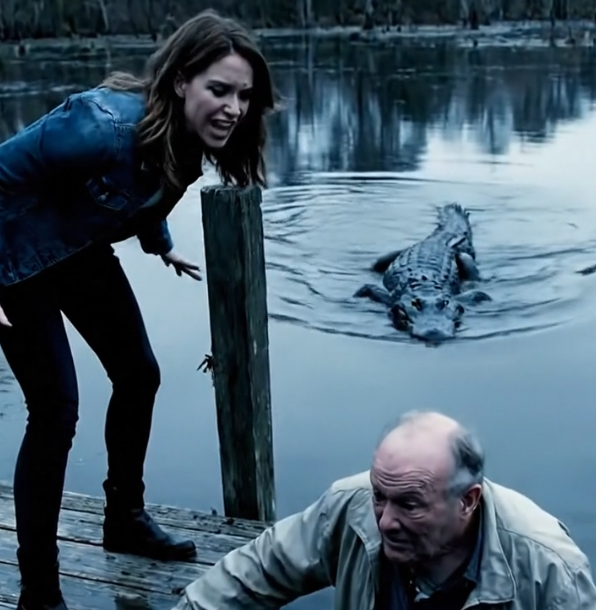
My Son and His Wife Whispered “Go to the Crocodiles” Then Shoved Me, Their Billionaire Father, Into the Amazon River. They Laughed on the Yacht, Believing They’d Inherited $2 Billion. They Had No Idea I Survived… Or That Contingency Plan Alpha Was Already Activated From a Mud Hut Via Satellite Phone. My Revenge Was Cold, Swift, and Absolute. They Never Saw Me Coming.
Chapter 2: The River’s Mercy, The Jungle’s Test
The shock of the cold was absolute. It wasn’t just water; it was the Amazon, thick, murky, and alive with unseen currents that grabbed at my legs like greedy hands. One moment, I was standing on the polished deck of my yacht, the humid air thick with Clara’s expensive, cloying perfume; the next, I was submerged, the world reduced to swirling brown and a desperate, burning need for air.
My lungs screamed. Disorientation warred with the primal instinct to survive. I kicked wildly, fighting towards the receding light filtering from the surface. When my head finally broke through, gasping, coughing, spitting out the vile river water, the first thing I saw was the stern of the Serenity moving away. Steadily. Unhurriedly.
Nathan. My son. He stood beside Clara at the railing. He wasn’t rushing to throw a life preserver. He wasn’t shouting for the captain to turn back. He was just… watching. And there it was, faint but unmistakable across the widening gap of water – a smile. Cold. Triumphant. The smile of a predator who has finally cornered its prey.
Clara leaned against him, her expression a mask of feigned concern, probably for the benefit of any crew member who might be watching. But her eyes, even from that distance, glinted with the same chilling satisfaction.
“Go down to the river where the crocodiles wait.”
Her whisper echoed in my ears, clearer now than when she’d uttered it moments before. It wasn’t just a threat. It was a sentence. They had planned this. The “family bonding” trip, the remote location, the slowing of the boat near a known crocodile habitat. It was calculated. Patricide, cloaked in the exotic beauty of the Amazon.
Rage, cold and pure, surged through me, momentarily eclipsing the fear. They thought I was finished. An old man, easily disposed of, an obstacle removed from their path to my two-billion-dollar empire. They had fatally underestimated me. I hadn’t built Wallace Global Group by being weak or easily intimidated. I had clawed my way up from nothing, survived corporate sharks, hostile takeovers, and market crashes that would have broken lesser men. I wasn’t about to let my own spoiled, grasping offspring be the end of me.
The current was strong, pulling me downstream, away from the wake of the yacht. Panic threatened to clamp down again. Crocodiles. Piranhas. The river teemed with things that could kill you in minutes. Every submerged log looked like a lurking reptile, every brush of unseen vegetation against my leg sent jolts of terror through my system.
But I forced the fear down. Discipline. Focus. That was the mantra that had built my life. Discipline creates destiny. My destiny was not to become food for Amazonian predators.
I assessed my situation. The yacht was gone. Shouting was useless. The shore looked impossibly far, a dense, uninviting wall of green. But it was my only chance.
Summoning every ounce of strength I possessed at seventy-one, fueled by fury and the sheer, stubborn refusal to die, I began to swim. Not with the practiced strokes of a leisure swimmer, but with the desperate, energy-conserving movements of someone fighting for their life. I angled towards the nearest bank, fighting the relentless pull of the current, my soaked clothes weighing me down like lead.
My arms ached. My lungs burned. The murky water stung my eyes. Every splash, every ripple, echoed unnaturally loud in the oppressive humidity, potentially signaling my presence to whatever hunted beneath the surface. I kept my movements as smooth, as quiet as possible.
Time lost meaning. It could have been minutes or hours. The sun beat down, turning the air into a suffocating blanket. Finally, blessedly, my feet touched mud. Soft, sucking mud that threatened to pull me back into the river’s embrace.
I clawed my way forward, digging my fingers into the slick bank, hauling my exhausted body through thick reeds and tangled roots. The smell of decay, of damp earth and rotting vegetation, filled my nostrils. I collapsed onto the muddy ground, gasping, my heart hammering against my ribs like a trapped bird.
I was alive. Drenched, bruised, shaking uncontrollably, but alive.
I lay there for a long time, the sounds of the jungle pressing in. The screech of unseen birds, the buzz of insects, the rustle of leaves that could have been anything from a monkey to a jaguar. The sheer, overwhelming wildness of it was terrifying. I was a billionaire, a man who commanded boardrooms and moved markets, reduced to a piece of flotsam washed ashore in one of the most remote and dangerous places on Earth.
But the rage hadn’t subsided. It simmered, a cold fire beneath the exhaustion. They had left me for dead. My own son. His venomous wife. They were probably celebrating already, toasting their inheritance with my champagne aboard my yacht.
Fools.
They thought the river would be the end of me. They didn’t understand. The river had just shown me the truth. And the jungle? The jungle would be my crucible.
As the adrenaline faded, the physical reality set in. I was soaked. My expensive clothes were ruined, heavy with mud and river water. My body ached. Small cuts and scrapes from the riverbank began to sting. And I was utterly alone, miles from anywhere resembling civilization, in a jungle teeming with dangers I couldn’t even begin to catalogue.
Discipline. Focus. Survive.
I forced myself to sit up. I needed shelter, water, a way out. The sun was beginning its descent, painting the sky in fiery oranges and purples – a beautiful, deadly warning that night was coming. And night in the jungle was a different beast entirely.
I scanned my surroundings. Dense vegetation, towering trees draped in vines, the muddy riverbank stretching in both directions. No path. No sign of human habitation. Just the relentless, indifferent green.
I remembered basic survival principles gleaned from books read decades ago, fragments of documentaries watched on sleepless nights. Find water – ironically, the river itself was too dangerous to drink from directly. Find shelter. Move consistently in one direction, preferably following the river downstream, increasing the chances of finding a settlement.
I stripped off my soaked blazer and tie, useless weight. My leather shoes were waterlogged and heavy, but offered some protection against whatever might be slithering on the jungle floor. I started walking, keeping the river in sight, pushing through the thick undergrowth. The humidity was suffocating, clinging to me, making every breath feel heavy. Insects buzzed relentlessly, biting, stinging.
Every shadow seemed to move. Every sound made me jump. Was that a snake? A jaguar? Just the wind? My city-honed senses were useless here. Here, I was prey.
But the cold rage kept me moving. The image of Nathan’s smiling face as the yacht pulled away. Clara’s venomous whisper. They had miscalculated. They thought throwing me overboard was the final move. They didn’t realize it was just the beginning of a different kind of war.
As darkness fell, thick and absolute beneath the dense canopy, the jungle transformed. New sounds emerged – clicks, chirps, guttural calls, the rustling of larger creatures moving through the undergrowth. Fear, cold and primal, threatened to overwhelm me. I found a relatively sheltered spot beneath the roots of a massive tree and huddled there, straining my ears, every nerve frayed. Sleep was impossible.
I thought about Nathan as a boy. The scraped knees I’d bandaged. The bedtime stories I’d read. The pride I’d felt at his graduation. Where had that boy gone? When had the ambition curdled into avarice, the respect into resentment? Clara. It started when Clara came into his life. She had seen the wealth, the power, and had systematically poisoned his mind, feeding his insecurities, stoking his greed, turning him against his own father. And he, weak and easily manipulated, had let her.
The night was endless. Cold seeped into my bones despite the humidity. Hunger gnawed at my stomach. Thirst became a burning agony in my throat. But I held onto the anger. It was fuel. It kept the fear at bay.
When the first, pale fingers of dawn finally pierced the canopy, it felt like a resurrection. I pushed myself to my feet, stiff, sore, but resolute. I found a small stream trickling down towards the river – clearer water. I drank cautiously, deeply. It tasted like life itself.
I started walking again, pushing through the relentless vegetation. Hours passed. The sun climbed higher, beating down mercilessly. My body screamed for rest, but I ignored it. Discipline. Focus.
And then, I saw it. Smoke. A thin, gray tendril curling up into the sky, barely visible above the trees, downstream.
Smoke meant fire. Fire meant people.
Hope, sharp and sudden, surged through me. I forced my aching legs to move faster, stumbling through the undergrowth towards the smoke, calling out, my voice hoarse. “Hello? Is anyone there?”
Chapter 3: Contingency Plan Alpha
I stumbled out of the dense jungle into a small clearing. A handful of simple, thatched-roof huts stood clustered together. Faces peered out, cautious, curious. Indigenous villagers. Their expressions were unreadable, their language unfamiliar.
They saw a wreck. An old, white man, clothes torn and muddy, face scratched, eyes wild with exhaustion and desperation. They could have turned me away. Left me to the jungle.
But they didn’t.
Compassion, I learned then, truly needs no language. An older woman approached, her face weathered but kind. She gestured towards a hut, murmuring words I didn’t understand but whose meaning was clear. Welcome. Safety.
They gave me water, clean and cool, from a gourd. They offered me food – some kind of grilled fish and fruit that tasted impossibly sweet. They gave me dry clothes, simple woven garments that felt strange but blessedly comfortable against my skin. They tended to my cuts with herbal poultices that soothed the stinging.
They asked no questions, likely understanding that I couldn’t answer. They simply offered help, a basic human kindness that stood in stark, brutal contrast to the calculated cruelty of my own family.
I rested in the quiet dimness of the hut, the exhaustion finally overwhelming me. But even as I drifted into a fitful sleep, my mind was working. Planning.
The next morning, feeling marginally more human, I knew I had to act. Time was critical. Nathan and Clara would be enacting their plan, moving to seize control, locking down assets. They thought I was dead, crocodile food. That was my advantage.
Through gestures and the few Spanish words I knew, which thankfully overlapped slightly with Portuguese, I tried to communicate my need. Teléfono. Satélite.
It took time, patience, and much pointing, but eventually, an older man understood. He led me to a slightly larger hut where, miraculously, they had a satellite phone, likely used for emergencies or occasional contact with the outside world.
My hands still trembled, not from cold now, but from adrenaline, as I punched in the memorized number. It rang, an alien sound in the heart of the jungle. Then, a crisp, familiar voice answered.
“Graves.”
Edward Graves. My lawyer. My oldest friend. The man I trusted implicitly. The keeper of my secrets and my contingency plans.
“Edward,” I said, my voice low, rough, but firm. “It’s Richard.”
Silence on the other end. Then, shock. Disbelief. “Richard? My God! Where are you? We thought… the reports… the boat…”
“The reports were premature,” I cut him off. “Listen carefully. Nathan and Clara tried to kill me. They pushed me into the Amazon.”
Another stunned silence. Then, Edward’s voice turned cold, sharp. The lawyer replaced the friend. “Are you secure?”
“For now. I’m in a village. No details. Activate Contingency Plan Alpha. Immediately.”
Contingency Plan Alpha. The protocol we had established years ago, designed for the unthinkable – betrayal from within. It was ruthless, swift, and absolute.
“Freeze all corporate and personal accounts linked to Nathan Wallace and Clara Wallace,” I instructed, the words precise, clinical. “Lock down their access to all Wallace Global Group systems. Transfer all liquid assets, personal and corporate reserve funds, to the designated Geneva accounts. Alert the board – emergency meeting, coded communication only. And prepare the legal documents, Edward. Attempted murder. Conspiracy. Fraud. Everything. They wanted a war. Now they’ll get one.”
Edward didn’t hesitate. “Consider it done, Richard. We’ll initiate immediately. What about you? How do we get you out?”
“Working on it. Stay dark until I make contact again. No press. No announcements. Let them think they’ve won.”
“Understood,” Edward said, the steel back in his voice. “Take care, old friend. And welcome back from the dead.”
I disconnected, the satellite phone feeling heavy in my hand. Phase one was complete. The financial guillotine was falling, even as Nathan and Clara likely sailed on, oblivious, celebrating their victory.
Now, phase two: my return.
Chapter 4: The Ghost in the Mansion
Getting out of the Amazon was less dramatic than getting in, thanks to Edward’s discreet arrangements. A float plane coordinated via satellite, a quiet landing strip, a private jet waiting. Within twenty-four hours of making that call from a mud hut, I was back. Not in my penthouse office, not making a grand entrance. I slipped back into the city like a ghost, unseen, unheard.
Edward met me at a private airfield. His handshake was firm, his eyes grim but relieved. “Everything is in motion, Richard. Accounts frozen. Board alerted. Lawyers are primed. Nathan and Clara are completely cut off. They tried accessing funds this morning. Caused quite a stir.” A grim smile touched his lips. “They have no idea you’re back.”
“Good,” I said. “Keep it that way. I’m going home.”
“Richard, perhaps security…”
“No, Edward. This is personal. I need to see their faces.”
My mansion felt alien as the car pulled up the long, familiar driveway. It looked the same – imposing stone, manicured lawns – but the betrayal had tainted it. It was no longer just my home; it was the scene of their anticipated triumph.
I let myself in quietly with my own key. The house was silent, but it was the silence of emptiness, not peace. I walked through the marble entryway, my footsteps echoing slightly.
And I found them. Exactly where I expected them to be.
In the grand living room, the one overlooking the city skyline. They were sitting on the plush sofas, crystal glasses of champagne in hand, laughing. Laughing. The sound was obscene. They were celebrating my death. Celebrating their inheritance. Celebrating their victory.
Clara was wearing one of my late wife’s necklaces, a piece I hadn’t seen in years. The audacity, the sheer, naked greed of it, sent another wave of cold fury through me.
I walked into the room slowly. Deliberately. Letting the sound of my footsteps on the polished floor announce my presence before they saw me.
Clara turned first, mid-laugh. The sound died in her throat, strangled. The champagne flute slipped from her fingers, shattering on the Persian rug, the bubbly liquid spreading like a stain. Her face went white, utterly, terrifyingly white. Shock. Disbelief. And then, naked fear.
Nathan turned a second later, drawn by her frozen horror. His glass didn’t drop, but his hand spasmed, sloshing champagne onto his expensive trousers. His jaw went slack. His eyes, moments before bright with avaricious glee, flooded with a primal terror. He looked like he had seen a ghost.
And perhaps he had. The ghost of his father, returned from the river grave they had consigned him to.
“Surprised to see me?” I asked. My voice was soft. Quiet. But it carried the weight of the Amazon, the weight of betrayal, the weight of imminent reckoning.
Neither of them answered. They just stared, frozen like statues carved from fear.
I crossed the room. I ignored the shattered glass, the spreading champagne stain. I walked to my chair – the large, worn leather armchair at the head of the room, the one I had occupied for decades while building my empire, while raising the son who now stared at me as if I were death itself.
The familiar creak of the leather as I sat down seemed impossibly loud in the suffocating silence.
I looked at them. Really looked at them. Saw the greed that had hollowed out my son. Saw the manipulative ambition glittering in Clara’s eyes, now momentarily eclipsed by terror.
“I trusted you,” I said, my voice still quiet, dangerously calm. “I gave you everything. My name. My wealth. My legacy.” I paused, letting the words hang. “But instead of family, I seem to have raised… opportunists. Vultures.”
Nathan finally found his voice, a choked, pathetic sound. “Dad… I… we thought… the boat…”
I raised a hand, silencing him. “Don’t bother with the lies, Nathan. I saw your face. I heard her whisper.” My gaze shifted to Clara, pinning her. Her lower lip trembled. “It was quite the plan. Almost perfect.”
I leaned back in my chair, the picture of calm control, though the cold fire still burned inside. “But you made one critical error. You assumed I was weak. You assumed I would simply… disappear.”
I let the silence stretch again, savoring their dawning horror as the implications began to sink in.
“Everything you own,” I continued, my voice flat, devoid of emotion, “every account you accessed, every luxury you indulged in, every cent you thought was yours by right of inheritance… it’s gone. Frozen. Seized.”
Their faces crumpled. The terror morphed into disbelief, then dawning, sickening realization.
“You betrayed blood for greed,” I stated, the finality of the judgment echoing in the opulent room. “And now? Now you will learn, firsthand, what it truly means to have nothing.”
Chapter 5: The Reckoning
The arrival of the legal teams was swift, orchestrated by Edward with military precision. They descended upon the mansion, armed with court orders and impenetrable documents. Security personnel, loyal to me, quietly secured the premises.
Nathan and Clara sat stunned, powerless, trapped in the very symbol of the wealth they had tried to steal. The champagne flutes lay forgotten. The laughter was a distant, mocking memory.
Within hours, every asset linked to them was legally frozen or transferred. Credit cards declined. Access codes revoked. Cars repossessed from the driveway. Even the clothes on their backs, bought with funds siphoned from company accounts, were technically no longer theirs. The speed and totality of their downfall were brutal, designed to leave no room for maneuvering, no chance for escape.
When the police arrived, summoned by Edward, Nathan and Clara didn’t resist. They couldn’t. The evidence was overwhelming. The yacht captain’s suspicious report, filed upon their unusually calm return without me. The testimony of the crew members who noted their strange behavior. The satellite phone records from the Amazonian village. The villagers themselves, providing sworn statements about finding me, battered but alive.
Attempted murder. Conspiracy.
As I watched the police lead them out of my house, out of my life, their faces were masks of numb disbelief. There was no defiance left, only the dawning, terrifying reality of their utter ruin. I felt no joy. No triumph. Only the quiet, grim satisfaction of justice served. The cold, clean feeling of a necessary amputation. The poison had been excised.
The betrayal had cut deeper than any physical wound could have. It had forced me to confront a painful truth I had long ignored: my focus on building an empire had perhaps blinded me to the rot growing within my own family. Wealth hadn’t corrupted them; it had merely revealed the corruption that was already there.
And I learned, in the heart of the Amazon and in the cold light of their treachery, that the deadliest predators aren’t always the ones with teeth and claws lurking in the murky water. Sometimes, they wear familiar faces. Sometimes, they smile while they push you over the edge.
Chapter 6: A Legacy Reclaimed
Weeks turned into months. The trial was swift, the guilty verdict inevitable. Nathan and Clara received long prison sentences. The Wallace Global Group weathered the scandal, thanks to Edward’s deft handling and the board’s decisive action in my absence.
I stood by my office window, the city skyline spread out before me, a testament to decades of relentless work. The empire still stood. But something within me had changed. The near-death experience, the visceral betrayal, it had clarified my purpose.
I didn’t step back from the company entirely, but I restructured. I promoted capable, loyal executives. And I made a decision that shocked the financial world.
I rewrote my will. The vast majority of my fortune would not go to distant relatives or undeserving heirs. It would be placed in a trust, dedicated to funding environmental conservation and sustainable development projects in the Amazon basin, and supporting the indigenous communities there – the people whose simple kindness had saved my life. A portion would also fund legal aid for victims of elder abuse and financial exploitation.
My legacy would not be defined by the son who tried to kill me, but by the work that would continue long after I was gone. A legacy not just of wealth, but of responsibility. Of giving back to the world that had, in its own brutal way, given me a second chance.
When people asked, cautiously, how I had survived the Amazon, how I had returned from the dead, I would simply smile, a glint of the old steel in my eyes.
“Never underestimate an old man who built his fortune with his own two hands,” I’d say. “And never forget: sometimes, the crocodiles are the least of your worries.”
The whisper still echoes sometimes, in the quiet moments: “Go down to the river where the crocodiles wait.” But it no longer holds the power of betrayal. Now, it’s just a reminder. A reminder that greed devours the soul faster than any predator. A reminder that survival is the best revenge. And a reminder that even in the darkest water, the will to live, fueled by righteous anger and a lifetime of discipline, can find its way back to shore. The river didn’t take me. It tempered me. It gave me back my clarity. And for that, in a strange, harsh way, I am grateful.