They Called Me a Crazy, Child-Stealing Recluse. They Said I Lived in the Woods, Broken by Grief. But When a 6-Year-Old Boy Showed Up on My Doorstep, Bruised and Silent, Clutching a Sketchbook… I Knew I Wouldn’t Let Her Take Him Back. Now, We’re Going to Court, and His Drawings Are Our Only Weapon.
The days that followed were a fragile truce with silence. The storm outside had passed, but the one inside my cabin had just begun. Noah, as I’d learn his name was from a tag sewn into his damp collar, didn’t speak. Not a word. Not a whisper. His silence was a physical thing, a heavy blanket that smothered every sound in the small, one-room cabin.
My world, once defined by its quiet solitude—the creak of the floorboards, the snap of the fire, the rustle of wind in the maples—was now defined by his silence. It was an accusing, terrified silence. He’d flinch if I moved too fast. He’d jump if a log fell in the fireplace. He ate like he was starving, but his eyes never left me, as if I might snatch the bowl away at any second.
He lived in the small nest of blankets I’d made on the sofa, and he had only one possession: that sketchbook. He clutched it to his chest when he slept. He set it beside his bowl when he ate. And for hours, he would just sit and draw.
I tried, at first. “There’s more stew, if you’re hungry.”
He’d freeze, pencil hovering, until I backed away.
“You’re safe here, child. No one is going to hurt you.”
He’d just pull his knees tighter to his chest.
I stopped trying to force it. I’d lost my own son, Thomas, to the world’s noise—a logging accident twenty years ago that had silenced my life. I knew grief. I knew trauma. And I knew you couldn’t rush it. So, I just… existed with him. I’d sit in my rocker, mending a quilt, and he’d sit on the floor, drawing.

Curiosity finally got the better of me. When he’d fallen into an exhausted, twitching sleep one afternoon, I crept over. The sketchbook was open on the floor.
The drawings weren’t of trees or birds. They were… monstrous.
Page after page of dark, jagged scribbles. There was a big, looming shape, all sharp elbows and a wide, screaming mouth. A house with broken windows. And in the corner of every single picture, there was a tiny, tiny figure, often hidden under a table or curled in a closet. My blood went cold. This wasn’t imagination. This was memory.
This was the “home” he’d run from.
We couldn’t hide forever. After a week, we were running low on flour and kerosene. The outside world was going to come calling, one way or another. I couldn’t leave him. The thought of him waking up alone, thinking I’d abandoned him, was unbearable.
“Noah,” I said gently, my heart in my throat. “We have to go to town. To the store. I won’t leave you.”
He just stared. Finally, slowly, he packed his crayons into a tin, tucked the sketchbook under his arm, and stood by the door. It was the first time he’d agreed to anything.
Willow Glenn isn’t a big town. It’s a “blink and you miss it” place. And everyone knows everyone. Or, at least, they think they do. They knew me as “Eevee Carter,” the woman who’d gone into the woods after her boy died and never really came back. The town recluse. The tragedy.
Pulling up to Archer’s Mill in my old pickup, I could feel the eyes on us before we even got out. Mr. Archer stopped loading a sack of feed, his mouth slightly open. Two women gossiping by the post office fell silent, their heads turning in unison.
“Stay close,” I murmured to Noah.
He didn’t need to be told. His small hand gripped the hem of my coat so tightly his knuckles were white.
“Evelyn?” Mr. Archer said, wiping his hands on his overalls. He was a decent man, but he was a town man. “Didn’t expect to see you. And… who’s this?”
“Just getting supplies, Ben,” I said, my voice flat.
“Heard Crystal Barnes’s stepson went missing,” he said, lowering his voice, but not enough. “She’s been putting up flyers. Says the boy… ran off. Says he’s ‘troubled.'”
I looked him dead in the eye. “He’s not troubled. He’s terrified.”
I paid for my flour, grabbed Noah’s hand, and walked out, the whispers following us like hornets. “That’s him,” I heard one of the women say. “I’ll be… she took him.”
The drive back was tense. I’d hoped we could stay under the radar, but I’d just painted a target on our backs. I had confirmed the town’s suspicion: the crazy old woman in the woods had stolen a child.
The confrontation came sooner than I expected.
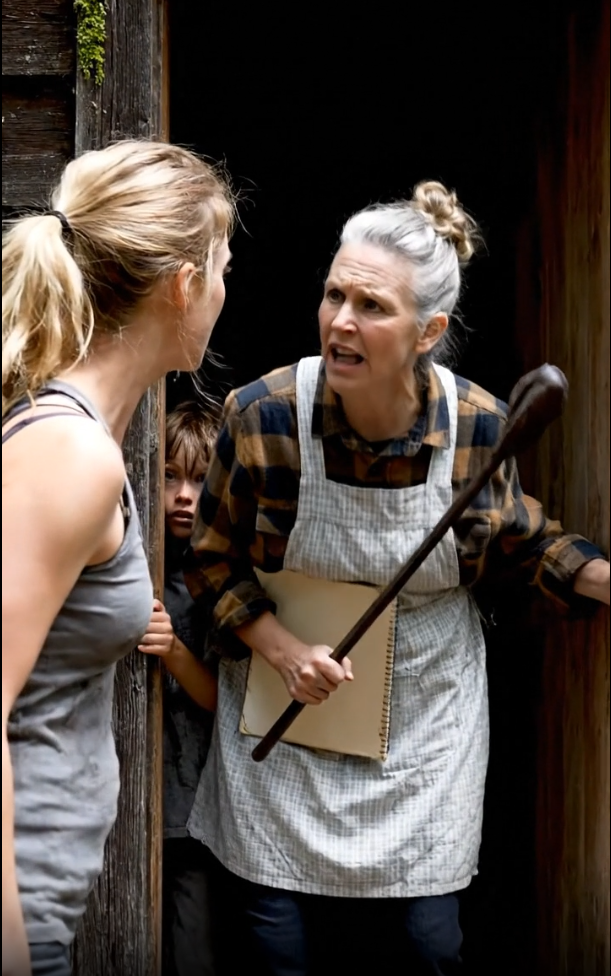
It was two days later. A red, sputtering pickup truck tore up my private road, sending gravel flying. I shoved Noah behind me before the truck even stopped.
The door flew open, and she stepped out. Crystal Barnes.
She was nothing like the monster in Noah’s drawings, which was what made her terrifying. She was young, pretty, and dressed in a way that looked respectable. She marched to my porch, her face a mask of practiced concern.
“I am here for my son,” she said, her voice dripping with venomous sweetness.
“He’s not coming with you,” I said, blocking the door.
From inside, I heard a small whimper. Noah had hidden himself under the table—just like in the drawings.
Crystal’s mask slipped. Her eyes narrowed. “You can’t do this. You have no right. He’s my family. I have been worried sick.”
“Worried?” My voice was low, shaking with a rage I hadn’t felt in twenty years. “You mean worried someone would see his bruises? Worried someone would find out what you did to him?”
“You old, crazy witch,” she hissed, her voice dropping. “You’re lonely. You lost your own kid, and you think you can just steal mine? I’ll have the sheriff up here so fast your head will spin. You’re going to jail, you child-snatcher.”
She took a step toward the door. I grabbed the heavy iron broom by the wall.
“Get off my property,” I snarled. “You are not touching him.”
Her face went dark. “This isn’t over. You have no idea what you just started.”
She stormed back to her truck, spun it around, and disappeared down the road. I stood there, shaking, my knuckles white on the broom handle. I locked the door and slid the bolt.
I turned to Noah. He was still under the table, rocking back and forth, his sketchbook clutched to his chest. He was making a low, humming sound.
He was right to be scared. She was right. This wasn’t over. This was a war, and I was a crazy old woman in a cabin with no one but a silent, traumatized child as my only witness.
The sheriff arrived the next morning. Sheriff Brody. He looked tired.
“Evelyn,” he said, not meeting my eyes. “I’ve got a formal complaint from Mrs. Barnes. Kidnapping.”
“It’s not kidnapping, Brody, it’s a rescue. Look at him.”
Noah was on the sofa, as far from the door as he could get.
“She says you’re unstable. That you lured him here. That you’re… unwell. Grieving.”
“And what do you think, Brody? You’ve known me thirty years.”
“I know you’ve been alone a long time, Eevee. The law is the law. DCFS is involved now. They’re scheduling an emergency hearing in Salem. You’re to bring the boy to the courthouse tomorrow at ten.” He sighed, looking at Noah. “And a judge will decide. Not me. And sure as hell not you.”
He left. The finality of it hit me. A judge. A courtroom. Strangers.
I had to find a lawyer.
I spent the rest of the day on my old rotary phone, calling every name in the Salem phonebook. Most hung up when they heard the words “kidnapping” and “DCFS.” Finally, one name, Grace Lyman, agreed to see me.
I met her that evening, leaving Noah with a promise I’d be back in an hour. Her office was small, cluttered, and smelled of stale coffee. Grace was sharp, tired, and didn’t mince words.
“This is bad, Evelyn,” she said after I told her everything. “Crystal has a step-parent’s rights. You have none. You’re a legal stranger. They will paint you exactly as Crystal described: a lonely, unstable recluse projecting her own dead son onto a runaway. Do you have any proof of this abuse?”
“The bruises are fading,” I said, my voice desperate. “It’s just my word. And…”
“And what?”
“And this.” I pulled Noah’s sketchbook from my bag.
I opened it. Grace fell silent. She turned the pages, one by one. The dark house. The screaming figure. The small boy in the closet. Her expression hardened.
“They’ll say he’s a child. That he’s drawing fantasies,” she said quietly. “That you coached him.”
“It’s all I have, Grace. It’s the only voice he has.”
She closed the book. “Okay. It’s not much. But it’s something. Dwire, Crystal’s lawyer, he’s a shark. He’ll tear you apart on the stand. Our only hope is that the judge… the judge looks at the evidence.”
The first hearing was a nightmare. The courtroom was sterile and cold. Crystal was there, dabbing at her eyes with a tissue, her lawyer, Mark Dwire, patting her shoulder. He was slick, expensive.
He portrayed Crystal as a loving, struggling stepmother who was “at her wit’s end” with a “deeply troubled” child.
Then he turned on me.
“And here we have Evelyn Carter. A woman who, by her own admission, hasn’t been a part of society in two decades. A woman living in an isolated cabin. A woman… consumed by the tragic, unsolved grief of losing her own son.”
“Objection!” Grace yelled. “Relevance?”
“It is entirely relevant, Your Honor!” Dwire boomed. “It establishes a motive. This isn’t a rescue. This is a desperate, lonely woman replacing the child she lost. She kidnapped Noah Brooks.”
I felt sick. I could feel the judge, Henry Whitlo, looking at me. His eyes were unreadable.
But then Grace presented the sketchbook.
Dwire laughed. “Scribbles, Your Honor. The ‘proof’ is a child’s scribbles. Coached, no doubt, by a woman desperate to build a case.”
But the judge didn’t laugh. He looked at the drawings for a long time.
“I am granting temporary custody to Miss Carter,” Judge Whitlo said, his voice even. “Pending a full hearing in four weeks. I am also appointing a guardian ad litem to speak with the child. We will settle this permanently. Until then, Mrs. Barnes, you will have no contact.”
Crystal let out a gasp that sounded almost like a sob. I just grabbed the armrests, my legs too weak to stand.
We had won. But it was just the first battle.
The next four weeks were the best and worst of my life.
The good: Noah started to change. He wasn’t just a shadow anymore. He helped me feed the chickens. He learned the name of our goat, Clover, and would sneak her pieces of toast.
And one night, sitting by the fire, he finally spoke.
I was reading a book. He was drawing. It was so quiet.
“E-Evelyn?”
My heart stopped. I put the book down. His voice was a tiny, rusty thing.
“Yes, Noah?”
“Is… is Clover cold outside?”
I almost wept. “No, honey. She has a warm barn with lots of hay. She’s okay.”
“Okay,” he whispered. And he went back to drawing.
It was a start. He started talking more. Short sentences. Questions. He’d point to birds. He’d ask about my son, Thomas, whose picture was on the mantle. He’d started drawing new things. He drew Clover. He drew the cabin. He drew me, standing by the fire. He drew… light.
The bad: Crystal was unraveling. She defied the court order. She’d park her truck at the end of my road, just sitting there. Watching. One night, a rock came through the window, a note wrapped around it. “HE IS MINE.”
I was terrified. Not for me. For him. I felt like I was failing to protect him all over again.
The night before the final hearing, snow began to fall. The world outside went silent, just like it had the night he arrived.
“Are we going… back to that place?” he whispered from the sofa.
I knelt by his blankets. “We’re going to the courtroom. We’re going to tell the truth. I will not let her take you, Noah. Do you understand me? I will not let her.”
He looked at me, his eyes wide in the firelight. Then, he opened his sketchbook to a blank page and began to draw.
The final hearing. The air was thick. The snow outside muffled the world. Crystal and Dwire were there, radiating smug confidence.
Dwire gave his closing argument. It was brutal.
“Your Honor, we have a simple case. A grieving woman. A lost boy. She preyed on him. She has brainwashed him against his loving family. The law is clear. Blood is blood. Family is family. Send this boy home.”
Then Grace stood up.
“Your Honor, Mr. Dwire is right about one thing. Family is family. But family is not blood. Family is safety. Family is warmth. Family is where you aren’t afraid to sleep. Noah Brooks’s family is in this room, but it is not Crystal Barnes. It is Evelyn Carter. His proof isn’t in my words. It’s in his.”
“Objection!” Dwire shouted. “The child is six!”
“The child,” Judge Whitlo said, his voice cutting through the room, “has a right to be heard.”
He looked at Noah. “Noah, you don’t have to say anything. But if you want to, we will listen.”
My heart was a hammer against my ribs. I could feel Noah trembling beside me. He was just a little boy. This was too much.
He stood up.
He clutched his sketchbook.
He walked, his small boots silent on the carpet, right up to the judge’s bench.
The room held its breath. Crystal was white-knuckling the table.
Noah didn’t speak. He just opened his sketchbook.
He turned past the dark, screaming pictures. He turned past the pictures of the cabin and the goat. He turned to the very last page. The one he had drawn last night.
The drawing was of my cabin. Smoke was curling from the chimney. The stars were out. And on the porch, two figures stood holding hands. One tall. One small.
Underneath it, in shaky, six-year-old letters, he had written one thing: “THIS IS HOME.”
Noah looked up at the judge. His voice was small, but it filled the entire, silent room.
“I don’t want to go back,” he said, his voice breaking but clear. “Please. I want to stay with Miss Evelyn.”
A sound, a strangled sob, came from Crystal’s table. But it wasn’t a sob of sadness. It was a sound of pure rage.
Judge Whitlo looked at the drawing. He looked at Crystal, whose mask of a grieving mother had finally, hideously, cracked. He looked at me, and I was crying, silent tears running down my face.
He looked back at Noah.
“Thank you, Noah,” the judge said, his voice thick. “That took a lot of courage.”
He cleared his throat and picked up his gavel.
“After reviewing all testimony, the evidence presented, and the clear, unambiguous wishes of the child… this court awards full and permanent legal custody of Noah Brooks to… Miss Evelyn Carter.”
The gavel cracked.
It was over.
Noah ran to me, slamming into my chest, his arms locking around my neck. I buried my face in his hair, my whole body shaking with a relief so profound it was almost painful.
“We’re safe, Evelyn,” he whispered into my coat. “We’re safe now.”
I looked up as Crystal was leaving the courtroom, her face a thundercloud of hate. But I didn’t care.
I held my son.
We drove home in the snow. The trees, which had once been my fortress of isolation, now looked like guardians, welcoming us home.
Years have passed. The whispers in town faded, replaced by knowing nods. “That’s Evelyn Carter and her boy.” Noah is tall now, his laughter filling the cabin that was once so silent. His sketchbooks fill a whole shelf, no longer full of monsters, but of landscapes, portraits, and futures.
Sometimes, when the fire is low, I look at that first sketchbook. I look at the drawing he showed the judge. “This is home.”
The world broke me once. It took my son and left me an empty shell. And then, in the middle of a storm, it sent me another. They say I saved Noah. But the truth, the one I know deep in my bones…
He saved me.