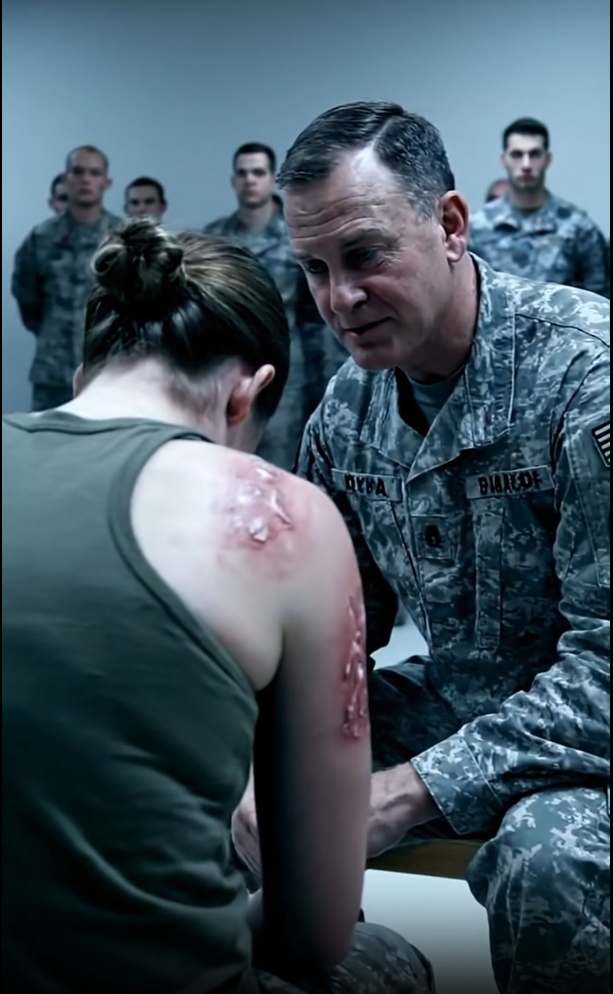
They called me “Princess” and “Cheese Grater,” openly mocking the terrifying, raised scars I kept hidden under my uniform. They thought I was weak, a token woman on a base of 800 men. But when they finally cornered me, the General walked in. His voice was thunder. And the story he told about who I really was, and what I did to his platoon three years ago… it didn’t just silence them. It shattered their world.
The door slammed open, the metal clang echoing off the damp tile like a gunshot.
I spun around, my heart leaping into my throat. My sweat-soaked shirt was still clutched in my hand. I instinctively tried to cover myself, but it was too late.
It was Maddox. And two of his friends, smirking, holding mops and buckets as a pathetic excuse.
“Oops, wrong room,” Maddox sneered, but he didn’t move. He didn’t even blink. His eyes, and the eyes of his friends, locked onto my back.
He froze.
The air in the tiny, humid closet went from exhaustion to violation in a single heartbeat. The laughter died in his throat, replaced by a stunned, morbid curiosity. In the harsh, buzzing fluorescent light, the skin on my back was a road map of my past. A tapestry of thick, raised, keloid scars that twisted from my left shoulder blade all the way down to my waist. They were old, healed, but they were ugly. They were terrifying.
The silence stretched for one, two, three seconds. It was the loudest sound I’d ever heard.
Then, a low, cruel whistle.

“Damn, Hayes,” one of his buddies laughed, a nervous, ugly sound. “Looks like you got into one hell of a bad romance. Who was he?”
Maddox found his voice. The shock melted back into that familiar, arrogant smirk. He was the king again. “A romance? Nah.” He took a step closer, and I recoiled, pressing myself against the cold, damp lockers. “Looks like she ran into a cheese grater… and the cheese grater won.”
The laughter erupted. It was sharp, loud, and merciless, bouncing off the hard surfaces, amplifying, surrounding me. It was everything I had been fighting to keep at bay. It was the sound of my failure to remain invisible.
I just… broke.
I didn’t have the energy to fight, to yell, to defend myself. The wall I had built, brick by heavy brick, was pulverized. The 12-mile march, the weeks of relentless taunts, the isolation—it all crashed down on me. I sank onto the small wooden bench, the laughter washing over me.
Tears, hot and angry, welled in my eyes and rolled down my cheeks. I dropped my head, my hair falling around my face, trying to disappear. The sound of their laughter wasn’t just laughter anymore. It was the sound of the fire. It was the sound of crackling wood, of screams, of my own skin blistering. I wasn’t at Fort Braden. I was back in that burning building, the weight on my back, the suffocating heat…
My pain only encouraged them. They fed on it.
“What’s wrong, princess? We just want the story!” Maddox taunted, his voice dripping with false concern. He took another step, now fully inside the small room, blocking the only exit. “Come on, tell us. Did you fall off a motorcycle? Or just piss off the wrong guy?”
“ENOUGH!”
The voice was thunder.
It wasn’t a shout; it was a physical force that struck the air and made the lockers vibrate. It was a sound that commanded obedience on a cellular level.
The door, which Maddox had left ajar, swung open fully. General Thorne stood in the doorway. He was a tall man, a man who had seen three tours in the desert and carried the weight of them in his eyes and the set of his jaw. He didn’t need to yell. His presence was enough to suck the oxygen out of the room.
The soldiers snapped to a pathetic, half-dressed, mop-holding version of attention. The blood drained from Maddox’s face. He looked like a child caught setting a fire.
Thorne’s eyes, cold as steel, swept the room. He saw Maddox and his friends, their smirks gone, replaced by pure, unadulterated terror. He saw the cleaning supplies, the open door. And then he saw me, huddled on the bench, my back still exposed, my body trembling with silent sobs.
His face, usually a mask of calm, professional command, twisted into something I had never seen before. It wasn’t just anger. It was a deep, profound, and personal fury.
He walked slowly into the center of the room. His boots struck the floor with a purpose that echoed in the sudden, unbearable silence. The only sound was the drip… drip… drip… of the faulty showerhead.
His voice, when he finally spoke, was dangerously quiet. It cut through every man in that room, filleting them where they stood.
“Do you even understand who you’re laughing at?”
The soldiers froze. Their laughter was dead, replaced by a cold, creeping dread. Maddox’s eyes were fixed on the floor. He couldn’t look at the General. He couldn’t look at me.
Thorne placed a steady, gentle hand on my shoulder. I flinched, but he didn’t move. “It’s okay, soldier.”
He turned his gaze back to Maddox. “You think you’re tough, Specialist Maddox? You think your drills and your 12-mile march make you a man? You think you’re a warrior?”
He pointed to my back. The scars.
“She is not just any recruit. Those… marks… you find so amusing. She got them saving an entire platoon.”
He paused, letting the words hang in the heavy, humid air.
“My platoon. Three years ago, overseas.”
The soldiers exchanged nervous, confused glances. Maddox’s head snapped up, his eyes wide with disbelief.
“She wasn’t in uniform then,” the General continued, his voice heavy with the memory, his eyes unfocused, looking past us, back in time. “She wasn’t trained. She was a civilian nurse. A volunteer in a field clinic in a war-torn village we were trying to evacuate. We were taking heavy mortar fire. The clinic, a temporary structure, was hit. It went up in flames in seconds.”
The room was so quiet I could hear my own heartbeat, a frantic drum against my ribs.
“We were pinned down,” Thorne said, his voice raw. “Pinned down by machine-gun fire. We couldn’t get to it. We watched it burn. And this young woman… she didn’t run away from the fire. She ran into it.”
His words triggered it. The memory I kept locked away, the one that woke me up at 3 AM, sweating and screaming.
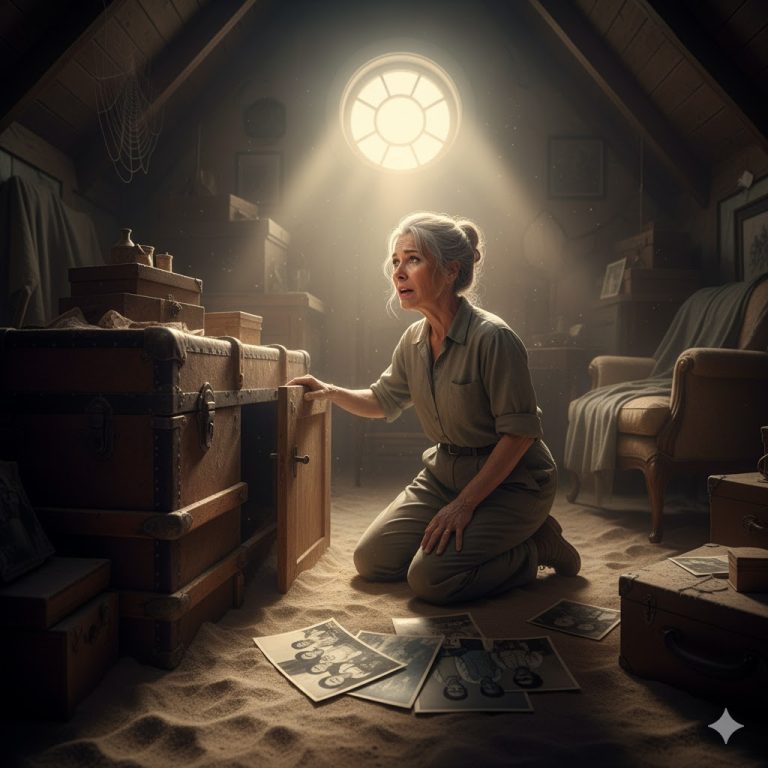
I’m running. The air is thick with smoke and cordite. The clinic is an inferno. I can hear them. The children. We had moved them to the back room, the safest place, but the mortar had hit the front. Now the only way out was the only way in. “You can’t go in there!” a soldier yelled at me, grabbing my arm. I ripped it away. “They’re babies!” I screamed, pulling my shirt up over my nose. The heat was a physical wall. It seared my lungs. I found them huddled in the corner. Two small children, a brother and sister, clinging to each other. I scooped them up, one under each arm. “Close your eyes! Hold your breath!” I yelled. I ran back toward the wall of fire that had been the entrance. I could feel my hair singeing, the skin on my arms and back blistering. But I didn’t stop. I burst through, collapsing on the dirt, gasping, shielding them with my body.
“Not once,” the General said, his voice shaking with restrained emotion. “Not twice. Three times.”
I handed the children to the soldier and, before he could stop me, I was running back in. There was one more. A baby. I could hear the crying. The roof was groaning. I found the infant, wrapped in a blanket, and tucked it inside my shirt. I turned to run, and a beam, fully engulfed in flames, crashed down. I had no time. I just turned my back to it. The impact drove me to my knees. The pain was blinding, white-hot, indescribable. I felt the skin on my back split and melt. I screamed. But I didn’t drop the child. I crawled. I crawled on my hands and knees, the roof collapsing around me, dragging myself and the baby through fire and molten shrapnel, every movement an agony I cannot describe.
“The scars on her back,” the General said, his voice dropping to a whisper, but it carried more weight than any shout. “They aren’t from a ‘bad romance,’ Maddox. They’re from shielding those children as the roof came down. When my men finally reached her, she had collapsed just outside the doorway, her body burned so badly we didn’t think she’d make it. But she lived. And so did every child in that clinic.”
The silence in the room was absolute, suffocating. Shame, hot and thick, flooded the faces of the men who had been laughing moments before. Maddox couldn’t look at me. He stared at his own boots, his entire body trembling, his face crimson. The other two looked physically ill.
“You think strength is about how many push-ups you can do,” Thorne said, his voice laced with a contempt so pure it was terrifying. “You think courage is swagger and dirty jokes. You walk around this base like you own it, but you’ve never faced real fire. You’ve never had to choose between your own life and someone else’s.”
He gestured to me, my tears now dry, my breathing ragged.
“Real courage is staring death in the face and still moving forward. It is bearing unimaginable pain so that others may live. That,” he said, nodding to me, “is why she is here. That is why she wears this uniform. Because she earned it in blood and fire before any of you even knew what a real sacrifice was. And I will not tolerate… I will not… tolerate a single man under my command mocking her again.”
He looked at the mops in their hands. “Now get out of my sight. All of you. You’re confined to barracks. I’ll deal with you personally tomorrow.”
They scrambled, dropping the supplies, practically falling over each other to get out of the room, to escape his gaze. Maddox was the last one out, and for a fleeting second, his eyes met mine. I saw no arrogance. I saw nothing but pure, hollowed-out shame.
The door closed, leaving me alone with the General. The only sound was the drip… drip… drip…
I hastily pulled my shirt on, wincing as the damp fabric touched my healed-but-sensitive skin. I couldn’t speak.
“Get yourself cleaned up, Hayes,” he said, his voice gentle now. He turned to leave. He paused at the door, his back to me. “And, soldier?”
“Sir?” My voice was a croak.
“Stand tall. You’ve earned your place here more than any of them.”
He left. I stood there for a long time, letting the water from the shower run cold, washing away the sweat, but unable to wash away the feeling of violation, or the strange, new feeling of vindication.
From that day, everything changed. And nothing changed.
The mockery stopped overnight. It was as if a switch had been thrown. The laughter at my expense died. The whispers ceased. But what replaced it wasn’t camaraderie. It was a thick, awkward, suffocating silence.
The men avoided me. They wouldn’t meet my eyes. They parted like the Red Sea when I walked into the mess hall. I was no longer “Princess” or “Cheese Grater.” I wasn’t even “Hayes.” I was a ghost. I was a walking, talking embodiment of their shame. They were too cowardly to apologize, and too proud to admit just how wrong they had been.
I didn’t care. I hadn’t come for their approval. I hadn’t come to make friends. I just kept my head down and worked. I ran my miles, I cleaned my rifle, I studied my manuals.
But the General’s words had changed me, too. I no longer hid. I no longer kept my head down, trying to be invisible. The wall wasn’t gone, but I had put a door in it. When I showered, I wasn’t as frantic to hide. When I changed, I didn’t care who saw. The scars were no longer my secret, my burden. They were my story. Let them look.
The real shift, the first tiny crack in the ice, came during a field exercise. It was a grueling 20-mile march in the high desert. The sun was a hammer, the air was dust, and our packs felt like they were filled with cement. We were 15 miles in, and the unspoken rule was “keep up or fall out.”
Maddox, pushing himself too hard—maybe out of shame, maybe to prove something to himself—took a bad step on a loose rock. I saw his ankle roll. A sharp, audible pop.
He hissed in pain but didn’t say a word. He just gritted his teeth, his face pale, and kept limping. But he was falling behind. The other soldiers, still following their old, selfish instincts, muttered and moved on. “Not my problem.” “Sucks to be him.”
I stopped. The whole line moved past me.
I walked back to him. He was leaning against a boulder, his face a mask of pain and humiliation. He tensed when he saw me, his eyes flashing with defiance, expecting a taunt, a moment of “I told you so.” He probably would have welcomed it. It would have been easier than what I did next.
I didn’t say a word. I just unclipped the heaviest part of his pack—the radio—and slung it over my own shoulders. My legs screamed in protest at the extra 30 pounds. I didn’t care.
“Get up, Maddox,” I said, my voice even, flat. “We’re not leaving you.”
I didn’t offer him a hand. I didn’t offer him sympathy. I just set a new, slower pace he could manage. He stared at me, his mouth half-open, a complex storm of emotions in his eyes. He said nothing. He just pushed himself off the rock and fell in behind me.
He limped for the last five miles, his eyes fixed on my back, on the pack that should have been his. The weight of my action was far heavier than the radio I’d taken. He never said “thank you.” But when we finally staggered back to the barracks, he just gave me a stiff, awkward nod.
And I never heard him mock anyone, for any reason, ever again.
The final test came weeks later. A storm, a real monster, swept across the training grounds, turning our night navigation exercise into a genuine survival situation. What started as a drill became a nightmare. Heavy winds, driving horizontal rain that felt like needles, and mud that sucked at our boots with every step.
A young recruit, Perez, a kid of maybe 19, collapsed face-first into the mud. His body was shaking violently with hypothermia.
“I’m done,” he whispered, his teeth chattering so hard he could barely speak. “I can’t. Just leave me.”
“Damn it,” someone muttered from the darkness. “He’s dead weight. We’ve gotta keep moving or we’ll all freeze.”
I stopped. The wind whipped my hair across my face. In the flash of lightning, my face must have been a mask of iron. I flashed back to the fire. The smell of smoke. The feeling of a small, limp body in my arms. The suffocating panic.
“No.”
My voice wasn’t a request. It wasn’t a suggestion. It was a command. It cut through the howl of the storm.
“You’re not quitting. Not tonight. Get on your feet, Perez!” I hauled him up, mud and rain dripping from both of us. He was limp, barely conscious. “Nobody gets left behind!”
I threw his arm over my shoulders, taking his weight. “Maddox! Grab his other side!”
There was no hesitation. Not a second. He was there, grabbing Perez’s other arm, hauling him up. “On three,” he grunted. “One, two, THREE.”
We lifted him. For the rest of the night, I led. I didn’t just endure the storm; I attacked it. I shouted encouragement. I cursed. I physically dragged my team through the worst of it, navigating by instinct and memory. By dawn, when the storm finally broke, every single soldier in my unit had made it through. Not one had been left behind.
We stood, a miserable, muddy, exhausted group, but we were a group. For the first time.
The General watched from a distance, binoculars in hand, a faint, proud smile on his lips. He knew what I was just learning: True leadership doesn’t come from a rank on your chest. It comes from the fire in your soul.
By the end of the training cycle, I wasn’t “the girl” anymore. I wasn’t a ghost. I was “Hayes.” I was, impossibly, their sister. The men who once laughed at my scars now fought for the right to stand next to me in formation, to be on my fire team. They trusted me. And, even more strangely, I was starting to trust them.
The story should have ended there. But it didn’t.
An alarm ripped through the base at 0300. This was not a drill. The high-pitched wail meant one thing: “Contact.”
A convoy had been ambushed in the pass, 10 klicks out. They were taking heavy fire, pinned down, with multiple casualties. Reinforcements were needed. Immediately.
My unit was deployed.
The ride out was silent, the adrenaline so thick it was hard to breathe. This was it. The real thing. We arrived to chaos. Tracer rounds cut green and red lines through the pre-dawn darkness. The air thrummed with the thump-thump-thump of a heavy machine gun and the sharp crack of incoming rounds.
It was brutal. Real gunfire, real smoke, real chaos. But amid the storm of it all, I was the calmest one there. The fire had baptized me in this. I had already faced death.
My voice was steady on the radio, directing cover fire, calling out targets. “Maddox, 2 o’clock, rooftop! Perez, stay low, move to the Humvee!”
We were moving, leap-frogging, suppressing fire, when an RPG tore through the air with a demonic whistle. It hit the wall just above our line.
Maddox was caught in the open, moving between cover. He froze. The explosion threw him to the ground, disoriented. Shrapnel—chunks of metal and concrete—rained down.
I didn’t think. I just moved.
I ran from my cover, tackling him, throwing myself across his body, shielding his head and neck with my own. It was a perfect echo of the past.
Thwack! Thwack!
Two pieces of shrapnel embedded themselves in my body armor, striking with enough force to knock the wind out of me. They hit right over the thickest scars on my back.
The dust settled. The enemy, having fired their last big punch, began to retreat.
Maddox was breathing hard, staring at me, his eyes wide with terror and disbelief. “You… you…”
“You’re okay,” I gasped, rolling off him. “Get to cover. Now.”
He had saved my life from the storm. I had saved his from the fire. We were even.
When we returned to base, bruised, battered, but alive, the General met us at the gates. The sun was just beginning to rise.
He walked past Maddox. He walked past Perez. He walked straight to me.
He stopped, looked me in the eye—soldier to soldier. His face was unreadable, but his eyes were not. They were filled with a profound respect.
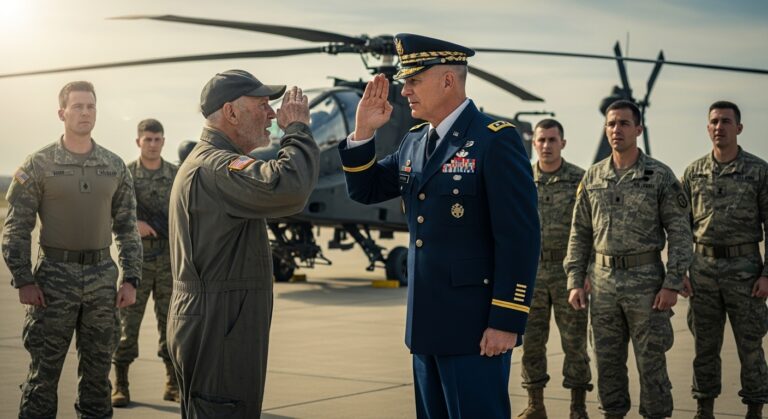
And then he executed the sharpest, most profound salute of his career.
One by one, Maddox, then Perez, then the entire unit, my unit, snapped to attention. They saluted the young woman they had once mocked.
I stood tall, my scars aching under my armor, the fresh bruises from the shrapnel forming on top of them. I took a deep breath, and I returned the salute.
They were no longer a burden. They were no longer my shame. They were my story. And now, finally, they were my honor.