They Said She Was a Vagrant. They Said Her Mother Was Missing. I Was 3 Months From Retirement. But the Homemade Doll Clutched in Her Hand Held a Secret That Would Bring the Whole System Down.
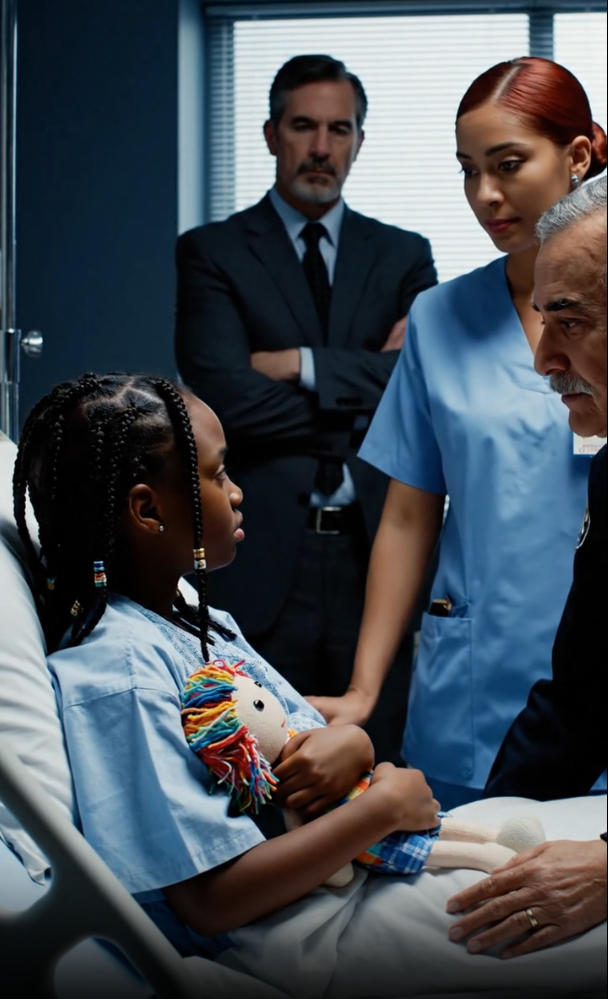
I sat in the chair beside her bed. My gut told me not to push. Instead, I just started to talk. Quietly. About the gloomy weather. About a brave little squirrel I’d seen doing acrobatics on the hospital grounds. As I spoke, I watched her. Really watched her. Her shoulders, which had been hiked up to her ears, gradually relaxed. Her fingers, which had been strangling the thin hospital blanket, loosened their grip.
When I finally stood to leave, her hand suddenly moved. A small, quick, almost involuntary gesture. It wasn’t toward me. It was toward the plastic bedside table.
Toward the bracelet.
I paused, my hand on the door. “I’m going to find out what happened,” I said, my voice softer than I intended. “I’ll help you, little one. I promise.”
Walking out of the hospital, I made a decision that violated a direct warning from my captain. This wasn’t going to be just another case file. This child, whoever she was, wasn’t going to be just another statistic. Not on my watch. Not on my last watch.
I drove back to Maple Lane. The wind had picked up, and the yellow crime scene tape snapped violently, like a trapped bird. Detective Martinez was there, flipping through a notepad, looking bored.
“Morning, Shepard,” he called out, not looking up. “Thought you’d be polishing your fishing lures, counting down the days.”
“Just following up,” I said, my eyes scanning the dilapidated house. “The girl’s condition is critical. Worse than they thought.”

“Well, we’ve done the sweep,” Martinez shrugged, closing his notebook with a definitive snap. “No signs of forced entry. No blood, no weapons. No evidence of other occupants. Honestly, looks like she might have been a squatter, seeking shelter, and just… gave up. We’re done here. Social services can pick it up.”
My instincts screamed. Every cop has that feeling. A cold prickle at the base of your neck that tells you the official story is a lie.
“Mind if I take one more look around?”
“Be my guest.” Martinez handed me a pair of latex gloves from his pocket. “Just don’t mess up your retirement paperwork.”
His car disappeared down the street, and I was alone. I stood in the doorway. The stench of dust, mold, and something else—something like stale fear—hit me. Dust covered everything, thick and gray. But as I moved slowly through the living room, my eyes, trained by 30 years of this, caught the details Martinez had missed.
A clean, perfect circle on a dusty coffee table, where a cup had recently sat. A deep depression in one couch cushion, as if someone sat in that exact spot, every single day. A shelf with small, dust-free rectangles, where picture frames had been.
“Someone was living here,” I muttered. “Living here until very, very recently.”
The kitchen told the real story. I opened the refrigerator. Not just empty. A single container of milk, expired just one week ago. In a cabinet, a box of children’s cereal, half-empty. Not a squatter. A mother and a child, running on fumes.
I moved methodically, documenting everything with my phone. My captain’s voice echoed in my head: Let the system handle it.
Upstairs, the bathroom had a single, worn-out toothbrush. The master bedroom, an unmade bed, the sheets twisted. But it was the second bedroom. The one at the end of the hall.
That’s the one that sent a column of ice straight down my spine.
The door was locked.
Not from the inside. From the outside. A heavy-duty sliding bolt, freshly installed.
My heart pounded against my ribs. I photographed the lock, my hand shaking slightly. I slid the bolt open. I pushed the door inward.
The room was sparse. A small cot, a single lamp, a few tattered children’s books on the floor. But this room was different from the rest of the house. It was meticulously, obsessively clean. The bed was made with perfect hospital corners. The books were arranged by size.
And on the wall, hung with a single thumbtack, was a child’s drawing.
It was a stick figure of a small girl holding what appeared to be a lopsided doll. Above them, in crude, wavering crayon: “Me and me.”
I stared at it. “Not ‘Maya’,” I whispered, photographing the drawing. “Her doll’s name… it’s ‘Mea’.”
As I turned to leave, something small and white caught my eye. A piece of paper, peeking out from beneath the cot. I knelt, my old knees cracking in protest, and retrieved a photograph. It was creased and worn, the corners soft from being handled.
A woman with haunted, terrified eyes, holding an infant.
On the back, in faded blue ink: “Leanne and Amelia, May 2017.”
Amelia.
In the hallway, I noticed a calendar. A cheap one from a local hardware store. The days were crossed off, one by one, with a red “X.” Methodical. Until October 3rd, just three weeks ago. Next to that date, a single, shaky word: “Medicine.”
My phone rang, the sudden noise making me jump. It was Nurse Sarah.
“Officer Shepard, I thought you should know. Our Jane Doe… she just spoke her first word.”
My grip tightened on the phone. “What did she say?”
“It wasn’t very clear,” Sarah said, her voice hesitant. “But it sounded like… ‘Mama.’ She got very agitated afterward. She’s crying for her.”
“I’m on my way,” I said, already moving. “And Sarah? I think her name might be Amelia.”
I drove to the hospital, the photograph feeling heavy in my pocket. A recently occupied house. A room locked from the outside. A mother and daughter, Leanne and Amelia. A doll named Mea. And a mother who was now, officially, missing.
This time, I didn’t hesitate. I went straight to Amelia’s room. She was sitting up, watchful as ever, those dark eyes tracking my every move.
“Hello again, Amelia,” I said softly. “I brought something I thought you might want to see.” I slowly, carefully, placed the photograph on her bed.
The reaction was immediate. A sharp, ragged intake of breath. Her small hand, thin as a bird’s claw, reached out. It trembled as her finger traced the woman’s face.
“Is that your mom?” I asked, my voice gentle. “Is her name Leanne?”
Tears filled Amelia’s eyes, spilling over onto the blanket. She remained silent, a lifetime of silence locked behind her lips.
“And is your name,” I pushed, my heart aching, “Amelia?”
At this, she looked up. The faintest, smallest nod. A single, profound confirmation. It was her.
“Amelia,” I repeated, letting the name settle in the room. “That’s a beautiful name.” A single tear rolled down her cheek as she clutched the photo to her chest.
I sat beside her. “Amelia, I want to help you. Can you help me understand who Mea is?”
At the mention of the name, her expression changed. A flash of pure, desperate longing. Her free hand moved to her wrist, where the bracelet had been.
“Is Mea your doll?” I asked.
Another slight nod. More tears.
“I’ll try to find Mea for you, Amelia,” I said, making another promise I had no idea how to keep. “I promise.”
From the hospital, I went straight to the station. Gloria, our records keeper for 20 years and the only person who knew where every single file was really buried, looked up from her computer.
“Well, if it isn’t almost-retired Shepard. What skeleton can I dig up for you today?”
“Property records for 1623 Maple Lane. And anything you have on a Leanne Mills.”
Gloria’s fingers danced over the keyboard. “Property purchased eight years ago by a Leanne Mills. Paid in cash. That’s unusual.” Her expression turned somber. “Ah. Here we go. One domestic disturbance call, nine years ago. Leanne Mills and a man named Robert Garrett. She declined to press charges.”
“Garrett…” The name felt cold.
Gloria kept scrolling. “And here’s something. A missing person’s report, filed three years ago. For Leanne Mills. Filed by a Martin Henderson. Her caseworker from Social Services.”
My pulse quickened. “Any indication what happened to her?”
“Case went cold.” Gloria looked up, her sharp eyes meeting mine. “This is about that little girl you found, isn’t it?”
I nodded. “One more thing. Any record of a child registered to Leanne Mills? Birth certificate, school enrollment, social security number?”
Gloria’s search came up empty. “Nothing. Zero. Zip. If she had a daughter, Officer, there’s no official record of her. As far as the state of America is concerned… this child doesn’t exist.”
“That’s not possible,” I said, but the cold dread in my stomach said it was.
“Unless,” Gloria lowered her voice, “the birth was never registered. Unless someone wanted her to stay invisible.”
As I walked to my car, my phone rang. Reynolds. “Shepard, what in the hell are you doing? Social services is sending someone to the hospital tomorrow to take custody. This isn’t our jurisdiction anymore.”
“Something’s not right, Captain,” I insisted. “The girl was locked in a room. There are no official records of her. And the mother was reported missing three years ago by her caseworker, but she was clearly living in that house until a few weeks ago.”
“And you’re going to solve all this in your last three months? Don’t be a hero, Tom.”
“Someone has to.”
“Don’t make me order you to stand down, Shepard.” He hung up.
I ignored the threat. My next stop wasn’t the station. I was going to visit Martin Henderson, the retired social worker.
Henderson lived in a modest, neat home, the kind of place you’d forget as soon as you saw it. At 72, he had the alert, weary eyes of a man who’d seen the worst of the system.
“I’ve been expecting someone to come asking questions eventually,” he said, not sounding surprised. He poured two cups of tea. “I feared as much. How is the girl?”
“Recovering. She’s spoken only a few words. Her name is Amelia.”
Henderson nodded slowly, a deep sadness settling over him. “I filed that missing person’s report three years ago. No one seemed concerned. Just another unstable woman who’d fallen through the cracks. They buried it.”
“Tell me about Leanne.”
“She was referred after that domestic incident,” Henderson said. “Pregnant, terrified her baby would be taken. She’d been in a horrific, abusive relationship… with that monster, Robert Garrett. But she was determined. She got that house, paid cash from a small family settlement.”
“But something went wrong,” I said.
“The system failed her,” Henderson said, his voice hard as iron. “Leanne had episodes, paranoia… she believed people were watching her, trying to take Amelia. I arranged for therapy. For a while, it worked.”
“What changed?”
“Budget cuts. My caseload doubled. Then a new director came in. Leanne kept a clean house. Amelia appeared healthy. They were downgraded to ‘low risk.’ I disagreed. I told them Leanne was becoming more isolated, refusing preschool, talking about being watched. Then one day, I arrived for a visit, and no one answered. The house looked vacant. I filed the report.”
I processed this. “The department records show that Amelia was taken into custody and placed in foster care.”
Henderson’s eyes widened in genuine shock. “What? That never happened. Who told you that? It’s in the official record? It’s a fabrication.”
Henderson stood, walked to a locked filing cabinet in his living room, and unlocked a drawer. “I kept my own records. Against policy.” He handed me a worn manila folder. “I know when documentation has been altered.”
I opened it. Meticulous notes. And photographs. A younger, happier Leanne with a toddler, Amelia. In one photo, the little girl was clutching a handmade rag doll with button eyes.
“Is this Mea?” I asked, pointing.
“The rag doll? Yes. Leanne made it for her. Her ‘guardian doll.’ Amelia was inseparable from it.”
My blood ran cold. “Mr. Henderson, who would have had the authority to alter official records about Amelia’s case?”
His expression darkened. “Only two people. The department director… and the case supervisor who took over when I raised concerns.”
“Who was the supervisor?”
“Robert Garrett.”
The name hit me like a physical blow. The abusive ex-boyfriend.
“Garrett joined the department six years ago,” Henderson said, his voice trembling with old anger. “He was assigned as my supervisor right when I began asking too many questions about Leanne. He told me to drop it. That she was a lost cause.”
“I need to borrow these,” I said, holding the folder.
“Be careful, Officer,” Henderson gripped my arm. “If records were falsified, if they created a ghost file, someone went to great lengths to make these two people disappear. These aren’t just negligent people. They’re dangerous.”
I drove back to Maple Lane, Henderson’s folder on the passenger seat. This wasn’t just neglect. It was a deliberate, systematic erasure.
I knew what I was looking for now. I was looking for Mea.
I went straight to Amelia’s room. I tore the cot apart. Nothing. I went to the kitchen. I remembered the photo of Mea on a high shelf from Henderson’s file. Too obvious. My eyes landed on an old, decorative cast-iron stove in the corner. Useless, except as a hiding place.
I tried the small iron door. It swung open. Empty.
But I reached inside. The back wall felt… off. A slight seam in the metal. I pressed, and a section of the false back gave way, revealing a hidden compartment.
Inside, a bundle wrapped in faded fabric. I unwrapped it.
Mea. The rag doll.
And a small, leather-bound journal.
I set the doll aside and opened the journal. The first entry, dated three years ago: They’re watching us again. I saw a car. Robert has found us. I’m certain of it. He’s still determined to take her from me.
The entries detailed her growing, suffocating paranoia—a paranoia I now knew was rooted in a terrifying reality. She described creating the “safe room” (the locked bedroom) for Amelia. Her handwriting grew shaky in the final entries, dated just weeks ago.
Getting weaker. The medicine isn’t working. If something happens, please tell my Amelia everything I did was to protect her. Mea knows all our secrets. Mea will guide her home.
The last page contained only a name and address. Sarah Winters, 1429 Oakdale Drive. My sister. Amelia’s only family left.
Sarah Winters. Nurse Sarah.
I raced to the hospital, the doll and journal tucked in my jacket. I called Gloria. “Gloria, run Sarah Winters, a nurse at Pinewood Memorial. Now.”
I found Dr. Winters at the nurses’ station. “Is Sarah on duty?”
“Just finished her shift. You probably just missed her.”
I went to Amelia’s room. She was listlessly pushing food on her tray. When she saw me, her eyes brightened slightly. But when she saw what I was carrying, her face transformed. A small gasp escaped her lips.
“I found her, Amelia,” I said softly, placing the rag doll in her arms. “I found Mea.”
She clutched it to her chest with an intensity that brought tears to my eyes. She rocked back and forth, burying her face in its yarn hair. Then, in a voice so quiet I had to lean in, she whispered, “You found her. You found Mea.”
“I promised I would,” I said, my own voice thick.
She looked up, her eyes clearer than I’d ever seen them. “Mommy said Mea would keep me safe… until someone good came.”
I sat on the bed. “Your mom loved you very much, Amelia. Where is she?”
“She said she might have to go to heaven,” she whispered, her eyes filling with tears again. “But Mea would stay with me.”
“Amelia,” I asked carefully, “your mom wrote that Mea keeps secrets. What did she mean?”
Amelia looked at her doll. With small, practiced fingers, she pulled at a loose seam in Mea’s back, revealing a tiny pocket hidden in the stuffing. From inside, she withdrew a small, ornate key.
“Mommy’s special box,” she explained, holding it out to me. “Under the big bed. For the good person who would help me.”
My phone buzzed. A text from Gloria. “Shepard, I found something. Sarah Winters’s original name was Sarah Mills. She changed it five years ago after a domestic incident. She’s Leanne Mills’s younger sister.”
I knew it. As I reached my car, I saw a folded paper under the windshield wiper.
Meet me at Riverside Park. 9:00 p.m. Come alone. I need to explain about Amelia. – Sarah.
I had to get the box first. I drove to Maple Lane one last time. “The big bed.” Not the master bed. The sofa bed in the living room. I felt underneath and my fingers brushed against it: a small, metal lockbox. The key fit.
Inside: a USB drive, a stack of photos, and a sealed envelope.
With my name written on it.
I stared, my blood running cold. With unsteady fingers, I opened it.
To whoever finds this, I hope you are someone kind. I’ve watched you from the windows these past months. The officer who walks this beat… who helped Mrs. Abernathy when she fell on her porch. If you’re reading this, you found Amelia. Thank you.
She had been watching me, evaluating me. The letter confirmed everything. Garrett’s systematic harassment. How she’d cut off Sarah to protect her.
My phone rang. It was Reynolds, his voice urgent. “Tom, I just got a call from CPS. They’re sending someone to take custody of the Mills girl. Tonight.”
“On whose authority, Captain?”
“Assistant Director Robert Garrett himself. He says there’s an existing case file, that she belongs in specialized care.”
“That’s not happening, Captain. Garrett is involved. He’s the one she was hiding from.”
“Tom,” Reynolds warned, “don’t do anything foolish…”
I hung up. 8:40 p.m. I had to meet Sarah.
Riverside Park was dark. Sarah was on a bench, her face pale. She was wearing a blonde wig. “Old habits,” she said, her voice shaking. I showed her the lockbox.
“I need to tell you everything,” she said, her words tumbling out. “Robert Garrett isn’t just a controlling ex. He has connections. And Amelia… Amelia is heir to our grandmother’s trust fund. Nearly $2 million when she turns 18. Money Robert can’t touch… unless he has legal custody.”
That was it. The motive.
“Leanne contacted me three years ago,” Sarah said. “She said she had evidence… the USB. The next day my apartment was broken into. That’s when I changed my name, became a nurse, and started searching.”
My phone rang. Reynolds. “I’ve got Judge Winters on the line—Elaine’s husband. He’s willing to grant you temporary emergency custody, but you need to get to the hospital now. Garrett’s people are already en route.”
We raced to the hospital, the air thick with urgency. Dr. Winters met us at the elevator. “Two people from social services arrived. A man and a woman. Something felt wrong, so I stalled them. They’re with Amelia now.”
We burst into the room. A man in a suit stood by the bed. A woman was packing Amelia’s few belongings. Amelia sat rigid, white as a sheet, clutching Mea.
“This transfer has been suspended,” I announced, my badge in hand. “By order of Judge Winters.”
The man turned, his face a mask of bureaucratic neutrality. “Officer Shepard. I’m afraid you’re mistaken. We have the authorization.”
“Not anymore,” I countered, holding up my phone with the judge’s emergency order.
For a moment, no one moved. Then the man nodded to his colleague, and they left. Without another word.
“Too easy,” I muttered.
Sarah rushed to Amelia. “It’s okay, sweetheart.”
Amelia’s voice was a terrified whisper. “He said… he said where I was going, dolls aren’t allowed.”
My phone rang again. Reynolds. “You got to her in time. But Tom… this isn’t over. Garrett is on his way himself. With a new court order from a different judge. And he’s bringing county officers with him.”
“How long?”
“20 minutes. Maybe less. Be careful, Tom. This guy has juice.”
I looked at Sarah and Dr. Winters. “We need to move Amelia. Now.”
“Where will we go?” Sarah asked, her face pale.
“My cabin,” I said. “It’s remote. An hour north. Reynolds knows where it is.”
“The service elevator,” Dr. Winters said, already moving. “It goes straight to the parking garage. I’ll have security create a diversion at the main entrance.”
Minutes later, we were hurrying through the sterile back corridors. Amelia, now dressed, held my hand and Sarah’s. “It’s like a secret mission,” I told her, trying to keep her calm.
As the service elevator doors opened, Dr. Winters squeezed my arm. “Take care of her.”
The doors began to close. Amelia looked up at me, her eyes filled with a trust that nearly broke my heart. “Officer Tom,” she said with surprising clarity. “Mommy was right about you. You are the good person she promised would come.”
I swallowed hard. As the elevator descended, the hospital intercom crackled to life: “Code yellow, main entrance. Code yellow.”
The diversion had begun. We were gone.
The cabin was nestled in the pines, a place to breathe. Amelia pressed her face to the window. “Is this where you live?” “Sometimes,” I smiled.
That night, for the first time since I’d found her, Amelia smiled. It was brief, hesitant, but it transformed her face. At noon the next day, we held a secure video call with Judge Winters. The USB drive was damning.
“This goes beyond one family,” the judge said, his face grave. “It suggests a pattern. Mr. Garrett is under investigation. I’m extending your emergency guardianship for 30 days. Ms. Winters, you’ll be co-guardian.”
The days at the cabin settled into a peaceful rhythm. Amelia’s voice grew stronger. Her nightmares faded. She began to laugh.
On the fifth day, it rained. We were building a fort in the living room when Amelia announced, “Mea needs a bath. She’s dirty from being hidden.”
As Sarah gently washed the doll in the sink, Amelia stopped her. “Wait. There’s something else inside. Mommy said it was important.”
She reached into the seam in Mea’s back, the one that had held the key. From deep in the stuffing, she pulled out a tightly folded, plastic-wrapped piece of paper. She handed it to me. “Mommy said the good person would know what to do with this.”
I unfolded it. It was a handwritten list. Names. Dates. Case file numbers.
“Sarah,” I called quietly. “Look at this.”
Her eyes widened. “There are 20 children here. All within the last five years.”
“Is it important?” Amelia asked. “Will it help other kids?”
I knelt, emotion tightening my throat. “Yes, Amelia. It’s very important. Your mom… she was trying to help a lot of children, not just you.”
A new understanding dawned on her face. “That’s why she said Mea keeps the most special secrets.”
I stepped away to call Reynolds. This was the final nail. Proof of a systematic conspiracy. Through the doorway, I watched Amelia carefully drying Mea with a towel. “You were right, Mommy,” she whispered to the doll. “The good person did come.”
Three months passed. Autumn painted the trees in gold. The investigation had exposed everything. Robert Garrett and three colleagues now faced criminal charges. 26 children were being reunited with their families.
The cabin had become home. The courts granted permanent co-guardianship to Sarah and me. I’d officially postponed my retirement. Indefinitely.
I stood on the porch, adjusting Amelia’s new backpack. “Ready for your first day?” I asked.
She nodded, clutching Mea. “Will the other kids like me?”
“They’ll love you,” Sarah assured her, smoothing her hair.
As we walked her to the waiting school bus, she suddenly turned and wrapped her arms around my waist. “Thank you for finding me, Officer Tom,” she whispered.
I knelt, meeting her eyes. They were no longer haunted, but bright with hope.
“No, Amelia,” I said, my voice thick. “Thank you for finding me.”
She smiled, tucked Mea safely in her bag, and climbed onto the bus. As it pulled away, I stood hand in hand with Sarah, watching the beginning of a new chapter. I finally understood what 30 years on the force had been for.
It was all just leading me to her.