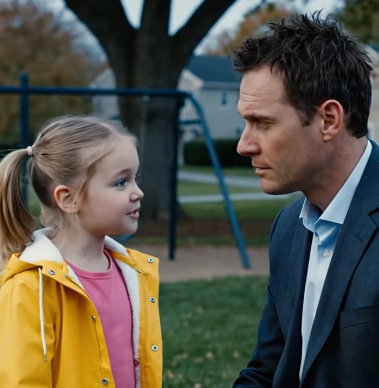
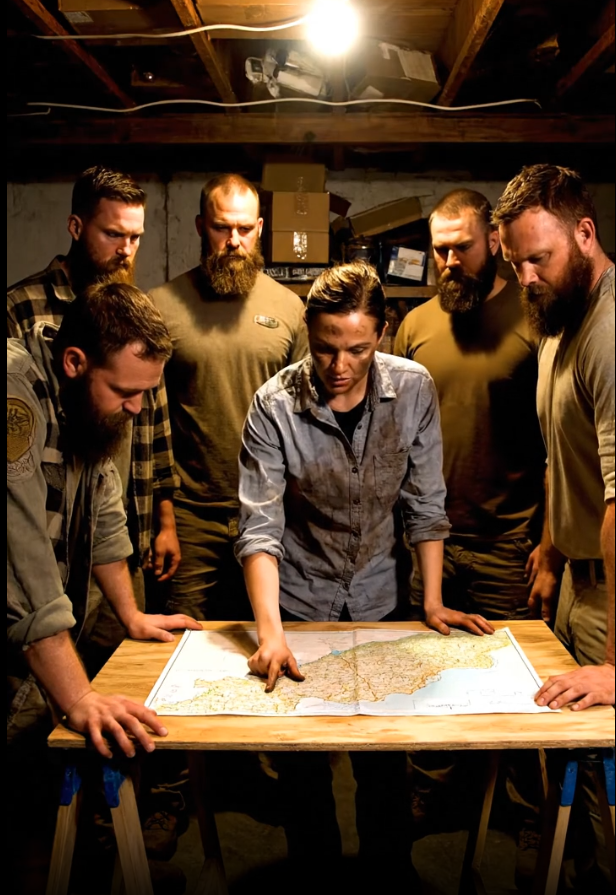
He called me ‘Harvard’ and asked my rank with a smirk. The whole SEAL team laughed, thinking I was just some lost ‘spook’ from the State Department. They had no idea I’d seen more combat than they had. 24 hours later, his man was bleeding out, they were surrounded, and I was the only one who could get them out alive. This is my story.
My voice cut through the stifling air, quiet but carrying. “Lieutenant Commander. Sarah Glenn. Naval Intelligence.”
I let that hang in the air for a second before sliding my credentials across the formica table. The plastic card skittered over a damp spot and stopped right in front of his tray.
“And I’m the one briefing your team in 30 minutes on Operation Shadow Hawk.”
The lieutenant’s—Reeves, I’d learn later—cocky smile didn’t just falter; it evaporated. His eyes flicked down to my ID, then back up to my face. The snickering from his team died instantly, replaced by the dull hum of the cafeteria’s air conditioner.
“Glenn?” one of them whispered. “As in…?”

I nodded, the familiar weight of the name settling on my shoulders. “Yes. Colonel Glenn is my father.” That was always the first question. It used to bother me. Now, it was just a fact, like the color of my eyes.
“But more relevantly,” I continued, my voice hardening just a fraction, “I’m the intelligence officer who has spent the last three months mapping every goat path and Taliban movement in the Korangal Valley. I’ve personally led four night operations behind enemy lines to place surveillance equipment and extract compromised assets.”
I leaned forward, the motion casual, and slowly rolled up the sleeve of my blue button-down shirt. The scar was still an angry red, a puckered, jagged line running from my wrist halfway to my elbow. It wasn’t pretty.
“I took this two weeks ago,” I said, my voice dropping. “The Taliban fighter who gave it to me won’t be hurting anyone else. So, if we’re done with the introductions, Lieutenant…”
The cafeteria doors swung open with a bang, saving him from having to reply. A man with a commander’s oak leaf on his collar and the kind of steely gaze that needed no rank to establish authority strode in. His eyes scanned the room and locked on me immediately.
“Lieutenant Commander Glenn,” he acknowledged with a curt nod. “I see you’ve met my team.”
“Just getting acquainted, Commander,” I replied, standing up and gathering my materials. The lieutenant, Reeves, was still staring at my arm.
“Good,” Commander Jackson said, his face unreadable. “Because in 12 hours, you’ll be accompanying us into the valley.”
My blood ran cold. “Sir?” This was not the plan. This was never the plan. Intel stays on the FOB. I coordinate from the command center. I don’t go with them.
“Mission parameters have changed. My office. Now.”
In the command center, the satellite imagery told a story that made my stomach clench. The thermal feed was lit up like a Christmas tree. Our primary extraction route, the one I’d spent weeks vetting, was now a kill zone. At least thirty fighters were setting up positions along the southern ridge.
“They knew we were coming,” I said, my voice barely a whisper. “Someone leaked.”
Jackson’s face was granite. “The mission is still a go. That compound contains intelligence on three planned attacks on American soil. We need it. We’re not scrubbing.”
“With respect, sir,” I said, turning to face him. “The original plan isn’t just compromised; it’s suicide. They’re waiting for us.”
“What do you suggest, Lieutenant Commander?” His tone was a challenge. He was testing me. The whole team was about to put their lives in my hands, and he needed to know if the cafeteria performance was a bluff.
I turned back to the map, my mind racing, discarding and formulating plans. “Here.” I pointed to a sheer rock face on the northern side of the valley. “It’s unwatched. Completely exposed. They think it’s impassible.”
“It is impassible,” Jackson argued, crossing his arms.
A small, grim smile touched my lips. “Not if you’ve climbed El Capitan, sir. I have. Twice.”
He stared at me for a long, hard second, searching my face for any sign of weakness or uncertainty. He found none.
“And after we get the intel?” he asked.
I traced a route through a narrow ravine on the map. “We exit through the Shepherd’s Pass. It’s barely wide enough for one person, but it leads to this plateau. Extraction is possible from there.”
“That’s a hell of a risk, Glenn.”
“It’s less risky than walking into a firing squad, Commander.”
Hours later, I was clinging to a sheer rock face, the weight of my gear and M4 pressing me into the stone. The Afghan night was cold, a stark contrast to the oppressive heat of the day. Six SEALs, including Lieutenant Reeves, were moving above and below me like spiders.
My fingers were numb, my forearms burning with lactic acid. This was infinitely harder than El Cap. This time, people were hunting me.
We paused on a narrow ledge, barely wide enough for our boots. Reeves, who was directly above me, looked down, his face illuminated by the faint green glow of his night vision goggles.
“Not bad… for an intelligence officer,” he whispered, the words a peace offering.
“I’m full of surprises, Lieutenant,” I whispered back, checking the chamber on my rifle.
That’s when the night exploded.
A sudden burst of gunfire erupted from the valley floor below us. Not at us, but half a mile away. Searchlights—powerful, truck-mounted beams—swept the mountainside, and shouts in Pashto echoed up the valley walls.
“They’ve spotted us,” Jackson hissed over the comms.
“No,” I countered, peering through my rifle scope at the commotion. The thermal signature was wrong. “They’re shooting at something else. Another team.”
I frantically switched my radio frequency, catching fragments of an American voice, choked with static and panic. “…pinned down… multiple casualties… need immediate…”
“Unrelated operation,” Jackson concluded, his voice like ice. “Not our problem. We stick to the mission.”
My blood froze. I met his eyes in the darkness. “Sir, those are our people down there.”
“Our mission is time-sensitive, Glenn. If we divert, we lose the intel. Those attacks happen.”
He was right. Logically, he was 100% right. But I could hear the desperation in that radio call. It was a choice I couldn’t make.
“Commander,” I interrupted, my mind racing. “I know exactly where that intelligence is kept. I’ve studied the compound blueprints for a month. I can get it. I can get in, get the files, and get out in under ten minutes. Split the team. Send Reeves and the others to support those soldiers. You and I, we’ll get the intel.”
The tension on that ledge was so thick I could barely breathe. I was asking him to choose between the mission and his men. An impossible choice.
Jackson’s decision came in a heartbeat. “Split the team. Lieutenant Reeves, take Martinez and Cooper. Light ’em up. Glenn, you’re with me, Wilson, and Ortiz. You better be right about that intel location.”
“I am,” I said, already moving.
We separated at the ridge. The distant gunfire intensified, a brutal symphony of .50 cals and automatic rifles. I forced myself not to look back.
The compound was quiet. Too quiet. A tactical deception.
“Two guards inside,” I whispered, pointing to the heat signatures on my thermal scanner. “Intel is in a hidden room. Beneath the eastern building.”
“Wilson, secure our exit. Ortiz, with me. Glenn, you get what we came for.”
It was flawless. Jackson and Ortiz moved like shadows, and the guards were down before they knew what hit them. I found the hidden hatch, dropped into the cramped space, and went to work. My hands, which had been shaking on the rock face, were now perfectly steady. I photographed documents, my camera’s small click the only sound. I plugged my drive into their server, the progress bar on my tablet the most important thing in the world.
Attack plans. Names. Dates. Targeting American embassies. My God.
“We’ve got it,” I said, pulling the drive. “Let’s go.”
That’s when the world detonated.
An RPG slammed into the building above us, showering us with dust and debris. The compound alarms blared.
My earpiece screeched. It was Reeves. “Commander! Special Forces extraction successful, but we’re taking heavy fire! Martinez is hit! He’s hit bad!”
“Status, Reeves!” Jackson yelled, pulling me out of the hatch.
“Bad, sir! He’s bleeding out. We need immediate evac, but our route is cut off! We’re pinned!”
I pulled up the satellite imagery on my tablet, my mind racing. “They need to come to us,” I said, pointing. “There’s another way. Through this compound. We create a diversion, they fall back to our position.”
“Do it,” Jackson ordered.
What followed was a blur of cordite, concrete, and chaos. My M4 was no longer a precaution; it was a part of me. I wasn’t an intel officer. I wasn’t Colonel Glenn’s daughter. I was a sailor, fighting next to my brothers.
When a grenade arced over the wall and landed near us, I didn’t even think. I kicked it, a desperate, clumsy soccer kick that sent it tumbling into a ravine. It exploded seconds later, the concussion rattling my teeth.
Reeves and his team burst through the gate, dragging Martinez between them. The young SEAL’s face was chalky white, his leg soaked in blood.
“Extraction point is compromised!” Jackson yelled over the gunfire. “They’re waiting for us!”
“Alternatives, Glenn! Now!”
I studied my tablet, the screen cracked from the explosion. “There’s a village,” I said, my voice hoarse. “Two miles north. I have contacts there. People who helped me before. They can shelter us.”
Jackson grabbed my arm. “You trust these people with American lives?”
I met his gaze. “I trust them with mine, sir. It’s our only shot.”
The two-mile journey felt like a hundred. We fought for every inch, engaging two enemy patrols. I moved and shot with a confidence that surprised even me. The training was muscle memory.
Dawn was painting the sky in shades of gray and pink when we reached the village. An elderly man, the one from my asset file, met us at the outskirts. I exchanged a few rapid-fire sentences in Pashto, and he ushered us into a hidden cellar beneath his home.
While the village doctor—a man with kind eyes and steady hands—worked on Martinez, I finally got a secure comms line to base.
“Extraction in six hours,” I announced, slumping against the cool dirt wall. “Helicopter at dusk.”
Silence. The only sound was Martinez’s pained breathing.
Lieutenant Reeves limped over and sat down across from me. The cockiness was gone, replaced by a profound exhaustion.
“You know,” he said quietly, not looking at me. “When I saw you in that cafeteria… I thought you were just another desk officer. Playing at war.”
I kept my eyes on my comms unit. “And now?”
He finally looked up. His eyes were clear. “Now I know better.” He hesitated. “Your father… he’d be proud of you, Commander.”
I finally met his gaze. “My father taught me that courage isn’t about not feeling fear. It’s about doing what’s necessary despite it.”
At dusk, we prepared to move. The intel I’d secured was already being analyzed. Three attacks prevented. Martinez was stabilized, his condition serious, but no longer life-threatening.
Before we left the cellar, Commander Jackson gathered us.
“What happened here,” he said, his voice low, “it doesn’t go in the official report. The risks Lieutenant Commander Glenn took, the calls she made… they were beyond her mission parameters. By the book, she should be reprimanded.”
The team was silent.
“Instead,” Jackson continued, “I’m recommending her for the Silver Star. Not that anyone outside this room will ever know the full story.”
As the distant whump-whump-whump of the helicopter rotors grew louder, I thought about that moment in the cafeteria. It felt like a lifetime ago. That young lieutenant, who’d jokingly asked for my rank, had no idea what he was setting in motion.
When we finally boarded the Black Hawk, lifting off into the dark, I took one last look at the mountains that had nearly claimed us. My father had seen Earth from space, a beautiful, fragile blue marble. He saw the whole picture.
I saw it from the ground. I’d seen its harsh realities up close—the dirt, the blood, the courage, and the impossible choices.
I realized, in that moment, that both perspectives were necessary. Both were true. And both were worth fighting for.