“We spent your $7,000 on a family vacation. Have fun.” The text from my dad, sent from Maui. He’d stolen my cash savings while I was at college. He thought I’d cry. He didn’t know I was on my way to my 82-year-old grandpa’s house—and that Grandpa was already pulling out his WWII typewriter to start a war.
Part 1
I flew back to Ohio from Denver the Tuesday before Thanksgiving under a heavy lid of Midwestern gray. The air was the color of dirty dishwater. Half-melted snow ringed the runway, the kind that sticks to dead grass like a bad haircut, a stubborn, ugly reminder of what was. The wind cut right through my jacket, the one the tag in Denver promised was “mountain-rated.” It had never met a wet, 40-degree Ohio wind.
I was twenty, and my bones felt older. I was tired from a full load of midterms, 15 credits of engineering classes I was barely passing, and the two part-time jobs it took to stay afloat. My life in Denver was a repeating loop of lecture halls, the smell of wet cardboard at the back of a Kroger, and the high-pitched whine of the power-washer I ran for a landscaping crew on weekends.
I power-washed decks for rich people in Cherry Creek, blasting away layers of grime until the boards flashed like new skin, all while my own life felt coated in a film I couldn’t get off.
That was the money. The $8,170. It was all cash, all twenties and fifties, stacked in an old Nike shoebox on the top shelf of my closet back home. I knew people would call it stupid. Why cash? Why not a bank?
They didn’t know what it felt like to wake up to a zero balance.
Last year, a perfectly-timed auto-draft for my car insurance had collided with a perfectly-late paycheck. The bank didn’t care. It auto-drafted my rent, the payment bounced, and the bank charged me $200 in cascading overdraft fees. I had to stand in my landlord’s office, feeling like a child, apologizing and promising it wouldn’t happen again. The shame of it was hot and metallic. I felt like a failure.
So, I went old-school. I went to ground. I’d cash my checks, pay my bills, and everything left over went into the box every time I came home for a break. It was my emergency fund. My escape hatch. My proof that I wasn’t a screw-up. It was the only thing in my life that felt solid.
I was telling myself that a few days at home would put my head back on straight. I just needed to smell my grandpa’s coffee, eat something that wasn’t from a microwave, and sleep in a bed that didn’t have a spring trying to puncture my lung.
Grandpa Harold was waiting at arrivals, right past the “Welcome to Columbus” sign. He held a scrap of cardboard that read in his square, all-caps handwriting: NATHAN — UNPAID FARMHAND.
I smiled before I even reached him. I dropped my bag, and he pulled me into a hug that smelled like motor oil, Irish Spring soap, and coffee. He was 82, carved from Ohio oak, and he hugged like he meant to hold your component parts together.
“You look thin,” he grumbled, grabbing my duffel. “You look old,” I shot back. He grunted, which was as close as he ever got to a laugh, and steered me toward his old truck. It was a 1990s Ford, the kind where the radio is just a suggestion and the heat only works on “High.”
On the drive, he didn’t pepper me with questions. He just drove, his hands at ten and two. He pointed with his chin at a deer on the shoulder, its leg bent at a sick angle. “People used to know how to drive in snow,” he grumbled. He flicked the wipers once, not for the snow, but as if the truck needed to hear that too.
Our neighborhood looked like it was holding its breath. The same tidy lawns, the same mailboxes, the same basketball hoops with no nets. But as we pulled into my parents’ driveway, the anxiety I’d been carrying all semester came roaring back.
The house should have been warm. That’s the rule of a Midwest Thanksgiving week. The porch light should have been on. A pie should have been cooling somewhere. A football game should be droning from the living room.
Instead: dark windows. No wreath on the door. No sound.
“They said they’d be here,” I said, my voice sounding thin. “Maybe they’re out,” Grandpa said, but his eyes were scanning the empty garage.
Inside, the silence was loud. The carpet looked untouched, the vacuum lines still perfect. The kitchen was too clean. The fridge hummed in a way that felt like someone clearing their throat in an empty church. It felt like the place had been staged for strangers, not lived in.
“Hello?” I called out. The house swallowed the word.
I checked my phone. One new text. From Dad. Three hours old. We spent your $7,000 on a family vacation. Have fun.
Attached was a photo. My mom, my dad, my sixteen-year-old sister Madison, and even our dog, Buster. All of them in matching, hideous blue-and-yellow Hawaiian shirts. They were smiling, arms around each other, under a big, carved-wood resort sign. The caption: Maui 2025!
I stared at the screen until the pixels blurred. My hands started to shake. They’d gone. They’d gone without telling me. Gone on Thanksgiving week. And used my money.
Have fun. The casual cruelty of it, the smirk in the words, was like a slap.
I showed the phone to Grandpa. He stood under the kitchen light, his face blank, reading the text over and over. He looked at the photo, his eyes narrowing on the matching shirts. He handed the phone back to me, then walked over and looked at my parents’ calendar, still stuck on October.
“I need to check my room,” I said. My voice was a croak.
I took the stairs two at a time. The house was cold. My room was just as I’d left it. My old baseball trophies. My high school textbooks. I went to the closet, reached up to the shelf, and my fingers met… nothing. Just the smooth, painted wood.
He didn’t even put the box back.
I slid a chair over. Stood on it. The shelf was empty. Dust undisturbed. The absence was as clean and sharp as a lie.
It stopped being a family slight. It stopped being a misunderstanding. It became theft.
I walked back downstairs. Grandpa was standing exactly where I’d left him, a statue of quiet fury. “It’s gone,” I said. “The box. It’s all gone.”
He didn’t say, Are you sure? He didn’t say, That’s terrible. He just nodded once, a short, sharp dip of his chin. He stared at the text message on my phone again. Then he looked up at me, his eyes clear and cold as the Ohio River in January.
“Well,” he said, his voice a low rumble. “We’ll show ’em where the crabs hibernate.”
I hadn’t heard that line since I was a kid, after a neighbor’s dog bit me and the neighbor tried to blame me. It was an old river-rat phrase, a saying from his days working barges. It didn’t mean I’m angry. It meant: I’m not going to shout. I’m going to end this. Properly.
Part 2
Grandpa Harold’s house was five miles away, but it felt like a different territory. His kitchen smelled like coffee, old wood, and the faint-but-permanent scent of the pipe tobacco he’d given up ten years ago. It was the smell of safety.
He didn’t say another word on the drive. He just got us inside, turned on the lights, and cranked the heat until the radiators started to ping. While I stared at the wall, he made coffee. Not a polite cup. It was thick, black, and hot enough to be a threat. He slid a chipped mug in front of me and set a yellow legal pad on the table between us.
“Write it all,” he said. “What?” “Everything. Where you earned it. When you earned it. The power-washing. The Kroger. How much you put in the box. Every dollar. Write it down.”
I started writing. It felt stupid, then it felt good. My hand was shaking, but the list grew. Summer 2024. Miller’s Landscaping. 14 decks. $2,200. Kroger. 20 hours/week. Approx $4,000. Cash jobs. $1,970. Total: $8,170. I slid the pad back to him.
Grandpa read my list without comment. He tapped his square fingertip on the total. Then he reached for the landline. He liked the weight of consequences in his hand.
“Who are you calling?” I asked. “People who keep receipts.”
He dialed a number from memory. “Benny. It’s Harold… I am. Listen, my grandson’s in a ditch. His father put him there. I need you to fix something that doesn’t want to be fixed… Yeah. Tomorrow morning.” He hung up.
He pulled a worn address book from the drawer by the sink. He dialed again. “Kramer? Harold Whitaker… Fine. My poker game is better than yours… Listen, I need you. Theft. Grand larceny, I figure… Eight thousand, one hundred and seventy dollars. The thief is his father… No, I’m not joking. We’ll be in your office at ten. Bring your sharpest pen.”
He hung up and dialed a third time. “Ed. Harold. How’s the hip?… Good. I need timestamps. You still know the man who pulls doorbell footage?… Charles Lawson’s place… Yeah, him. I also need to know who at the airport swaps cash for travel cards. I need a name, Ed… I appreciate it. The crabs are sleeping just fine.”
He hung up the phone and looked at me. The “unpaid farmhand” was gone. This was General Whitaker. “He’s not just angry,” I whispered, the shock finally cracking. “He’s… he’s proud. He was proud of it. He sent me a photo.” “A man who steals from his son is a coward,” Grandpa said, pouring himself a cup of coffee. “A man who brags about it is a fool. Cowards run. Fools get caught.”
By dinner, which was a silent meal of canned soup and saltines, he had a plan. It wasnView Posts in the legal system, public shame, and a few polite, certified warning shots aimed at the three places my father valued most: his job, his accountant, and his country club.
Grandpa wasn’t angry. He was exact. You don’t get to eighty-two by wasting breath.
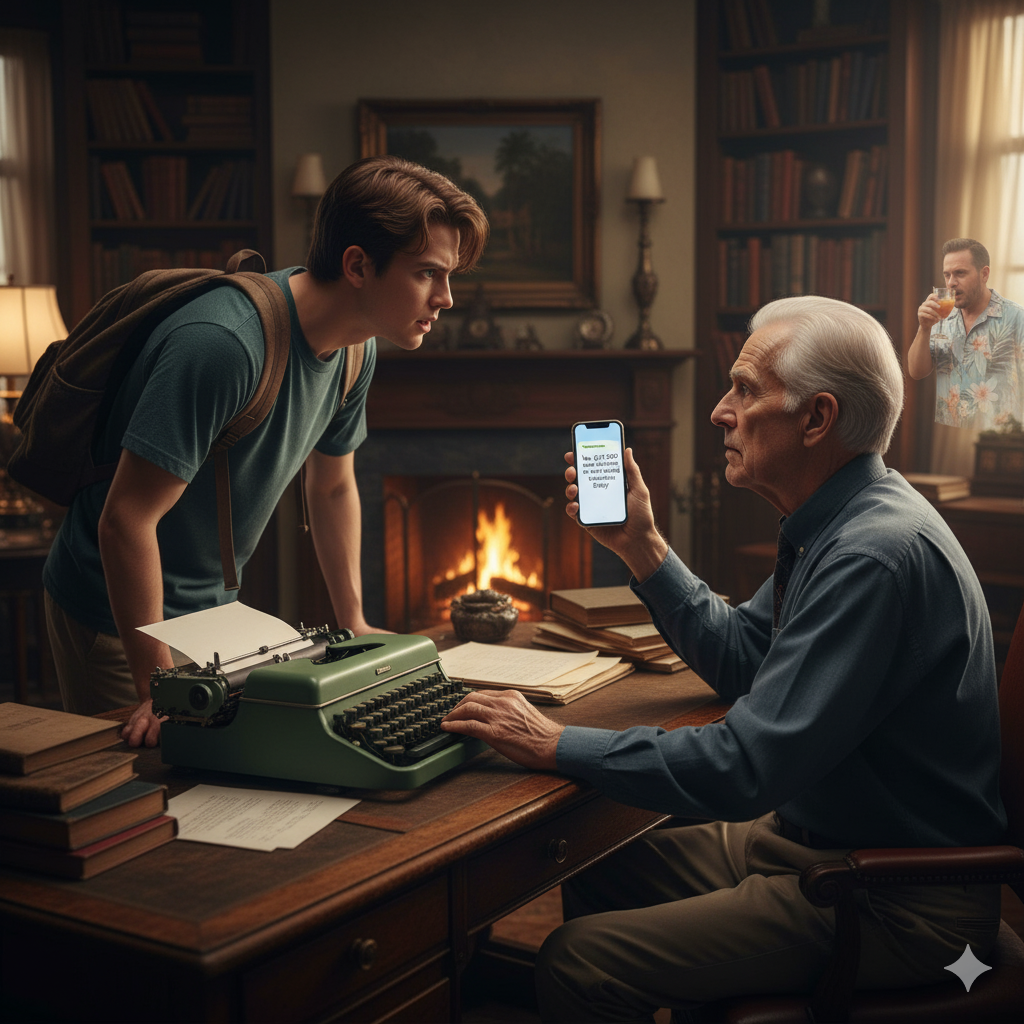
Thanksgiving morning, I woke to a sound I hadn’t heard in a decade: the metallic clack-clack-clack of his WWII-era Remington typewriter. He’d dragged the 50-pound beast from the attic and set it in a square of sun, as if the machine fed on daylight.
The kitchen table was his war room. There were folders of my father’s old mortgage statements, my tuition bills, and in the very center, my yellow legal pad.
He was typing like a carpenter, each strike measured and true. “What are you doing?” “Building a wall,” he said, not looking up. Clack. Clack. Zzzzzing.
When he finished, he rolled the paper out and slid it to me. It was a letter.
To: Charles Lawson. From: Harold Whitaker, on behalf of Nathan Lawson.
On or around November 19, 2025, you entered your son’s locked room and removed a shoebox containing $8,170 USD in cash savings.
This money was earned by Nathan Lawson and was his sole property. You subsequently converted this cash to travel cards and left the state.
This action constitutes theft under Ohio Revised Code 2913.02. We have video and financial records corroborating this fact.
You have until Monday, November 27, at 5:00 PM to return the full amount. Failure to comply will result in a formal police report being filed with the county, and we will proceed with all available civil and criminal remedies.
This is not a negotiation. This is arithmetic.
I looked up, stunned. “He’ll get so mad.” “Good,” Grandpa said. He made three certified copies. He addressed them with the same typewriter.
- Charles Lawson, C/O HR Department, Midwest Lending Solutions.
- Charles Lawson, C/O Dawn Michaels, CPA. (Dawn also did my Uncle Rick’s taxes.)
- Charles Lawson, C/O Membership Committee, Brookline Hills Country Club.
“Polite artillery,” he said, licking the envelopes like the stamps were vows. “The kind that lands on time.”
Wave two began at First Federal. We sat down with Carla, the senior teller with earrings like little steering wheels and a habit of looking you straight in the face. She slid the forms across the desk. “New student account?” she asked, smiling at me. “Joint,” Grandpa said. He tapped the line with a square fingertip. “Primary: Harold Whitaker. Co-signer: Nathan Lawson.” Carla’s eyes softened at my name. “You family?” she asked Grandpa. “I am the part that keeps records,” he said. She nodded as if that were a job title. We opened the account. Grandpa deposited a ceremonial one hundred dollars and called it bait. “Not for fish,” he told me in the parking lot. “For finding out which cat will stick his paw where it shouldn’t.”
From there we went to Kenny’s garage print shop. The place smelled like ink and gasoline, and the big offset press thumped like a heart that had decided never to stop. “Kenny,” Grandpa said. “I need postcards. For a party.” “What party?” Kenny grinned, wiping his hands on a rag. “My 75th birthday.” “Harold, you’re 82.” “It’s a surprise party. For me. This Sunday. Can you do it?”
Kenny printed 100 save-the-date postcards for Grandpa’s fictitious 75th birthday party, set for this Sunday at five at our address. In cheerful, looping fonts: “Drop in to celebrate Harold—coffee is on!” And in smaller type at the bottom: “Bring your favorite story about Harold (and any old receipts you’ve been meaning to show him).”
The guest list: Mom’s Pilates friends, her church group, and all the neighbors whose opinions traveled faster than the mail.
As we were driving away, Ed called. The good news was wrapped in the bad. “Got him,” Ed said, his voice flat. “Doorbell camera from the neighbor across the street. Your dad’s car, 12:03 AM, Tuesday. He used his key. Went straight upstairs. Left at 12:11 AM, carrying a Nike shoebox. Got a bank kiosk at a Kroger near the airport at 2:30 AM. Swapped cash for travel cards. And the travel agency confirmed it: itinerary to Maui for two adults, one minor, and a pet-friendly reservation. Times and amounts match, Harold.” “Technology doesn’t care about your story,” Ed said. “It cares about timestamps.”
Thanksgiving at our place is usually loud by nine. That morning, the furnace did all the talking. Grandpa and I ate eggs, and then we went to the community center. We loaded frozen turkeys into trunks for the church drive. He believed holidays had two modes: serve, or stand your ground. Sometimes both.
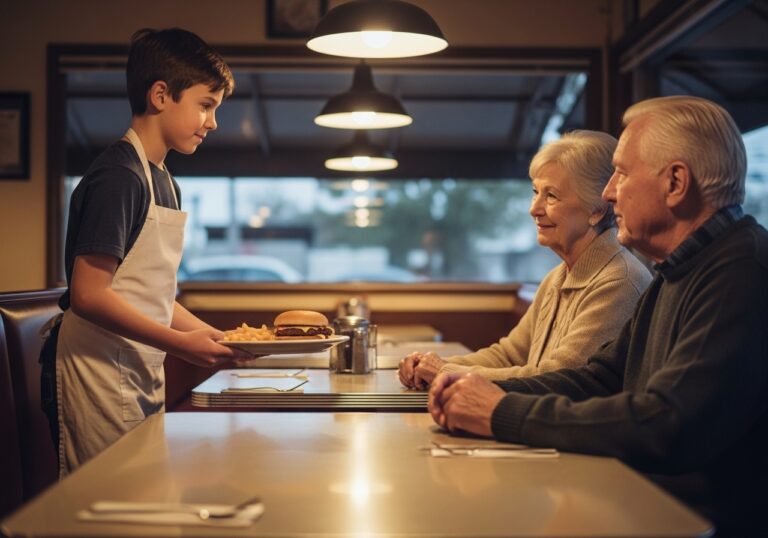
A little boy in a Bengals hat tried to carry a bird bigger than his torso, and he laughed when Grandpa called him “powerful.” A young woman with three kids in tow cried when we gave her an extra pie. Grandpa pretended not to notice her tears and just asked if she liked pecan or apple better. “Depends,” she said, wiping her nose. “On whether you steal the pecans from your mama’s pantry or buy ’em.” We all laughed, a lot more than the line deserved. It felt good to be useful.
On Black Friday, the certified letters landed where they needed to. The postcards went in the mail. We filed the small-claims case for $8,170 plus fees and interest, and an affidavit asking the court to restrain Dad from moving any assets. The clerk praised Grandpa’s tidy forms. “You can ask a court for courtesy,” he told me in the truck. “Sometimes they give it.”
Saturday morning, the phones started pinging like hail on metal. First, my phone. Mom: Call me now. What have you done? Mom: That money was family money. We paid for your roof for 20 years. Mom: Your grandfather is a cruel, jealous old man. He is going to get your father fired.
Grandpa looked at my phone and flicked it to silent. “They don’t get you on the hour,” he said.
Then, an unknown Maui number texted me. A picture from a resort pool. My parents, smiling like it was an effort. Madison, gripping the dog like a prop. No caption. It didn’t need one.
Then Grandpa’s phone. A voicemail. “Harold, it’s Erin from Pilates. I just got your invite! How exciting! Tell me what to bring to the party on Sunday…” The church ladies started coordinating casseroles with military efficiency. An email notification popped up on my laptop, which was still linked to the family calendar. A new event, created by Dad’s boss: “Monday, 9:00 AM. Subject: URGENT: Integrity Review.” A voicemail from Dawn, the accountant, on Grandpa’s machine: “Charles, it’s Dawn. I received a… concerning piece of mail. We need to discuss your tax implications immediately. This is a reputational risk, Charles. Call me.”
Grandpa skimmed it all, nodded once, and poured more coffee.
By noon, a detective Ed trusted called to say he’d stop by. He wasn’t in uniform. He brought the doorbell footage on a thumb drive and the ATM stills. He laid them on the kitchen table. “County’ll decide how to handle it,” he said, flipping through the pages of Ed’s report. “But facts are facts. It’s clean. Do you want to press charges?”
I looked at Grandpa. He didn’t move. He didn’t blink. He was leaving the choice to me. “Yes,” I said. My voice was firm. “But I’ll drop them. I’ll drop everything when the full amount is returned, with a signed admission of debt, and an agreement he gets counseling for financial abuse. And he stops using my name as a prop at his country club.” The detective nodded, almost smiling. “I like a conditional. Gives a man a door and a wall at the same time.”
A storm over the Pacific delayed their flight home. They wouldn’t land until Sunday afternoon. In the meantime, Grandpa turned the dining room into a courtroom that smelled like coffee. He set out the good plates. He lined the mantel with “scrapbook” contributions from neighbors—printouts of my dad’s Venmo requests labeled “emergency,” texts asking for “short-term floats,” a receipt from a neighbor who’d paid Dad $500 cash for lawn care I remembered doing. He stacked the documents by type and date, the way a mason stacks bricks. “A wall,” he said, patting the top sheet. “So the wind can’t talk you out of what you know.”
Kenny delivered a little pamphlet that looked like a church bulletin. On the cover: Grandpa and me, holding a turkey at the community center. Inside, in fine print: “If you’ve ever ‘lent’ cash to Charles Lawson for a ‘family emergency,’ bring receipts. We’re making a scrapbook.” I raised an eyebrow. “You asked people to bring receipts?” “I asked them to bring truth,” he said.
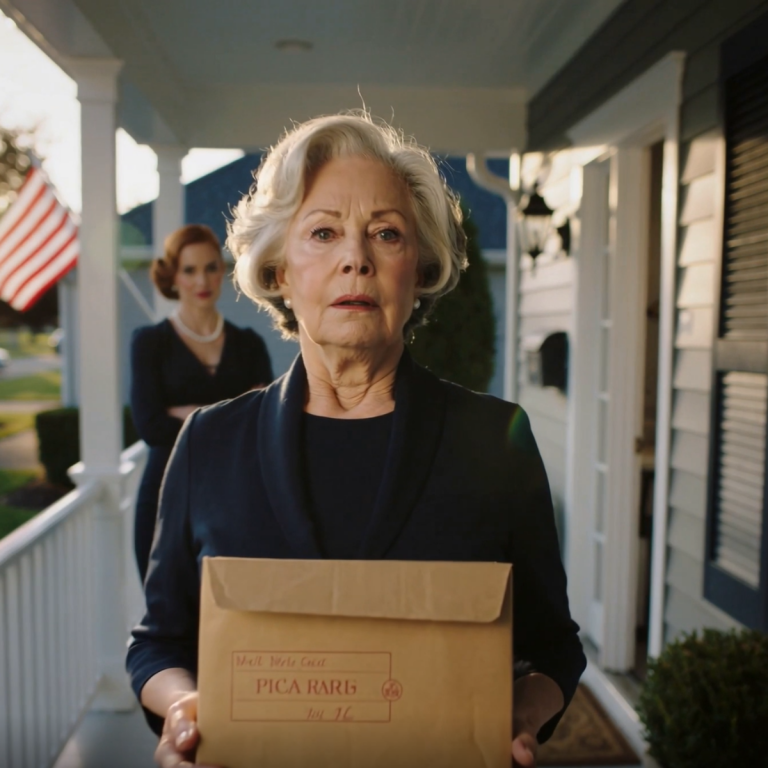
By four on Sunday, our driveway looked like Thanksgiving again. Minivans. Trucks. The church ladies with Pyrex dishes steaming up the cold air. Erin from Pilates with a glittering, complicated salad. Ed, in a sport coat. Dawn, the accountant, with the look of someone who had said the word “ethics” out loud at work. People hugged Grandpa, shook my hand, and tried to act like they didn’t know exactly why they were really there.
At 4:32 PM, a rental SUV slid into the driveway, crooked. My parents climbed out, wearing their airport faces—gray, tired, and angry. Madison hovered by the back wheel, chastened. The dog barked at the sign on the door: WELCOME, FRIENDS. COFFEE IS ON. RECEIPTS TO THE MANTEL.
Grandpa met them on the porch. “Harold—” Dad began, trying to shoulder past him, still playing the man of the house. “Charles,” Grandpa said. It was his bull-stopping voice. The one that carried across a river. “You’ll be polite in my house.”
Mom’s smile was a piece of Tupperware—snapped on tight and completely empty. “Harold, what is all this? A party?” “Receipts,” Grandpa said. “The kind you prefer not to keep.” “You weren’t even going to be here,” Madison blurted at me, the words tumbling out. Then she saw my face and stopped. “I… he said… he said you weren’t…” She swallowed the rest.
I stepped forward. My voice didn’t shake. “You took $8,170 from my room,” I said to my father. “The doorbell camera shows you. The bank kiosk shows you converting it. You texted me that you spent it. You did it on Thanksgiving week.” “That money was family money,” Mom said, her voice rising. “He paid for your roof!” “I paid rent when you asked,” I said. “Shelter isn’t a tip jar.” “You hid cash in a shoebox!” he shot back, as if that were the crime. “I hid cash because last year a bank fee ate a week of groceries!” I said. “I hid cash because I learned from you that you can’t trust what you can’t hold!”
Ed held up the small folder. “Report’s on file, Charles,” he said. “County reviews tomorrow. If you’d like to keep your HR department out of a deposition, I suggest you sit down and cooperate.”
Inside, Grandpa poured coffee like it sealed agreements. He set a legal pad in front of my father. “Write,” Grandpa commanded. “‘I, Charles Lawson, will return $8,170 to my son, Nathan Lawson, by Monday at 5 p.m.’” “This is humiliation,” Dad whispered, looking at the neighbors. “This is arithmetic,” Grandpa said. My father looked at the mantel, crowded with the small, unglamorous truths of his neighbors. He took the pen. He wrote, slow and angry. He signed. He dated.
Dawn cleared her throat. “There’s also the matter of restitution,” she said gently. “Borrowing under false pretenses from your neighbors has tax implications.” “Dawn,” Mom hissed. “Linda,” Dawn said back, polite as porcelain and hard as it. Grandpa laid out one more paper. “And you will write that you will not access my grandson’s accounts, devices, or mail without his written consent,” he told my father. “Sign it.” He signed.
The room changed temperature. People didn’t applaud; they exhaled. Ed photographed the documents with his phone and took a check Dad wrote on the spot for $2,000 as a down payment. “Zelle the rest by five tomorrow,” Ed said. “Don’t make me come get it.”
Mom asked to talk to me privately. “We’re talking where the receipts are,” Grandpa said. “Apologize where you stole.” “I’m sorry,” she said. It was to me, to the room, to the truth finally let out of its cage. “We told ourselves it was family money. We were wrong.”
She sat. Madison’s hands twisted in her sleeves. When everyone else drifted toward the kitchen—because casseroles ignore lawsuits—she stayed by the table with me. “I was scared,” she whispered. “He told me you weren’t coming home. He said you didn’t care about us, that you had all this money and you were hoarding it.” “I care,” I said. “I also care about not being stolen from.” She nodded, a tiny motion with a lot of learning behind it. “I’ll make it right with you, too,” she said. “However you say.” “Start with telling the truth when it’s small,” I said. “And don’t let anyone spend your name without your permission.”
On the porch later, with the cold leaning in and the neighborhood calm, Grandpa handed me a fresh mug. A snowflake landed in it, melted, and disappeared. “You kept your feet,” he said. “I had your table,” I said. He nodded. “Witnesses help.”
Zelle pinged three times on Monday: $6,170, with a note that read, simply, I’m sorry. I forwarded the screenshots to the detective and to Dawn. HR placed Dad on administrative leave. The club suspended his membership. The accountant declined to file his taxes.
That night, Grandpa pulled the typewriter back into the center of the table. “One more letter,” he said. He wrote it to me.
It said I was not an unpaid farmhand. It said I had spent years paying for a toxic peace with silence, and that this week I had balanced the ledger. It said a table is meant to feed you, not pin you. It said love without accountability is sugar water—sweet, useless, and sticky.
It said he was proud. Not because I won, but because I refused to cheat.
He signed it with his blocky name and slid it across to me. I put it in a clear sleeve, right behind the signed confession from my father. Truth loves to look ordinary.
On a clean blue Sunday in March, I drove out to Grandpa’s. The porch smelled like thawing earth. We sat with coffee and didn’t say much. We didn’t need to. “I keep thinking about walking into that empty house,” I said. “How loud the quiet was. How certain it felt that no one was coming.” He nodded. “Sometimes the lesson is that the people you’re waiting for aren’t the ones who will show,” he said. “Sometimes it’s you. Sometimes it’s me. Sometimes it’s the woman at the food drive who knows the difference between stealing pecans and buying them. Family is who brings receipts and stays for coffee.”
This is the part I don’t put on postcards: Five days after I walked into an empty house, my parents stood on a porch, crying and begging me to fix a problem they had made for themselves. I didn’t fix it for them. I fixed my part. I paid myself back with boundaries and paper. I watched my grandfather turn a typewriter into a lighthouse.
He still signs his notes the same way: Keep your feet. Keep your face. Keep your receipts. And in small print at the bottom, like a joke told after the audience has gone home, he adds: The crabs are sleeping fine.