A 3-Star Admiral Mocked A ‘Civilian’ Dad In A Hoodie At Daycare, Demanding To Know His Rank. He Expected A Stuttering Apology, But The 3 Words The Dad Whispered Back Didn’t Just Silence The Playground—They Instantly Ended The Admiral’s Career.
PART 1: The Fog of War
The fog in San Diego that morning wasn’t just weather; it was a living thing. It rolled in off the Pacific Ocean, thick and heavy, tasting of salt, wet rust, and the kind of damp cold that bypasses your skin and seeps right into the marrow of your bones. It was a perfect shroud, clinging to the jagged gray silhouettes of the destroyers sleeping in the harbor, muffling the sharp, rhythmic thwack-thwack-thwack of jogging platoons on the asphalt.
Naval Base Coronado is a world of disciplined motion. It is a universe of crisp creases, shined shoes, sharp salutes, and men who belong to the ocean.
And then, there was me.
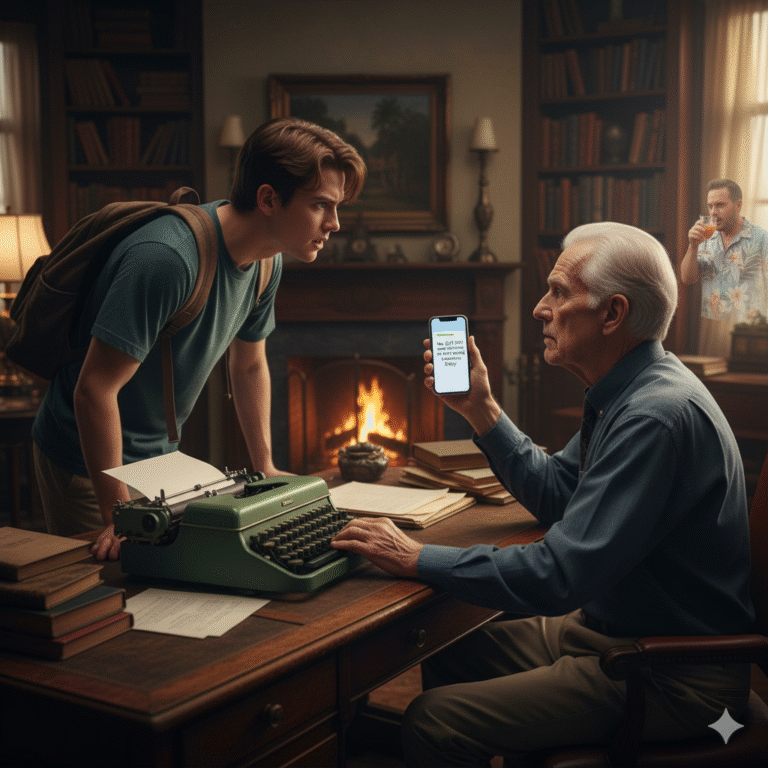
I stood near the chain-link fence of the base daycare, an anomaly in a worn, heather-gray sweatshirt that had seen better decades and a pair of faded jeans stained with motor oil. My hands, calloused and rough—the hands of a man who fixes his own truck and doesn’t mind the dirt—were jammed deep in my pockets to hide the tremor that sometimes hits me when the morning air is too cold.
I had my sleeves rolled up, exposing forearms that bore no tattoos, no watches, no insignia. To the passing world, I was a nobody. I was just a dad, waiting for his son. But even in the density of the fog, I felt exposed. I carried a silence around me that set me apart more than any uniform ever could.
The daycare doors finally burst open, shattering my internal monologue. A projectile of pure, kinetic joy launched itself across the small patch of damp grass.
“Daddy! Daddy, look! I’m a jet! I’m breaking the sound barrier!”
I knelt just in time, bracing my knees against the wet pavement, catching all forty pounds of Ethan. He slammed into my chest with a laugh that could defy a blizzard, let alone a little California fog. His small hands clutched a cheap plastic F-18, and for one, fragile, beautiful moment, the world contracted to just this. The smell of his shampoo—strawberry and sunshine. The warmth of his small body. The absolute, terrifying peace of being a father.
That peace lasted exactly four seconds.
It shattered with a sound that I hated more than gunfire. Laughter. Not the light, bubbling kind from the playground, but the loud, resonant, brass-filled laughter of men who command rooms and expect the walls to listen.
I didn’t even have to look up. I knew the cadence. I knew the aura.
Admiral Reed.
He was the head of West Coast SEAL operations, a man who commanded more power, more elite operators, and more dark money budgets than some small European nations. He was walking down the pathway with his entourage—a pair of younger, harder-looking Lieutenant Commanders who acted as his shadows, his echo chamber, and his enforcement.
Reed was a man who feasted on respect. He was accustomed to being the gravitational center of any space he occupied. He walked with the swagger of a man who knows that everyone watching him is afraid of him.
And he had just spotted me.
He saw the civilian clothes. He saw the quiet, unassuming posture. He saw the messy hair. He saw a man who didn’t belong in his pristine, militarized world. And in Admiral Reed’s world, things that didn’t belong were either assimilated or crushed.
He decided to have a little fun before his morning briefing.
He stopped, his polished shoes gleaming even in the dull light. A self-assured, shark-like smirk played on his lips. His men quieted instantly, sensing the shift, waiting for the joke.
“Hey there, buddy,” Reed called out. His voice boomed with a casual authority that was anything but casual. It was a sonic weapon.
I stiffened, instinctively pulling Ethan closer to my chest. I didn’t turn around immediately.
“I’m talking to you, slick,” Reed continued, stepping closer. The gravel crunched under his boots. He gestured broadly at the bustling, heavily armed base around us, then pointed a gloved finger at my chest. “You look a little lost. This is a military installation, not a homeless shelter. You look like you belong… well, somewhere else.”
He paused, letting the implication hang in the damp air like a bad smell. His eyes raked over my sweatshirt, lingering on a fraying thread at the collar.
“What’s your rank, soldier? Or did you just wander in off the street to steal some coffee?”
The other officers chuckled—a dry, sycophantic sound. They were enjoying the sight of their boss, the great Admiral Reed, putting a sloppy civilian in his place.
Ethan, sensing the tension the way animals sense earthquakes, quieted in my arms. He looked up at me, his blue eyes wide and confused. “Daddy?”
I stood up slowly. My knees popped. I kept one hand on Ethan’s shoulder, a protective weight.
I didn’t get angry. I didn’t get red in the face. I didn’t look at my feet. I just became… still. It’s a specific kind of stillness. It’s the way you get still in a deep forest when you hear a branch crack behind you and you know, with primal certainty, that you are not alone.
I turned and my eyes locked with the Admiral’s.
The air between us seemed to crackle. His smirk remained, plastered on his face, but his eyes were expectant. He was waiting for the script to play out. He was waiting for a nervous laugh. He was waiting for a stammer. He was waiting for a “No, sir, sorry sir, just picking up my kid, sir.”
He didn’t get one.
He got the heavy, profound, suffocating silence of a man who has seen the inside of the machine and knows exactly how the gears grind.
His smile tightened. The silence wasn’t submissive; it was defiant. The public teasing was now a public challenge. He couldn’t back down in front of his subordinates.
“I asked you a question,” Reed pressed, his tone hardening, stripping away the veneer of humor. He stepped into my personal space. “I don’t like loiterers on my base. Identify yourself.”
I felt Ethan flinch at the man’s raised voice.
And that’s when the decision was made.
The fog seemed to swirl around us, insulating the four of us from the rest of the world. I took a shallow breath, the iron-laced air burning my lungs.
My voice, when it came, was quiet. It didn’t boom. It didn’t echo. It was low, flat, and monotonic. It cut through the damp air with surgical precision.
“Major General,” I said.
PART 2: The Signature
The Admiral froze.
His smirk didn’t just fade; it evaporated, as if it had been wiped clean by a chemical solvent. It was replaced by a look of profound, terrifying confusion.
The two commanders behind him stopped breathing.
I watched the gears turning in Reed’s head. I could see the math happening behind his eyes. He was a three-star Vice Admiral. I had just claimed a two-star rank, Major General. In a straight naval hierarchy, strictly speaking, he still outranked me.
He was looking at a man in a dirty sweatshirt claiming to be a General Officer. It was impossible. It was absurd. But something in my voice—the lack of hesitation, the absolute lack of fear—stopped him from laughing.
But the arrogance was too deep. He was about to call my bluff. I saw his mouth open. I saw the indignation rising. He was ready to summon the MPs. He was ready to have me hauled off the base for stolen valor or impersonating an officer.
So, before he could speak, I added the final three words.
The three words that held the weight of my entire life. The three words that would stop his world. The three words that made the Admiral’s blood run cold in his veins.
“I signed yours.”
The silence that followed was absolute. It was louder than a gunshot. It was the sound of a career dying.
Reed’s face went from confused to a blotchy, ashen white. His pupils dilated. His eyes widened, not in anger, but in pure, unadulterated terror.
He understood.
The officers behind him didn’t, not fully, but they knew a kill shot when they saw one. They instinctively took a half-step back, distancing themselves from the blast radius.
“I signed yours.”
In the rarefied, oxygen-deprived air of top-tier command, a Major General who speaks about ‘signing orders’ for a three-star Admiral like Reed means one thing, and one thing only: Oversight.
It meant I didn’t work for the Navy. It meant I didn’t work for any branch he could see on an org chart. It meant I worked for the Department of Defense, for a classified inter-agency review board, for a committee in the Pentagon so deeply nested in the intelligence apparatus that it held the final veto on the budgets, the missions, and the continued existence of entire operational wings.
Wings like the West Coast SEALs.
Reed’s eyes were unblinking. He was staring at a ghost.
He realized, with a sickening lurch of his stomach, that in a single moment of casual hubris, he had just publicly challenged, mocked, and demanded the rank of the man who, in all likelihood, was overseeing the multi-billion dollar black-budget review that kept his entire command afloat.
He had just tried to humiliate the man who held his professional life in the palm of one calloused hand.
“General… General Brooks?” Reed stammered.
His voice was no longer a boom. It was a strained, strangled whisper. All trace of authority, all that brass and confidence, was gone. He looked wildly at his team, who were now desperately trying to study the asphalt, the fog, the seagulls—anything but me.
“Sir,” he choked out, sweat suddenly visible on his forehead despite the cold. “I… my profound apologies. I did not… I didn’t recognize you out of context. The… the civilian attire…”
I didn’t relax. I didn’t offer a cynical smile. I didn’t give him the mercy of an “at ease.” My eyes were the same still, gray pools they had been a moment ago. I let him dangle in the wind for a few seconds longer.
“Context is everything, Admiral,” I replied, my voice just as measured, just as final. “And my context is right here now.”
I tapped Ethan’s small shoulder, gently.
The Admiral swallowed, a visible, painful bob of his Adam’s apple. The sheer magnitude of his blunder was setting off every alarm bell in his gut. He knew the protocols. My presence here, in this sweatshirt, at this daycare, was supposed to be completely anonymous. My presence was classified. My son was classified.
He had just shone a spotlight on a shadow.
“Of course, sir. General. We will respect your privacy. Absolutely. Consider this incident… completely erased. It never happened.”
Reed snapped a salute. It was hysterical—far too sharp, far too rigid, far too respectful for the open air. It was a salute of frantic submission.
Then he turned on his heel. He didn’t just walk; he fled. He strode away with the rigid, frantic speed of a man running from a catastrophic failure, barking a hushed order to his men. His team scrambled to catch up, their boots thumping a panicked retreat into the fog.
The laughter was gone.
The path was silent again. The only sound was the distant cry of a gull and the whoosh of the ocean against the breakwall.
Ethan, bless his innocent heart, was utterly oblivious to the seismic shock that had just hit the senior command structure of the US Navy. He looked up at me, his head tilted, clutching his toy jet.
“Daddy, why did the man call you a General?” he asked, his voice small. “Are you a boss?”
I knelt, the motion slow. Every joint seemed to ache, a phantom pain from a life I tried to leave behind. I wasn’t wounded by the Admiral’s disrespect; I was wounded by the memory the rank stirred up.
I brushed a stray piece of blond hair from his forehead, my rough hand gentle against his skin. He looked so much like his mother.
“It’s just an old name, buddy,” I said, my voice thick with things I couldn’t say. “A long time ago, Daddy used to help make sure the biggest, most important toys worked. Now… I just help make sure your toys work.”
He smiled, satisfied with the logic, and held up his jet. “Okay! Zoom!”
But the truth was heavier than any body armor I had ever worn.
I, Major General Daniel Brooks, had not “retired.”
I had been discharged by necessity. Placed in a highly specialized protective isolation program. The reason I was in civilian clothes, the reason my hands were “rough” from working on engines I didn’t need to fix, the reason my wife, Sarah, was gone… it was all the same reason.
Project CERBERUS.
Three years ago, I was the youngest General to ever run it. It was a system of global data-fusion and predictive defense. It was supposed to make war obsolete. A digital shield.
I was under pressure. The kind of pressure that turns coal into diamonds and men into dust. A global cyber-attack was imminent. I had seconds to make a choice. I signed off on a critical patch fix.
It worked. The shield held. The world never even knew what it had been saved from.
The military gave me the Distinguished Service Medal. The President called me a hero.
But the patch… the patch had a bug. A single, devastatingly simple line of code that I missed in my exhaustion. It didn’t affect the defense system. It corrupted a single, non-military network: the traffic control system near Quantico.
The resulting four-car collision at an intersection took Sarah’s life.
The Department of Defense… they couldn’t have their hero also be the man responsible for the bug. They couldn’t let the truth destroy the entire CERBERUS program and public faith in the command structure.
So they staged my “early retirement.” They gave me a new civilian life in a new city. They gave me a staggering, silent pension. They gave me custody of Ethan.
The price of my silence was my sanity. My penance was my invisibility.
And Admiral Reed, in one stupid, arrogant moment, had just shattered that fragile shell.
I had used my rank not as a boast. It was a weapon. A shield. I used it to enforce the anonymity I so desperately need. Reed would now ensure that every single officer on this base, from the CO to the lowest E-1, understood that the man in the gray sweatshirt at the daycare was radioactive. He was a shadow they dared not look at, much less address.
I had sacrificed my dignity for my safety.
I picked up Ethan, holding him close, the small plastic jet digging into my collarbone. I looked past the base, past the enormous gray giants sleeping in the harbor, and out toward the Pacific horizon, where the fog was finally beginning to burn off.
I was safe again, locked behind a new fortress of professional fear and classified information.
But as I carried my son toward the gate, the weight of the stars I used to wear, and the weight of the single life I had accidentally destroyed, settled back onto my shoulders.
My new rank isn’t General. It’s Father.
And it’s the only fight I have left to win.