I wrote an anonymous letter to save a 19-year-old Marine from nightly hazing. A month later, a Major General read my letter aloud to the entire base in the pouring rain. “Whoever wrote this—see me after.” My career was over. I was a traitor. But when I walked into his office and saw the framed photo on his desk, my blood froze. The recruit… he wasn’t just a recruit. And the General knew exactly who I was.
Part 1
“Whoever wrote this… see me after.”
The general’s voice still echoes in my head. It cut through the sound of the Carolina rain like a blade.
My throat went dry. Every Marine in that formation stood like stone, rain dripping off their helmets, boots sinking into the parade ground mud. And there I was, heart hammering against my ribs, pulse pounding in my ears.
I was the one who’d written it. The anonymous letter. The one that had just sealed my fate.
That was the moment I learned courage doesn’t always roar. Sometimes, it’s just the sick, quiet feeling of knowing you’re about to lose everything for doing the one thing you had to do.
Two months earlier, Camp Lejeune felt like it always did in early winter. Gray skies, the lingering smell of diesel fumes, and the constant, grinding hum of routine.
I was Staff Sergeant Clare Monroe, US Marine Corps, Logistics Division. Twelve years of service, no reprimands, no medals worth framing. Just steady work, good reports, and the core belief that order meant safety. I kept my head down. I did my job.
Then I saw him.
Private Evan Roth. Barely nineteen, with the kind of wide, trusting eyes that hadn’t seen enough of the world to know how cruel it could be. He was the kid who still said, “Yes, ma’am,” like he was talking to his high school principal, not a battle-hardened NCO.
His bunk was near mine in the barracks, and every night, I’d hear the same, sickening ritual.
Laughter, low and sharp. Muffled shouts. The thud of a boot against a metal locker, followed by a smaller, softer thud.
Then, silence.
At first, I told myself it wasn’t my business. I’m ashamed to admit that.
Recruits learn discipline. Tough love builds Marines. The Corps is hard for a reason. That’s what we tell ourselves. That’s the lie we use to sleep at night.
But the dark, blooming bruises on his wrists, the ones he tried to hide under his sleeves at chow. The tremor in his voice when he’d say, “I slipped during PT, ma’am”—those weren’t training.
That was cruelty dressed up as tradition.
One night, around 2300 hours, I was heading back from a late shift. I passed the showers. The lights were off, but I heard the hissing spray of cold water and the same sharp laughter.
I froze.
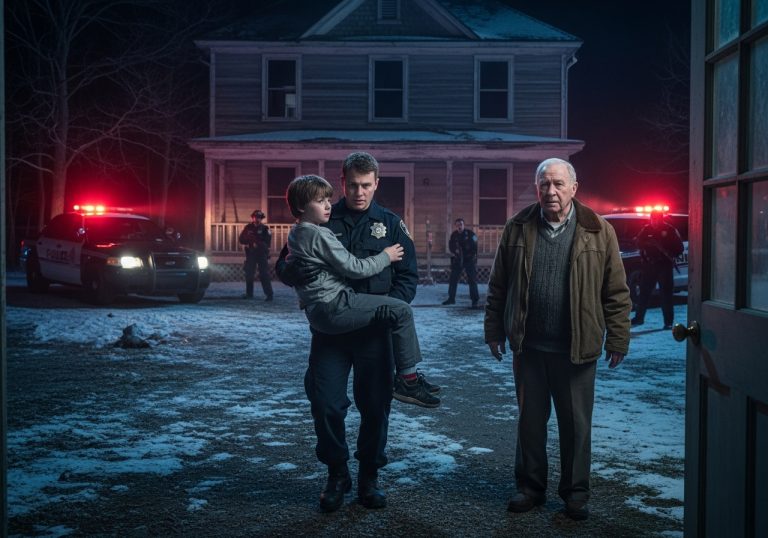
Through the gap in the door, I saw it. Two corporals—Miller and Vance—had him cornered. They were spraying him with icy water from the high-pressure cleaning hoses, soaking his fatigues, laughing as he shivered violently.
“Sing for us, choir boy,” Miller sneered, his voice echoing off the tile. “Sing us that little song your mama taught you.”
Evan just stood there, arms wrapped around himself, teeth chattering too hard to speak.
I stood there in the dark hallway, paralyzed. I outranked them. I could have burst in, lights on, and ended it right there. But I also knew what that meant. A formal report. A “she-said, he-said” that would paint me as the problem. The NCO who couldn’t handle her own barracks.
So I kept walking. Straight to my quarters, my own footsteps sounding like accusations in the empty hall.
But I couldn’t sleep. Not after that.
The next morning, I stood staring at the Marine Corps Code of Conduct pinned above my desk. I will never forget that I am a Marine, responsible for my actions and dedicated to the principles which made my country free.
That line used to be background noise. Now it sounded like a judgment.
By midnight, I’d made my choice.
I grabbed a blank page of standard-issue paper. My hand was shaking, but I forced it steady. I wrote every detail I’d seen. The dates. The names. The incidents. The showers. The “slipped during PT.”
I didn’t hold back.
To whom it may concern,
There’s a recruit in Bravo barracks, Private Roth, being targeted nightly. The abuse violates every standard we are sworn to uphold. It is not training; it is torture. If no one speaks, someone’s going to get hurt, or worse. Please act before it’s too late.
I stared at the empty space at the bottom. My name. My career.
I didn’t sign it.
I folded it clean, walked down the silent corridor to the duty officer’s office, and slid it under the door. I didn’t knock. I just walked away, my heart a cold stone in my chest.
When I lay down in my bunk that night, I felt something I hadn’t in years: true, bone-deep fear. Not of the enemy, not of the dark. Fear of my own conscience.
The next few days were quiet. Too quiet.
The air in the barracks changed. The late-night laughter stopped, but it was replaced by something worse. Whispers.
Someone had ratted. Someone had written a letter.
At morning chow, heads turned when I walked by. No one said a word to me, but I could feel it—suspicion, invisible and heavy as body armor.
Miller and Vance were pulled into questioning. They returned hours later, red-eyed and silent, their faces pale with rage.
Later that week, our senior drill instructor assembled the company. His tone said it all. He was disgusted. Not at the hazing. At whoever had broken the silence.
“We have an allegation,” he spat, his eyes scanning every face. “Which means one of you… one of our own… decided to break faith. Decided to go outside the family.”
My blood ran cold.
That night, Evan approached me quietly by the vending machine, checking over his shoulder to make sure no one was watching.
“Ma’am,” he said, his voice barely audible. “Whoever it was… who tried to help… If you see them… tell them thank you.”
I wanted to tell him it was me. I wanted to tell him to be careful.
Instead, I just said, “Keep your head up, Private. Things will get better.”
He smiled, but it was faint, like he didn’t believe it. “Yes, ma’am.”
But they didn’t get better. They got worse.
A week later, during weapons maintenance, I overheard two NCOs from another unit whispering.
“They’ll find out who wrote it,” one said, his voice low as he cleaned his rifle.
“Doesn’t matter,” the other grunted, slamming a magazine home. “Whoever it was, career’s done. You don’t rat on your own. Period.”
I kept my hands steady, field-stripping my M16, the smell of gun oil thick in my throat. My heart thudded behind every word.
By the end of the month, it all boiled over.
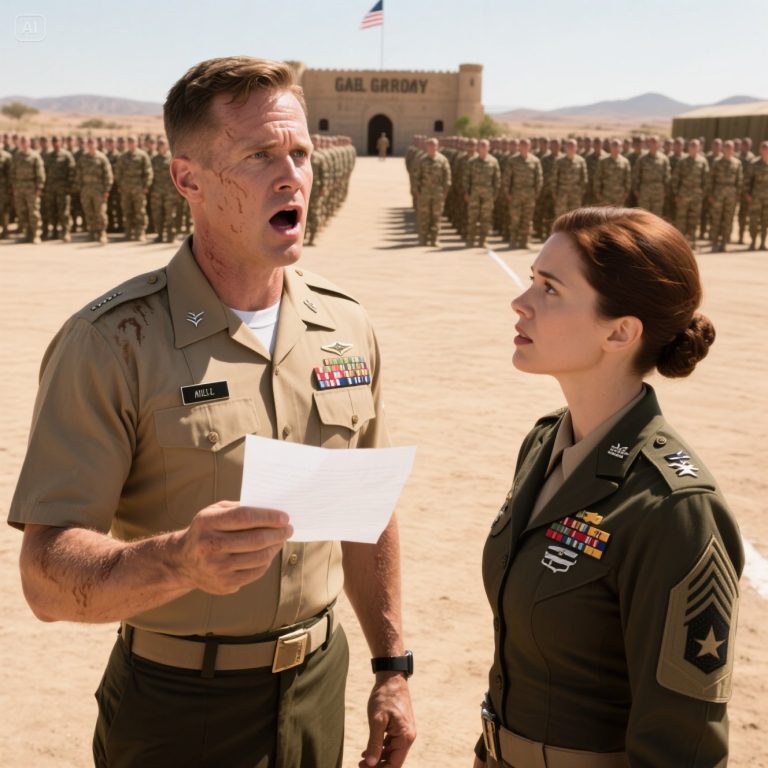
We were ordered to assemble on the parade ground. 0700. Full dress, no explanation. The rain fell sideways, cold and relentless. The air crackled with tension.
Then, a convoy rolled in. Black sedan, silver insignia, a two-star major general’s vehicle.
He stepped out. Tall, composed, with eyes like polished steel. He wore no umbrella, just the kind of authority that seemed to part the rain around him.
He took the podium, unfolded a single sheet of paper—my paper—and began to read.
My letter. Every line. Every single word.
He didn’t name names, but each word landed like a hammer blow on the silent formation. The silence that followed was deafening. Even the rain seemed to pause.
When he finished, he refolded the paper and scanned the formation, his gaze slow and deliberate, as if he could see right through our uniforms, right into our souls.
“Whoever wrote this,” he said evenly, his voice carrying without a microphone, “see me after.”
My pulse spiked. The world narrowed to the sound of my own breath. He tucked the letter into his jacket, turned on his heel, and walked off the field.
As the unit was dismissed, I stood frozen, boots sinking in the mud. Every instinct I had, every cell in my body, screamed, Stay quiet. Blend in. Disappear.
But another voice, the same one that made me write the letter, whispered, Stand up.
I turned toward headquarters. Every step felt like I was wading through wet concrete. When I reached the door to his temporary office, I paused. The hallway was silent, lit by a single flickering bulb. My reflection in the glass looked older, harder.
I knocked once.
“Enter,” came the general’s voice.
I stepped inside, my hand snapping up in a salute, and met his eyes.
That’s when I froze.
On his desk, in a simple silver frame, sat a photo. The moment I saw it, I forgot how to breathe.
It was Private Evan Roth, his face younger and unguarded, smiling, his arm slung casually around the shoulder of the same man now sitting before me.
Part 2
The general’s tone was calm, but sharp enough to cut glass.
“Close the door, Staff Sergeant.”
I obeyed. The sound of the latch clicking shut felt deafening, final. He gestured to the single hard-backed chair across from his desk.
“Sit.”
My boots felt like they weighed a hundred pounds. I sat stiffly, back straight, hands locked on my knees, my mind racing. His son. It’s his son. Oh God, he thinks I knew. He thinks I was trying to… what?
He studied me. It felt like hours. The only sound was the rhythmic ticking of the wall clock and the relentless rain against the window.
“You wrote the letter.”
It wasn’t a question.
“Yes, sir.” My voice was a croak.
“Why?”
The truth trembled at the back of my throat, but I forced it out. “Because someone had to, sir. What was happening to that recruit… it wasn’t discipline. It was cruelty.”
His gaze didn’t waver. “You’re aware that submitting anonymous reports through unofficial channels violates Standing Order 14C.”
“Yes, sir.”
“Then why not go through your chain of command? Why not report to your Master Sergeant? To your Captain?”
I hesitated. This was it. This was the moment that would define the rest of my life.
“Because, sir,” I said, meeting his eyes, “the chain was the problem.”
For a heartbeat, I thought I’d gone too far. His jaw tightened. But instead of the explosion of anger I expected, a flicker of something else crossed his face—not anger, but a deep, profound pain.
He leaned back slowly, exhaling through his nose.
“My son didn’t tell me your name,” he said, his voice suddenly quiet.
My head jerked up. “Your—your son, sir?”
He nodded, tapping the frame on his desk. “Private Evan Roth. He was placed in your unit as part of an internal morale assessment. An ‘undercover’ operation, if you want to call it that. None of the officers, not even the base commander, were informed. The results were… revealing.”
I just stared. I couldn’t speak. My mind was a blank slate, wiped clean by shock.
“Of course you didn’t know,” he interrupted my silent panic, his voice gentle now. “That’s the point. I sent him in to see if the ‘tough love’ culture had become something toxic. He was supposed to report back. But he didn’t.”
He picked up my letter, his letter, from the desk.
“He didn’t report,” the general continued, his voice hardening again, “because he was afraid. Afraid of the very men who were supposed to be training him. Afraid of what would happen if he spoke up. Afraid, Staff Sergeant, of the same ‘chain’ you just told me was the problem.”
He held up the letter. “And then this landed on my desk. An anonymous report. From someone who had no idea who he was, no political reason to act. Someone who just… saw something wrong.”
He read a line from it aloud. “If no one speaks, someone’s going to get hurt.”
His voice softened. “You were right.”
Relief and confusion tangled inside me so tightly I thought I might be sick. “Sir,” I managed to say, “am I in trouble?”
He gave a faint, almost tired smile.
“That depends on what kind of trouble you believe in, Staff Sergeant Monroe. You broke a rule. But you upheld an oath. As far as I’m concerned, you’re the only one in that barracks who did.”
He stood up. “You’re dismissed. Go back to your duties. This conversation never happened.”
“Sir, what about Miller and Vance?”
“That,” he said, his eyes turning to steel again, “is my problem. Not yours.”
I saluted, turned, and walked out. My legs were shaking so badly I barely made it down the hall.
By the next morning, the story had spread like wildfire. Not the real story, but the barracks version. SSgt Monroe was in the General’s office for almost an hour. She’s the rat. She’s the one who wrote the letter.
When I entered the chow hall, the familiar roar of conversation died mid-sentence. It was like a wave of silence followed me to the line. Eyes followed me like searchlights.
I kept my head down, tray trembling slightly in my hands.
As I looked for a table, Corporal Miller—fresh from his “questioning”—stepped in front of me. His face was still blotchy and red, but his eyes were full of a cold, satisfied malice.
“Well, well,” he sneered, loud enough for the whole room to hear. “Guess snitches get promoted now. How’s it feel, ma’am? Selling out your own?”
The entire hall was watching. Waiting.
I set my tray down slowly on the table beside them.
“Guess some Marines,” I said, my voice quiet but carrying, “forgot what ‘our own’ is supposed to look like.”
I looked him dead in the eye. “You’re lucky all you got was questioning, Corporal.”
The silence that followed was thick as oil. Miller’s smirk vanished, replaced by pure hatred. He didn’t say another word.
I ate quietly, but inside, the tension buzzed. The investigation had shifted everything. People didn’t laugh anymore. They watched each other. The camaraderie that once filled the barracks had been replaced by a toxic, pervasive suspicion. And it was all pointed at me.
Evan—Private Roth—was quietly transferred out that same day. “Family emergency,” the official report said. When our eyes met across the motor pool as he left, he just nodded once. A quiet thank you he couldn’t say out loud.
I was alone.
A week later, during a logistics drill, Master Sergeant Vance—my actual superior, an old-school Marine who believed in the chain of command above all else—cornered me in the supply bay. His voice dropped low, the kind that carried warning more than words.
“General’s got his eye on you, Monroe. I don’t know what you did, or who you know, but that’s not a blessing. That’s a target.”
“With respect, Master Sergeant,” I said quietly. “I just did what was right.”
He scoffed, spitting on the concrete floor. “You did what was emotional. You broke chain. You put your feelings above protocol. And in this line of work, emotion gets Marines killed.”
He walked off, leaving the scent of motor oil and his contempt hanging in the air.
I stood there, hands shaking, pretending to recheck the cargo manifest just so no one would see. He was right. I was a target now. Not just for Miller, but for everyone who believed the “old way” was the only way.
That night, thunder rolled over Camp Lejune again. I couldn’t sleep. The letter, the General, the glares, Vance’s warning—it all spun in my mind like a carousel that wouldn’t stop.
I went outside. The rain misted across the asphalt, soft and cold. The base was quiet, except for the distant hum of generators.
Under the dim floodlights, I saw Evan sitting on the steps of the barracks, coat pulled tight, eyes distant.
My heart jumped. “Private? I thought you were transferred.”
He looked up, startled, then smiled faintly. “I am, ma’am. Just… saying goodbye. My father’s car is waiting.”
I sat beside him, the concrete damp beneath us.
“They won’t touch you now,” I said. “The General’s watching.”
“Doesn’t make it easier,” he murmured. “The silence feels worse than the shouting. Everyone knows. They just… pretend they don’t.”
I nodded. I understood that kind of silence. The kind that made you question if doing right was worth the noise it cost.
Before I could reply, he looked at me, his eyes glinting in the low light. “You think I’ll ever fit in here, ma’am? After all this?”
I thought about my twelve years in uniform. The bruises I’d hidden, the pride I’d swallowed, the orders I’d followed without question.
“You don’t have to fit in, Private,” I said quietly. “You just have to stand.”
He smiled, the first real smile I’d seen from him. “Yes, ma’am. My dad said you’d say something like that. He said you were the real thing.”
“Your dad…”
“He wanted me to give you this,” Evan said, pressing a small, heavy coin into my hand. A General’s challenge coin.
“He said you earned it,” Evan whispered. “He also said… this isn’t over. Be careful, Staff Sergeant.”
He stood, saluted sharply, and disappeared into the rain.
The following morning, I was called to headquarters again. My stomach clenched. Not again.
But instead of the General’s office, I was sent to the assembly hall.
When I stepped inside, every NCO and Officer in Bravo Company was already seated. Miller and Vance were in the front row, looking smug. They thought this was my execution.
General Roth stood at the podium. This time, he wasn’t holding my letter. He was holding a stack of formal reports.
“Courage,” he began, his voice booming in the enclosed space, “isn’t a medal. It’s a mirror. And when an organization stops recognizing its reflection, it’s already lost its honor.”
His eyes swept the room, landing on Master Sergeant Vance. “When a recruit is too scared to report abuse to his NCOs… the system is broken. When NCOs are more outraged by a letter than by the abuse… the system is broken.”
His gaze shifted to Miller and his buddy. “Corporal Miller. Corporal Vance. You are charged with assault, battery, and conduct unbecoming a Marine. You are hereby stripped of your rank and will be processed for dishonorable discharge.”
Miller’s face went white.
“Master Sergeant Vance,” the General continued, his voice dropping. “For fostering a command climate that encourages silence and punishes integrity… you are relieved of your duties, pending a full review of your fitness to lead.”
My own Master Sergeant looked like he’d been punched.
The air in the hall tightened. I knew everyone knew he was doing this because of me. He didn’t name me, but it didn’t matter. My peers turned, some respectful, some… resentful.
When he finished, he left the stack of reports on the podium and walked out.
I stared at that podium—the spot where my letter had been read—now the spot where careers had just ended. I’d started a storm that couldn’t be undone.
The morning after the assembly felt different. Too quiet. Too careful. Marines spoke in clipped tones, eyes darting away the moment I walked into a room. It wasn’t open hostility anymore. It was something colder.
Isolation.
That’s how the Corps punishes without paperwork.
At 0600, an aide delivered a sealed envelope to my rack. By order of Colonel Dunar (the base commander), report to command briefing at 0900 hours.
I knew what that meant. The General was gone, and the local command was left to clean up my mess.
By 0830, I was standing outside the conference room, uniform pressed, ribbons aligned, palms damp. Through the glass, I saw them. Colonel Dunar, the new Master Sergeant, and two officers from legal.
When I walked in, Dunar’s tone was neutral, but his eyes weren’t. “Staff Sergeant Monroe, have a seat.”
He didn’t waste time. “Your actions, while… noted… by General Roth, have created an operational nightmare. You bypassed protocol, created internal disruption, and compromised chain-of-command discipline.”
“With respect, sir,” I said quietly. “I followed the only chain that still worked. My conscience.”
Dunar’s jaw tightened. “This isn’t a debate, Sergeant. We cannot reward insubordination, regardless of the outcome.”
He slid a paper across the table. “You will not be charged. But you are reassigned to Internal Logistics, effective immediately. Desk duty. Paperwork. You are not to interact with Bravo Company recruits.”
It was the polite version of exile.
“Yes, sir,” I said softly.
“Dismissed.”
My new “office” sat behind the motor pool, four gray walls, a flickering fluorescent light, and stacks of forms that hadn’t been touched since the 90s.
Chief Petty Officer Lam, a quiet woman with steel-gray hair and kind eyes, handed me a clipboard without ceremony.
“Inventory reports,” she said. “Start with pallet rows 1 through 12. It’s… a lot.”
“Yes, ma’am.”
She paused, then looked at me. “And Monroe?”
“Yes, ma’am?”
Her voice softened. “You did the right thing. Don’t let the noise make you doubt that. This place,” she waved at the dusty room, “is just where they put people who are too right for them to handle.”
I nodded, grateful for the first kind word in weeks.
Days turned into weeks. Weeks turned into a month. Routine replaced purpose. My hands, once calloused from convoys and fieldwork, now smelled like printer ink. At night, I’d jog the base perimeter just to feel movement again, the Atlantic wind cutting through my lungs, sharp and honest.
I was forgotten. A ghost in the supply chain.
One night, I was working late, trying to reconcile a shipping manifest that made no sense. The numbers were all off. A critical shipment of replacement parts for the Humvees was listed as “Delivered,” but the motor pool said they never got it.
I dug deeper. The sign-off sheet… the signature was forged. It looked almost like mine, but it wasn’t.
Someone was sabotaging the manifests. Someone was trying to make it look like I was failing.
I cross-referenced the duty rosters for the day the shipment “arrived.” And there he was. Master Sergeant Vance. He hadn’t been transferred after all, just moved to… Logistics Oversight. My new, indirect boss.
He was setting me up to take the fall for his own incompetence, or worse, his revenge.
I felt the old fear return, cold and sharp. But this time, something else was there, too. Anger.
I didn’t write a letter.
I picked up the phone.
Two days later, Colonel Dunar was in my tiny office, his face grim. Master Sergeant Vance stood beside him, looking smug.
“Staff Sergeant Monroe,” Dunar began, “we have a major problem. A critical shipment is missing. Your signature is on the delivery manifest.”
“That is not my signature, sir,” I said calmly.
Vance scoffed. “It looks like your signature to me, Sergeant. Careless mistake.”
“It’s not,” I repeated. “And I can prove it. Chief Lam, if you would.”
Chief Lam stepped forward and placed a small security log on the desk. “According to gate security, Master Sergeant Vance was the only one in this warehouse on the date of that delivery. He signed out the manifest, and signed it back in an hour later. Staff Sergeant Monroe was on the rifle range all day.”
Vance’s face went pale.
“Furthermore,” I added, “I pulled the logs from the motor pool. The shipment never left the depot. It’s still sitting in Bay 4. He just… changed the paperwork to make it look like I’d lost it.”
Dunar stared at Vance, his face turning a dark red. “Master Sergeant…?”
Vance sputtered. “She… she’s lying! She’s with the General!”
Before Dunar could respond, a new voice came from the doorway.
“He’s not lying, Colonel. But you are.”
General Roth stepped into the tiny office. It felt like all the air had been sucked out of the room.
“Sir,” Dunar stammered. “I was not aware…”
“You weren’t meant to be,” Roth said, his eyes fixed on Vance. “I’ve been monitoring this unit’s logistics since your ‘review’ of Master Sergeant Vance. Seems you thought ‘relieved of duty’ just meant ‘move him somewhere he can’t be seen.’ But a snake is a snake, no matter what part of the grass it’s in.”
He turned to me. “I was waiting to see what you would do, Staff Sergeant. Whether you’d break, or whether you’d fight.”
He smiled. “You fought.”
He looked back at Dunar. “Colonel, Master Sergeant Vance is now a matter for military police. And you… you and I are going to have a long talk about what leadership means.”
Vance was escorted out. Dunar looked like he’d seen a ghost.
General Roth turned to me in the silence of the dusty office.
“I told you this wasn’t over, Staff Sergeant. This,” he gestured to the room, “was the last part of the test. Not for you. For them.”
He pulled an envelope from his jacket.
“Your transfer orders, Monroe. You’re reassigned to Quantico. You’ll be heading my new task force on… you guessed it… internal morale and anti-hazing protocols.”
He smiled. “And this.”
He handed me a small box. Inside were the chevrons of a Gunnery Sergeant.
“You didn’t just expose a sickness, Gunny,” he said, his voice full of pride. “You’re going to be the cure.”
I stood there, the weight of the coin in one pocket and the new stripes in my hand, and for the first time in twelve years, I wasn’t just a Marine following orders.
I was one who knew which ones were worth following.