
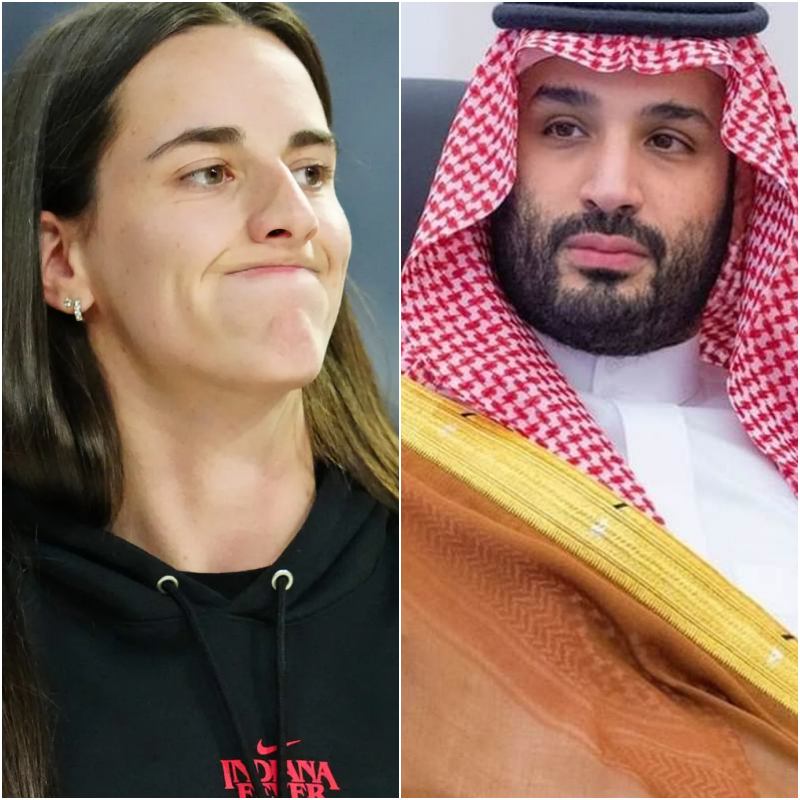
$50 Million Question: How a Saudi-Backed Super-League Is Poised to End the WNBA’s Era of Dominance
The Nuclear Option: A Financial Threat of Unprecedented Scale
The WNBA is currently experiencing a historic high in visibility and economic potential, largely driven by the phenomenon of a few generational talents. Yet, the league’s celebration is being drowned out by a deafening roar from the East—a thunderous financial challenge that is not only unprecedented in women’s sports but also constitutes an immediate, existential threat to the WNBA’s continued existence.
A new Saudi-backed women’s basketball venture, tentatively referred to as “Project B,” has emerged from the shadows and is reportedly prepared to offer its top target, Caitlin Clark, a contract that has sent shockwaves through the entire industry: up to $50 million per year.
For context, this figure is not just multiples higher than any WNBA contract; it represents legitimate, star-level NBA money. Clark could potentially sign a four-year, $200 million contract, a staggering sum that instantly reframes the entire economic reality for professional female athletes. This isn’t just a challenge; it’s a full-scale raid on the WNBA’s most precious assets, utilizing a financial arsenal the domestic league simply cannot match.
Undermining the Foundation at the Worst Possible Time
The timing of this revelation could not be worse for the WNBA. The league is currently navigating a period of intense instability, with the collective bargaining agreement (CBA) negotiations underway and almost the entire league—barring the rookies—set to become free agents. The WNBA’s primary goal in these talks is to gain a measure of exclusivity, hoping to convince players to focus solely on the domestic league in exchange for significantly higher salaries.
Project B has functionally destroyed that negotiating leverage.
The new league is scheduled to launch next fall, running from November through April, neatly fitting into the WNBA’s off-season. This initially non-conflicting schedule is a masterful move, allowing players to cash in on a second, massive salary without abandoning their current WNBA teams.
However, the money is the real shockwave. While the WNBA struggles to quadruple its contract offers, Project B is promising salaries that are multiples higher. A mid-tier WNBA player currently making $150,000 could realistically expect $1.5 million or more from Project B. For a player like Paige Bueckers, who will earn under $100,000 in her first four WNBA years, the temptation of a $10 million or $20 million contract for playing in the off-season is simply irresistible.
The league has already begun signing WNBA players to contracts, signaling that the poaching operation is no longer a hypothetical future but a present reality. The WNBA’s hope for exclusivity is completely “cooked” when players can secure life-changing, generational wealth in a six-month window.
Structure, Vision, and the Global Power Play
Project B is more than just a massive salary offering; it is a sophisticated, globally-minded sports venture. Founded by former Google and Facebook executive Grady Bernett, alongside a co-founder of Skype, the league is leveraging vast technology and financial resources, including a significant Saudi fund, to build an immediate powerhouse.
The league’s structure is designed for maximum excitement and minimal fatigue. It will feature six teams of 11 players each, playing in seven two-week tournaments across major international cities in Asia, Europe, and the Americas. The global, tournament-based schedule is a direct competitor to other nascent off-season initiatives like Unrivaled, and its financial power will almost certainly eliminate them.
Crucially, the new venture is backed and advised by some of the most respected names in basketball and global sports. Former WNBA star Elena Beard is serving as the Chief Basketball Officer, signaling a genuine commitment to the professional game. She is joined by high-profile investors and advisors, including WNBA legend Candace Parker, tennis superstar Novak Djokovic, and tennis champion Sloane Stephens. The concentration of star power behind the management and investment team lends immediate credibility to the project.
This league is also placing its focus squarely on the women’s game first, a strategic decision likely made after the reported withdrawal of NBA figures like LeBron James and Maverick Carter from the men’s side of the project. By focusing on women’s basketball during a period of exponential growth, Project B is aiming to capture the market while the WNBA is at its most vulnerable.
The Inevitable Reckoning
While the initial non-conflict schedule is a temporary comfort for the WNBA, the true threat lies in the long-term intent. Project B’s executives have already suggested that the league could eventually shift its season to compete directly with the WNBA.
The moment that happens, the WNBA faces a terrifying reckoning. If Project B exercises its option for exclusivity, the choice for the world’s best players becomes impossible to ignore: the WNBA’s existing salaries and travel conditions, or a $200 million contract to play in a globally-televised, tournament-style league.
The departure of a single superstar—let alone the entire tier of elite talent—would immediately and irrevocably shatter the WNBA’s claim as the world’s premier destination for women’s basketball. The league risks being relegated to a developmental or secondary status, simply unable to retain its most valuable names.
This is the central battle for the future of the sport. It’s a contest not of skill, but of capital, with Project B wielding a financial weapon of mass destruction. For the WNBA, the clock is ticking on a CBA that must somehow offer enough security and financial reward to prevent a complete talent drain, or face a future where the world’s most compelling female athletes ply their trade for a league born overnight on the strength of a $50 million check. (