Homeless, Hunted, and Hidden: The Day a Little Girl Offered Her “Mommy” to a Stranger Collapsed in the Snow—And Unlocked a Widower’s Heart
The Whisper Between Snowflakes
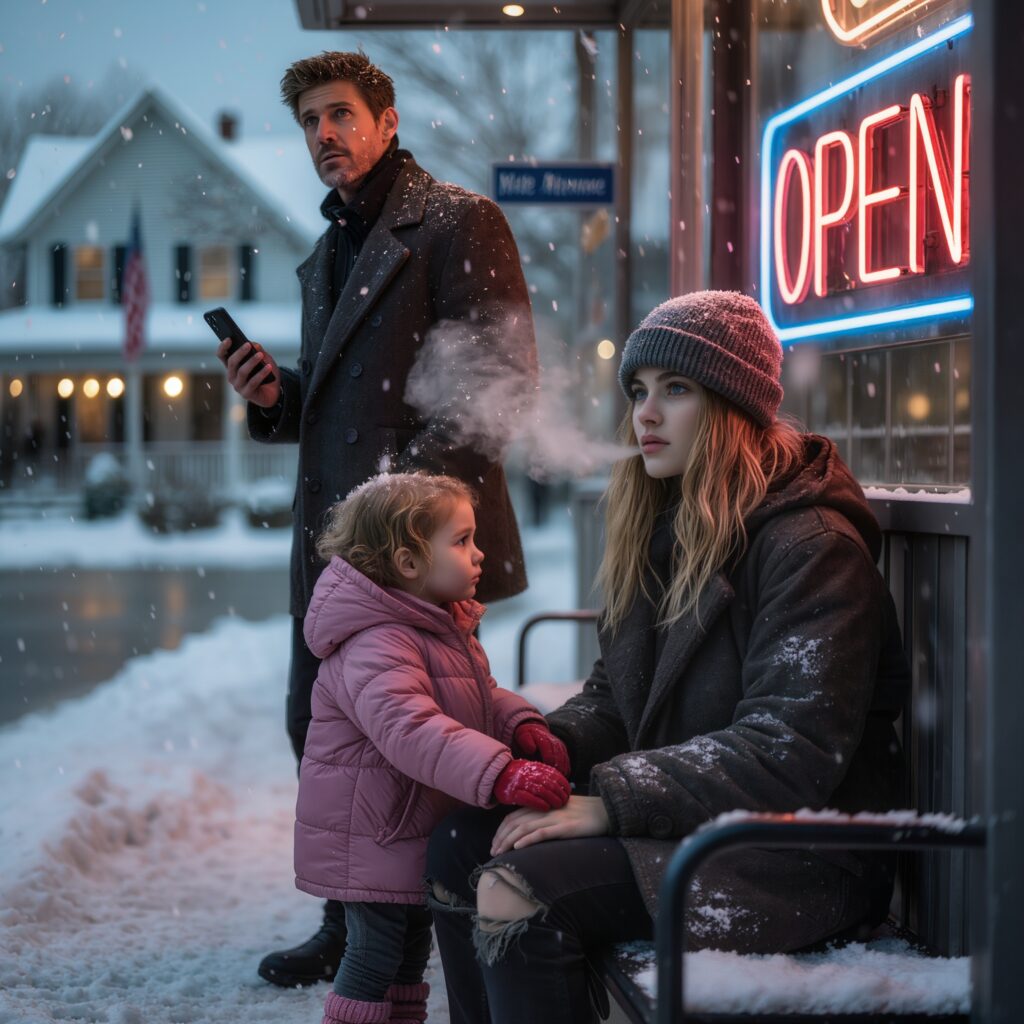
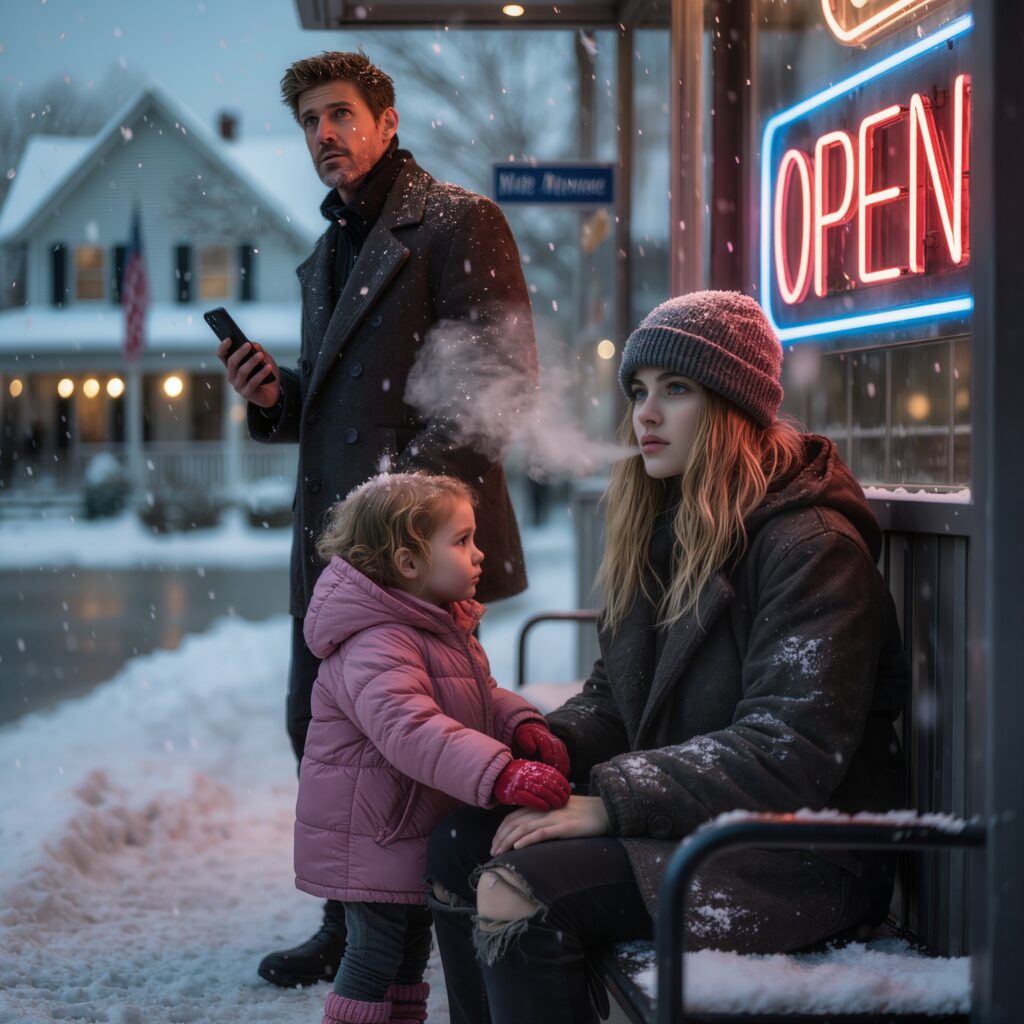
The small voice rang out like a whisper between snowflakes. Elliot Monroe spun around, startled, phone still pressed to his ear. The unexpected sound cut through the drone of city traffic and the heavy silence of a sudden snow squall. His four-year-old daughter, Laya, stood a few feet away, her tiny, mittened hands resting gently on the lap of a young woman curled on a bus-stop bench.
The woman didn’t move. Her pale blue, exhausted eyes blinked slowly, as if the effort were too much to bear. She was wrapped in a coat so tattered it seemed to melt into the grey slush around her—a shadow more than a person—clutching a faded cloth tote like a forgotten treasure. Snow clung to the golden strands of her messy hair, and her lips were slightly parted as she tried to catch her breath, a quiet shiver running through her limbs.
Laya, with the pure conviction only a child could muster, reached out, placing a bear-shaped cookie in the woman’s lap with tender care.
“You can live with us,” she said.
The words, so innocent, yet so profound, echoed in Elliot’s ears. He rushed over, ending the call and pulling his daughter back instinctively. He knelt beside her and looked up at the woman, his caution honed by years of surviving alone with his child.
“Miss, what are you doing with my daughter?” he demanded, his voice tight.
The woman slowly raised her hands, palms open in a gesture of surrender. “Nothing. I didn’t touch her. She just came over.” Her voice was hoarse, almost lost to the cold, but steady enough to be believed.
Elliot narrowed his eyes. The woman’s skin was flushed—too red in the wrong places—her mouth slightly blue. She clutched the tote tighter, her gaze lowering. “I didn’t ask for anything,” she murmured. “But thank you for having such a kind child.”
“Laya gave her cookie to a cat first,” Laya added matter-of-factly.
Elliot followed her gesture and saw it: half a torn bread roll in the snow near the bench, where a scrawny, trembling cat now pawed at the crumbs. The other half was clearly gone. The woman hadn’t begged. She hadn’t spoken first. And yet, something about her silence felt louder than anything he had heard all day.
“I think we should go,” he muttered, taking Laya’s hand.
The Collapse
He turned to leave, but behind him, he heard the woman shift. She was trying to stand—slowly, carefully, as if she didn’t want to make trouble—but her knees buckled. She stumbled sideways, colliding hard with the icy metal post of the bus-stop shelter before crumbling to the ground in a heap of fabric and fading snow.
Elliot spun around, his heart a frantic drumbeat against his ribs.
“Dad!” Laya cried, tugging at his coat.
He ran to her side. “Miss, can you hear me?”
No response. He crouched down, pressing two fingers gently against her neck. Her pulse was there, but it was weak, a faint flutter beneath the skin. Her forehead was slick with sweat, burning hot, even as the rest of her skin was ice cold. He saw a scrape on her hand, raw and red. Her breathing was shallow; her lips were pale and cracked. This woman was seriously sick.
He looked around. No cars passing. No one nearby. No time to wait for an ambulance that might never find them in the worsening weather. Without another thought, Elliot scooped her up. She was shockingly light, a mere collection of bones and blankets. Her coat opened slightly as he lifted her, revealing torn sleeves and bruised arms. She didn’t resist, only whimpered softly against his chest.
“Let’s go, Laya,” he said, voice low and urgent.
“Is she going to die?” Laya asked, eyes wide with fear.
“Not if we get her warm.”
They moved quickly, the snow crunching underfoot. Elliot’s house wasn’t far—three blocks at most—but every step felt heavier than the last. He didn’t know this woman, didn’t know her name, didn’t know her story, but something had shifted inside him the moment she fell. He could have walked away. He should have, maybe. But he didn’t.
As they neared the porch, Laya whispered, “I still think she’s our home now.”
Elliot didn’t answer. He just opened the door.
The Inevitable Search
The fire crackled softly. Isabelle stirred beneath the warm weight of a wool blanket, her eyelashes fluttering against her cheeks. The air smelled faintly of cedar and cinnamon. As she opened her eyes, the room slowly came into focus: the soft amber glow of a fireplace, polished wood floors, a tall bookshelf, and the faint hum of something cooking. She was on a long sofa, her coat folded neatly at the foot of the couch.
Then she heard the scratching of crayons. Laya sat cross-legged on the rug, tongue between her teeth in focus, drawing with fierce concentration. Her paper was filled with color—three stick figures holding hands, one tall, one small, and in the middle, one with a halo of yellow hair. Above them, in shaky but deliberate letters, she’d written, “My home.”
Isabelle blinked, stunned. She tried to sit up, but her body protested. That movement was enough to alert Laya, who jumped up with a proud grin, holding up her picture. “That’s us.”
“Isabelle,” she rasped, her voice barely audible, confirming her name.
“Daddy says you can stay until you’re better. But I think you should stay longer.”
Before Isabelle could respond, Elliot entered the room, his expression a carefully constructed wall. He set down a glass of water and a bowl of soup. “You passed out in the snow,” he said flatly. “I didn’t have a choice. You needed help. When you’re better, you’ll leave.”
His measured tone, devoid of cruelty but utterly clear, stung her. “Thank you,” she whispered, lowering her gaze.
The rest of the day passed quietly. At dinner, she ate slowly, keeping her eyes down whenever Elliot glanced her way. Later, as she helped clear the dishes, the loose sleeve of her sweater slipped down her forearm. Elliot’s eyes caught something: a long scar, raised and jagged, running across her wrist. He said nothing, but the image etched itself into his mind.
That night, long after the house had gone quiet, Elliot heard it—a soft, pained groan from the living room. He found Isabelle curled into herself, eyes tightly shut, pale and clammy. He picked up the phone. An hour later, a private physician arrived.
“She’s severely dehydrated. Fever of 102,” the doctor murmured. “Rest, fluids, warmth.”
“Does she have insurance? Any next of kin we can notify?”
Isabelle stirred weakly. Her voice broke as she mumbled, “No one. There’s no one who needs to know if I’m alive or not.”
Her words hung in the air like frost on glass. The doctor departed. Elliot stood there for a long time, watching her sleep. He didn’t know her story, but he knew pain when he saw it. He’d seen that same expression in the mirror years ago, after he was left with a newborn and a silence too loud to bear.
Before going back upstairs, Elliot walked into the kitchen. The next morning, Isabelle found a steaming mug of tea and a small folded napkin on the coffee table. She opened it.
“You’re not invisible.”
Her lips trembled. For the first time in years, someone had seen her.
But Elliot was a man who didn’t like loose ends. That night, after Laya was asleep, he searched. It didn’t take long. The headline was second on the list: A promising fashion student accused of stealing designs from NY Showcase. There was a photo—Isabelle, younger, polished, bright-eyed. Accused, but not convicted. Ruined all the same. Doubt, cold and sharp, crept in.
The Inevitable Goodbye
The next day, he found her in the hallway. “Can I ask you something?”
He showed her the article. She stared for a moment, then looked up, not surprised. “That’s me.”
“Did you—?”
“No,” she cut in gently. “I didn’t. But people believed I did. Sponsors pulled out. My landlord raised the rent. My friends vanished. The guy I trusted had already emptied my account. I figured you’d look me up. You seem like someone who does not like loose ends.”
He flinched. She was right.
“I didn’t steal anything. That design was mine. But after a while, people didn’t want the truth. They just wanted someone to blame.” She looked at him. “So tell me—do you believe me?”
He opened his mouth, closed it, hesitated. That was all she needed.
“Thanks,” she said softly. “For your honesty.”
She walked back to the guest room and began to gather her things. Laya’s eyes widened when she saw her at the door. “You’re leaving?”
“I have to, sweetheart.”
Laya held out her stuffed bear. “Teddy. So you won’t be alone.”
Isabelle’s eyes filled. She hugged the bear, then the little girl—long and tight. Elliot stood by the stairs, frozen, watching his daughter cling to a woman she had known for days but trusted like family. The sight broke something inside him.
Isabelle kissed Laya’s forehead, opened the door, and disappeared into the evening.
That night, Laya wouldn’t rest. “She didn’t even say goodbye,” she whispered.
“I know,” Elliot murmured, kneeling beside her bed. “She was someone special.” His voice caught. Laya pointed to her drawing taped to the wall—three figures, arms wrapped around each other. Below, written in crayon: “Please stay.”
Elliot turned away, but not fast enough to hide the tears.
The Turning Point in the Snow
It was past bedtime when Elliot first noticed Laya’s absence from bed. He found the living room door slightly ajar. Following the soft glow of the streetlamp, he stepped onto the porch and saw her tiny frame through the falling snow. Laya’s slippers crunched in the drift as she limped down the driveway, following a faint glow.
“Lila,” he called, panic seizing his throat.
She didn’t answer. He hurried after her. Just ahead, Isabelle sat by a streetlamp, her coat wrapped tight—unreadable. After years of training in control and detachment, Elliot remained silent until the sudden sound of a stumble, then a low cry. Laya had collapsed, tears mixing with snowflakes. Blood oozed from her palm.
Elliot broke into a run, but before he could reach them, Isabelle was there. She knelt beside Laya without hesitation.
“Hold still, sweetheart,” she murmured, folding a handkerchief from her coat pocket to bind the wound. She pressed the scarf gently, soothing Laya’s tears with warm hands.
Elliot reached them, voice low. “Lila, you frightened me.”
“I wanted to find her.”
Elliot looked up at Isabelle. The way she held his daughter spoke more than words ever could—the kind of nurturing he’d thought lost forever. The armor he’d worn for years cracked in that moment. He hadn’t loved like this before, not so suddenly, not so fiercely.
“Thank you,” he said softly.
He knelt and met Isabelle’s eyes. The snow drifting behind her looked like confetti falling from a sky that didn’t know to stop.
“We,” he began, voice thick. “We need you.”
Laya gripped Isabelle’s coat. “Don’t leave again, Mommy.”
Isabelle’s eyes went wide. Her breath caught. For a trembling second, she stared at the two of them—the father whose defenses had fallen, and the daughter whose belief had cracked open her heart. Elliot pulled them both inside. The door shut on the cold.
In that unspoken moment, he let go of fear. And for the first time, he believed some doors deserved to stay open.
The Greater Miracle
Isabelle returned, not as a guest this time, but as a warm presence. She taught Laya how to draw, and one Saturday, Laya sketched three hands—one large, one slender, and one tiny—overlapping in the center of a sun. Below: “This is love.”
That night, the fireplace glowed low. Elliot took the seat across from her. “You’ve made this place lighter,” he said quietly.
She smiled but looked away. “It’s your home. I’m just passing through.”
“No,” he said. “No, it’s more than that.”
Their eyes locked. He leaned forward, and for a fleeting second, the world was silent enough to believe in second chances, but just before his lips met hers, Isabelle pulled back.
“I can’t,” she whispered. “I can’t be her.”
“I’m not asking you to be anyone but yourself!” he argued, his voice tightening.
“Then why does it feel like I’m being measured against a ghost?”
“Because you won’t let yourself be seen,” he said. “You think I want someone else, but I want you. Your scars, your silence, your strength. I don’t want perfect. I want real.”
“So you’d rather leave first?” he asked, bitter.
She didn’t answer. Her eyes shimmered with sorrow. Without another word, she turned and walked out the door.
Three days later, the house was silent. Elliot went to straighten the guest room and saw it: an envelope on the pillow. The name written on it was Laya. Inside, the letter was slightly smudged.
Sweetheart, you’re the first person in a long time to call me mommy. But before I can be someone’s mother, I have to learn how to believe I deserve to be. There are pieces of me I’m still stitching back together. Tell your daddy that he gave me something no one else ever has: the space to be real. And I hope one day I’ll be brave enough to walk back through that door, not as someone passing through, but as someone who finally knows where she belongs.
She had left—not to run away. She had left to learn how to come back.
Home is Where My Mommy Is
Months later, at a charity fashion gala, Isabelle stood by her collection—elegant dresses and framed sketches. Her centerpiece dress had delicate, hand-stitched threads woven along the hem in the shape of tiny holding hands. She had rebuilt her name and her courage.
“And now,” the host said, “a very special reading by a very special little girl.”
Laya Monroe walked onto the stage, dressed in a soft pink dress, holding a crumpled piece of paper. Her small voice carried with steady clarity.
“Home is not the walls around me or the pillows on my bed. Home is when she sang to me and kissed my sleepy head. Home is where my daddy smiles and holds her hand so tight. Home is where my mommy is, and maybe that is tonight.”
Tears slipped past Isabelle’s lashes. Elliot emerged from the side, holding a wooden frame: the silk scarf she had wrapped around Laya that first snowy night.
“I framed the day I met you,” he said, voice low, eyes shining. “That’s when home returned.”
“I thought I left too much damage behind to ever deserve a future,” she whispered.
“And I thought keeping people away would protect what little I had left,” Elliot replied. “But it turns out letting you in gave us more.”
She pulled a folded piece of paper from her pocket—the note he had left beside her teacup that first night. “You’re not invisible.”
She unfolded it gently. “You were the first to see me again. Not the headlines, not the mistakes—just me.”
He stepped closer. “I want to see all of you without fear, without running.”
Isabelle looked over to Laya, then back at Elliot. Her voice cracked as she whispered: “Then I think I’d like to come home.”
Laya leapt from the stage and barreled into Isabelle’s arms, her laughter ringing like music.
The morning light spilled softly through the kitchen window. Isabelle and Laya were cutting heart shapes out of cookie dough. Elliot leaned against the doorway, watching the two girls—one by birth, one by heart.
“You know,” he murmured, “this is the first morning in years I didn’t wake up feeling like something was missing.”
He led her to a room they had never opened: a sunlit studio with a large drafting table and fabric spools. A plaque was freshly mounted: Isabelle’s Tomorrow. A Place to Begin Again.
“I wanted to give you a place where your hands could create again,” Elliot said.
“You built something in us first,” Elliot replied. “This is just returning the foundation.”
As they sat down to eat, Isabelle pulled a small, old handkerchief from her pocket, embroidered with a new line of stitching.
Family is not built by blood, but by the hands that hold when you’re lost.
Elliot stared at it, then reached out and ran his thumb over the last word. “You held us both when we didn’t even know we needed it.”
They had not found perfection, but they had found home. And sometimes the family we find is the one that finds us first.