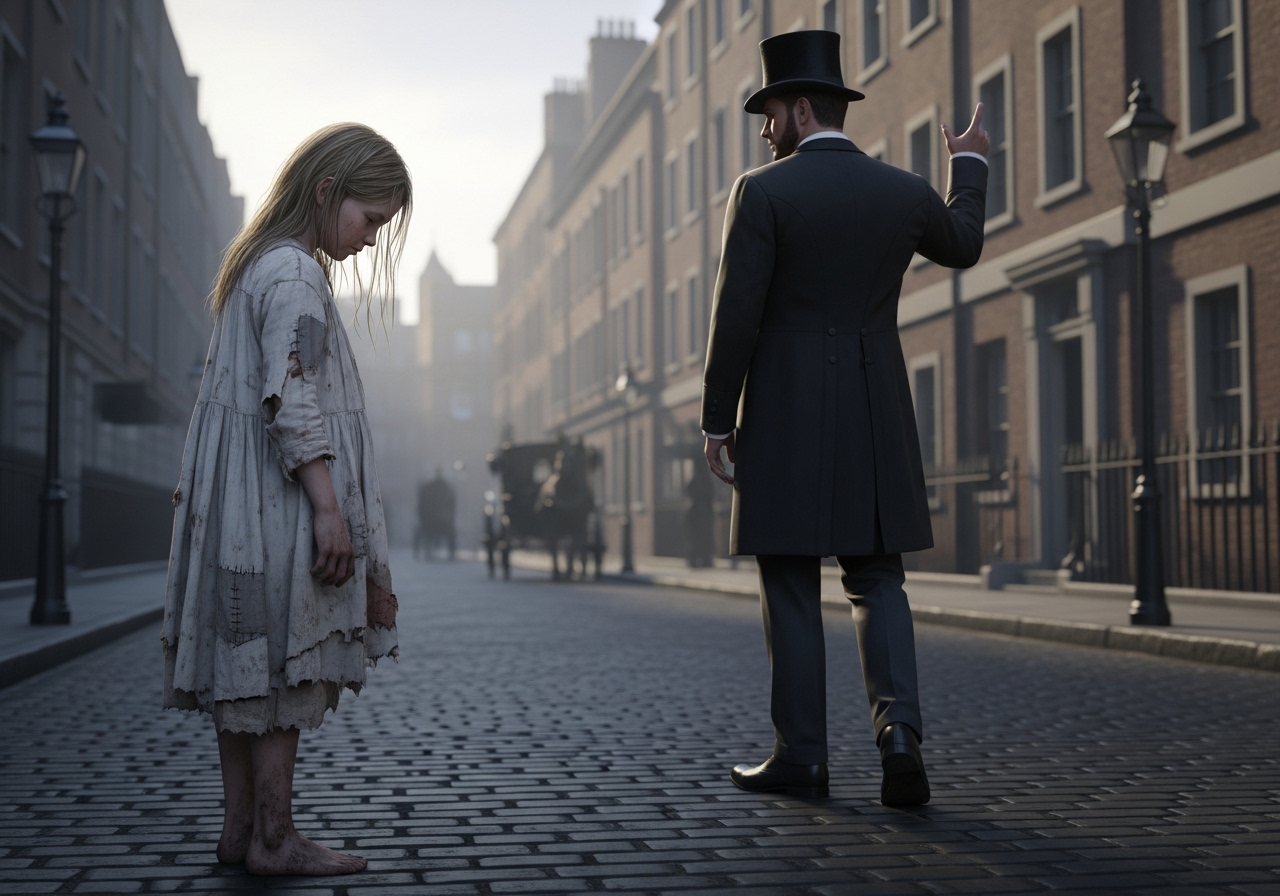
I Asked The Sad Man For A Dollar. He Kicked My Cup. So I Gave Him A Miracle For Free.
Chapter 1: The Gray Cloud and The Kicking Man
The rain in New York City doesn’t taste like water. It tastes like metal, old pennies, and exhaust from the yellow taxis that splash dirty puddles onto the sidewalk where I sleep.
My name is Lily. I’m ten, I think. Grandma said I was ten before she went to sleep and didn’t wake up last winter. Now, it’s just me and Mr. Bear. Mr. Bear is missing an eye and half his stuffing, but he listens better than most people in suits.

I was sitting on my flattened cardboard box outside the big glass doors of Mount Sinai Hospital. It’s a good spot because the vents blow warm air sometimes, smelling like laundry soap. But tonight, the wind was mean. It bit through my coat—a big, scratchy wool thing I found in a dumpster behind a dry cleaner. It smelled like mothballs and wet dog, but it was mine.
I pulled my knees to my chest, watching the people come out of the spinning doors. I like to watch their colors. Most people have colors. Happy people are yellow or bright orange. Busy people are red, moving fast. Sick people are a pale, dusty blue.
Then, he came out.
He didn’t have a color. He was just… gray. A big, swirling storm of angry, dark gray.
He was dressed in a suit that looked smoother than my skin, the kind that shimmers under the streetlights. He had shiny shoes that probably cost more than all the food I’d ever eaten. But his face looked like he was screaming on the inside. He stood there in the freezing rain, lighting a white stick that made smoke. His hands were shaking, like mine do when I haven’t eaten in two days.
My tummy made a loud, angry growl. It hurt. It felt like a knot being pulled tight.
“Mister?” I whispered. My voice sounded small, swallowed by the noise of the city traffic.
He didn’t hear me. He was staring at a puddle like he wanted to fight it. He looked so lonely, even though he looked rich.
“Mister…” I tried again, louder this time. I held out my plastic Hello Kitty cup. It was muddy, but you could still see the kitty’s pink bow. “Please? Just a dollar? I’m really hungry.”
He turned his head fast. He looked at me, but he didn’t see me. He saw trash. He saw an obstacle.
“Get lost, kid,” he growled. His voice sounded like gravel being crushed under a tire.
I didn’t move. I couldn’t. I saw the gray cloud around him getting darker. It wasn’t just anger. It was fear. I know fear. I see it in the mirror every morning when I wash my face in the park fountain.
“You smell sad, Mister,” I said. I didn’t mean to say it, but the words just fell out. “And… like sickness. Heavy sickness. Is it your wife? The lady in the high tower?”
He froze. The smoke stick burned his fingers, but he didn’t flinch. He looked at me with eyes that were red and tired. “How do you know about my wife?”
“I see things,” I said, pulling my backpack tight. It had my treasures in it—my jars, my leaves. “I can help. The doctors in there… they look at the beeping machines. I look at the light inside. Feed me, Mister. Buy me a warm meal, and I’ll fix her.”
I saw a tiny spark in his eyes. Just for a second. A tiny flicker of hope.
But then, the gray cloud swallowed it up. He laughed. But it wasn’t a nice laugh. It was a scary, jagged sound, like glass breaking.
“You?” he sneered. His face twisted up like he smelled something rotten. “You dirty little brat? My wife is being treated by the finest scientific minds in the United States. I have spent millions trying to save her. And you… you think you can save her in exchange for a sandwich? Go find your parents!”
“Nature listens when science goes deaf, Mister,” I said quietly. It was something Grandma used to say when she made her special tea for the neighbors.
That made him explode.
“Get away from me!” he screamed.
He swung his shiny shoe. Whack.
My cup flew out of my hand. It hit the curb and bounced into the gutter. My three quarters and two dimes—my whole day’s work, my breakfast and lunch for tomorrow—scattered into the black, oily water.
I didn’t cry. Grandma said tears make you colder. I just looked at my money floating away, sinking into the sludge. Then I looked at him.
“You’re mean,” I whispered, clutching Mr. Bear. “But you’re just scared.”
“Scram!” he spat, pointing a finger at me. “Before I call the police.”
He marched to a big, long car that looked like a spaceship. He slammed the door so hard the ground shook.
I crawled on my hands and knees to the gutter. The water was freezing, numbing my fingers instantly. I fished out the quarters, wiping the black slime on my coat.
“It’s okay, Mr. Bear,” I whispered to my pocket. “He didn’t mean it. He’s just hurting.”
But as the car drove away, I felt a tickle in my chest. A cough. A deep, rattling cough that tasted like iron.
Chapter 2: The Fever and The Paper
Two days went by. Or maybe three. Time gets weird when the heat inside you gets too high.
The cold had moved inside me. It wasn’t just on my skin anymore. It was in my bones. My chest felt like someone was sitting on it, a heavy, crushing weight. I couldn’t stay by the hospital anymore; the security guard told me to move along, said I was scaring the visitors.
So I went to my safe place. It’s under the Queensboro Bridge. There’s a spot near a steam vent where the big trucks rumble overhead. It’s loud, but it’s warm. I have a refrigerator box there. It says “Fragile” on the side in red letters. That’s me. I’m fragile.
I was curled up in a ball, shivering so hard my teeth clicked together. My head felt like a balloon about to pop. I closed my eyes and tried to dream about Grandma’s kitchen. The smell of rosemary, thyme, and chicken broth.
Suddenly, I heard running. Heavy footsteps splashing in the mud. Not the shuffle of the other homeless people. These were hard, fast steps.
“Little girl! Lily! Where are you?”
It was a man’s voice. A screaming voice.
I squeezed my eyes shut. Maybe it was the bad men. I hugged Mr. Bear tighter.
“The Little Sparrow?” I heard Old Joe say. Joe lives three boxes down. “She’s in the box. Leave her alone, she’s sick.”
The footsteps got closer. Then, someone ripped the cardboard flap of my box open.
It was him. The Kicking Man.
But he didn’t look scary anymore. He looked ruined. His shiny suit was covered in mud. His tie was gone. His hair was wet and messy, plastered to his forehead. He was on his knees in the dirt, breathing hard, like he had run a million miles.
“Lily,” he panted. He knew my name? How did he know my name? “Lily, wake up.”
I opened my eyes. Everything was blurry, like looking through a foggy window. “The Kicking Man,” I whispered. My voice sounded like a rusty hinge.
“I’m sorry,” he was crying. Actual tears mixing with the rain on his face. “I’m so, so sorry.”
He reached into his pocket and pulled out a huge stack of green paper. Money. More money than I had ever seen in my whole life. It was wet and soggy.
“Here,” he shoved it at me. “Take it. It’s ten grand. I can get more. I have millions. Take it all. Just come. Come fix her. Please.”
I looked at the green paper. I tried to lift my hand, but it was so heavy. I pushed the paper away with weak fingers.
“I told you,” I coughed, and it hurt so bad I saw stars. “I don’t want your paper. Paper doesn’t stop the shivering, Mister.”
“What do you want?” he screamed, desperate. “Name it! Toys? A house? Disney World? Anything!”
I sat up slowly. The world spun around me. I looked him right in the eye.
“I want soup,” I said. “Chicken noodle. And I want to eat it at your table. Not in the kitchen. Not in the alley. At your table. Like a princess.”
He stared at me. He looked confused. “Soup? That’s it?”
“Yes,” I whispered. “And… you have to carry me. I can’t walk.”
The Kicking Man—whose name was Arthur, I learned later—didn’t hesitate. He didn’t care that I was dirty. He didn’t care that I had lice or that I smelled like the street.
He scooped me up in his arms. His suit felt silky against my cheek. He held me tight, like I was something precious. Like I wasn’t trash.
“I’ve got you, Princess,” he sobbed into my hair. “I’ve got you.”
Chapter 3: The Wild Mint and The Golden Soup
The hospital smelled like lemons and rubbing alcohol. It was bright, too bright. Arthur carried me right past the guards.
“Mr. Sterling, you can’t bring a… a child in here! She’s a health hazard!” a man in a uniform shouted, blocking the way.
“Get out of my way!” Arthur roared. He sounded like a lion protecting a cub. “She is my guest! If you touch her, I’ll buy this building and fire you!”
The guards jumped back. We went up in the elevator. It went so fast my tummy did a flip. When the doors opened, we were in a room that looked like a palace. There were soft velvet chairs, big windows looking at the city lights, and flowers everywhere.
And there was a bed. In the bed was the lady. She was so pale, she looked like snow. She had tubes in her arms and a machine breathing for her.
A doctor with white hair tried to stop us. “Arthur, she’s filthy! You’re exposing Martha to germs! This is insanity!”
“Get out,” Arthur said. His voice was quiet but scary. “Everyone out except her.”
Arthur put me on a velvet chair at a small dining table. My feet dangled way above the floor. He picked up a phone.
“Soup,” he barked. “Chicken noodle. The best you have. Hot. Now.”
When it came, he didn’t just slide it to me. He shook out a linen napkin and tucked it into my dirty coat. He put a heavy silver spoon in my hand. He stood there, waiting, looking at me like I was the most important person in the world.
“Please, Princess,” he said, his voice cracking. “Eat.”
The soup was warm. It tasted like golden sunshine. It tasted like Grandma’s hug. I ate every drop. I felt the warmth spread from my tummy to my frozen fingers.
“Now,” I said, wiping my mouth with the back of my hand. “Hot water.”
I opened my backpack. Mr. Bear watched me with his one eye. I pulled out my jars. The doctor, who was hiding in the corner, looked at them like they were bombs.
“My grandma taught me,” I told them, my voice a little stronger now. “She said the earth has all the answers, even when people forget to listen.”
I took out the dried, jagged roots and the crinkly green leaves. Astragalus and Wild Mint.
“Grandma said when people are stuck between here and the stars, the mint calls them back,” I explained. “It wakes up the spirit.”
I mixed the tea. The smell filled the room—strong, spicy, and fresh, like the woods after rain.
I hopped off the chair. My legs were still wobbly, but I walked to the bed. The lady looked like she was already gone. Her chest barely moved.
“Lift her head up, Mister Arthur,” I said.
He did. His hands were gentle now, not angry fists.
“Drink, lady,” I whispered to her sleeping face. “It tastes like spring.”
We managed to get a few spoonfuls of the dark liquid down her throat. She swallowed.
Then we waited. The machine went beep… beep… beep.
Nothing happened.
Five minutes passed. Ten.
Arthur started to shake. The gray cloud came back, heavier than before. “It’s not working,” he whispered. He looked at me, and for a second, I thought he was going to kick me again. “You lied. You’re just a kid. What do you know?”
“The medicine is inside,” I said, zipping up my backpack. “But the tea only opens the door. You have to walk her through it.”
“Me? I’m not a doctor!” he cried.
I walked to the door. I was tired. So, so tired. The fever was coming back.
“You built a big castle, Mister Arthur,” I told him, looking at the fancy room. “But you forgot to put a home inside it. Her spirit is trying to leave because it’s freezing in here. You yell. You throw things. You don’t love. You just own.”
He fell to his knees. “What do I do?”
“Talk to her,” I said softly. “Not about your money. Talk to her about her. Make it warm.”
I slipped out the door. As the elevator closed, I heard him start to cry. I heard him talking about a picnic and a meatloaf sandwich.
“I love you, Marty,” I heard him sob. “I’m just a poor man with money. Don’t leave me.”
And then, I heard the beep change. It got faster. Stronger.
I smiled. The mint had called her back.
Chapter 4: The Letter to the Sad Man
I didn’t go back to the hospital. I knew my job was done.
I went back to the bridge. But the cold was different now. It wasn’t shaking me anymore. It was just… heavy. Like a big, warm, dark blanket that I couldn’t take off.
I slept for a long time. Days, maybe. Sometimes, Old Joe would bring me water. Sometimes, Sarah from the shelter would come and try to get me to go with her.
“Come on, Lily,” Sarah said one night, touching my forehead. “You’re burning up. We need to go to the doctor.”
“No doctor,” I mumbled. “I’m waiting for the Sad Man. He’ll come back.”
But he was busy being happy. And that was okay. That was the deal.
One night, the stars looked really bright. Brighter than the streetlights. I saw Grandma standing near the bridge pillar. She was wearing her flower apron, the one that smelled like flour and sugar.
“It’s time to come home, Little Sparrow,” she said, holding out her hand.
I knew she was right. My chest didn’t hurt anymore. I just felt floaty, like a balloon letting go of the string.
But I had to leave a message. I couldn’t let him think it was just the tea.
I went to the shelter one last time. It took all my energy to walk there. I asked Sarah for a crayon and a piece of paper. My hand was shaking, but I wrote it. I wrote it big so he could read it.
Dear Mister Sad Man…
I folded it up and gave it to Sarah. “Give this to the man in the suit when he comes. He will come. He promised.”
“Lily, please,” Sarah said, crying.
“I’m tired, Sarah,” I smiled. “Just sleep now.”
I went to the back room of the shelter. I lay down on a cot. It was softer than my box. I hugged Mr. Bear tight.
I closed my eyes. I thought about the soup. It was the best soup I ever had.
The gray cloud was gone. Everything was yellow now. Bright, warm, happy yellow.
Chapter 5: Lily’s Table
I wasn’t there in my body when Arthur came back, but I saw it. You see everything from where I am now. The stars are very good windows.
It was a month later. Martha was okay. She was sitting up, reading books, laughing. Her cheeks were pink again. Arthur was happy, but he had a hole in his heart where he remembered me.
He came to the shelter wearing a regular coat, not a shiny suit. He had a check in his pocket for five million dollars. He wanted to adopt me. He had a room ready for me with a pink bed.
When Sarah told him I was gone, he didn’t scream. He didn’t kick anything.
He just leaned against the wall and slid down to the floor. He buried his face in his hands and wept. He looked like a little boy who lost his balloon.
Sarah gave him my note. I watched him read it.
Dear Mister Sad Man,
I didn’t need your money. I wasn’t hungry for food. I was hungry to be seen.
You thought you were buying a cure. But the tea was just tea. Grandma’s tea. The cure was you. You needed to serve a little kid to remember how to be nice. You needed to get your knees dirty to see the sky.
Your wife didn’t just need medicine; she needed a husband who wasn’t too proud to ask a kid for help.
Keep your money. Or give it to the other kids who are cold. Just keep holding her hand.
— Lily.
He cried for a long time. But they were good tears. Cleaning tears.
He didn’t keep the money.
Six months later, I looked down and saw something amazing.
In the Bronx, in an old warehouse, there was a new sign. It was painted in bright colors—purple and pink and yellow, just like I liked. It had a drawing of a flower on it.
It said: “Lily’s Table.”
Arthur was there. He wasn’t wearing a suit. He was wearing an apron covered in flour. Martha was there too, looking beautiful and strong, ladling soup.
The line of people went down the block. There were people like Old Joe, and kids like me who didn’t have moms or dads.
A little girl walked up to the counter. She looked scared. She was clutching a dirty doll.
Arthur smiled at her. It was a real smile, reaching all the way to his eyes. “Welcome, princess,” he said. “We’re glad you’re here.”
He handed her a bowl of steaming chicken noodle soup and a big chocolate chip cookie.
“My name is Arthur,” he told her. “And this is for Lily.”
He wasn’t the Sad Man anymore. He was the Soup Man. And even though he wasn’t rich in the bank anymore, his color was shining. It was the brightest, warmest gold I had ever seen.
And I knew, finally, he was healed too.