The Teacher Mocked Her “Empty” Shoebox, Then The Janitor Asked One Question That Silenced The Room
Chapter 1: The Weight of Cardboard
The morning sun that filtered through the windows of Room 3B at Oak Creek Elementary was usually a welcome sight, signaling the start of another day in the sleepy suburbs of Ohio. But for seven-year-old Mia, the sunlight felt like a spotlight she desperately wanted to avoid.
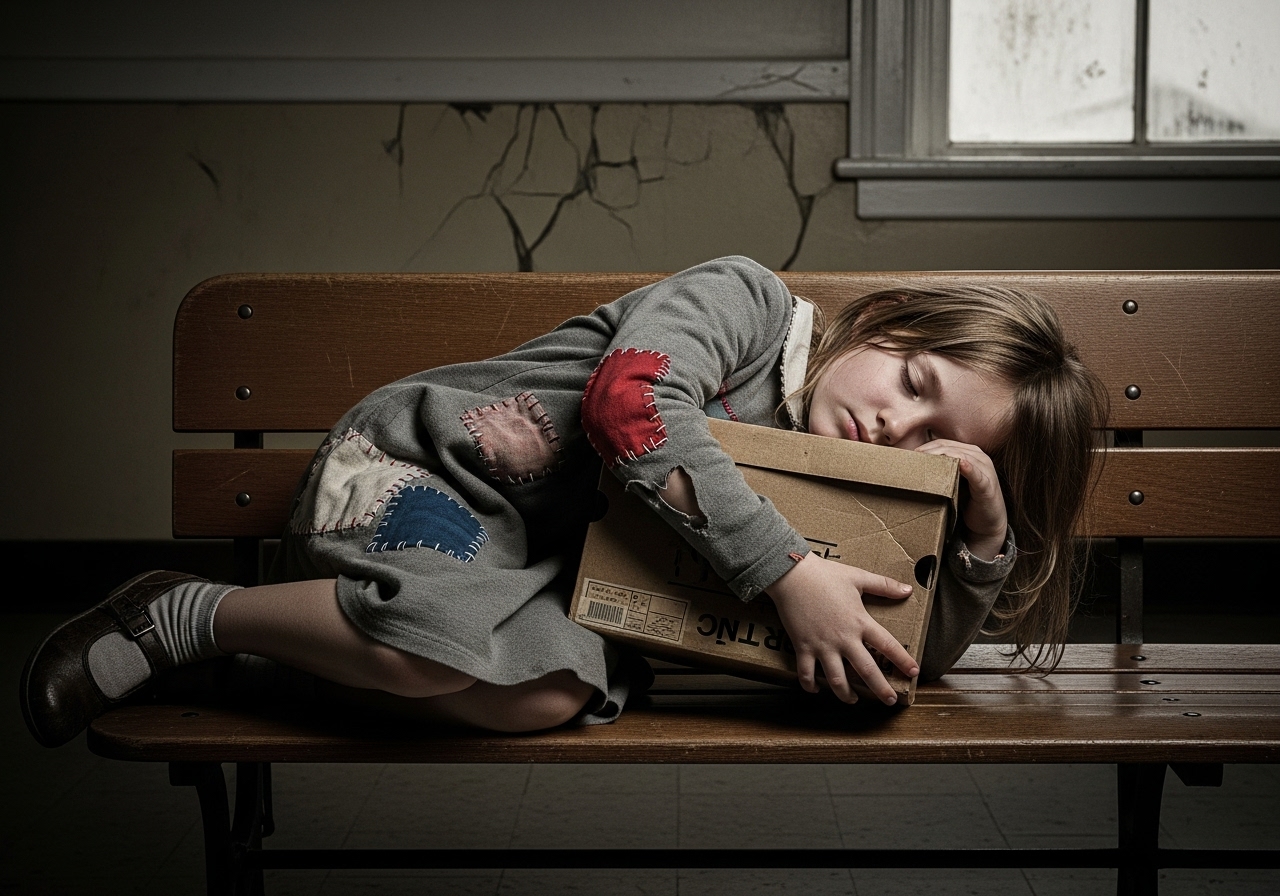
She sat in the back row, her small frame shrinking into the hard plastic chair. Her clothes were clean but undeniably worn; the hem of her denim dress was frayed, and her sneakers were scuffed gray, the pink laces slightly mismatched in shade. But it wasn’t her clothes that Mia was worried about today. It was the object resting on her desk, covered by her trembling hands.

It was a shoebox. An old, beat-up cardboard box that had once held men’s work boots, size 11. The corners were reinforced with layers of silver duct tape, and the lid was slightly concave, as if it had been held and hugged a thousand times.
Mrs. Evelyn Halloway stood at the front of the room, tapping a piece of chalk against the blackboard. Mrs. Halloway was a woman in her late fifties, with hair the color of steel wool and a posture that suggested she was constantly bracing herself against a strong wind. She was a veteran teacher, one who prided herself on order, discipline, and academic rigor. She had little patience for nonsense, and even less for excuses. To her, the classroom was a machine, and emotions were simply rust in the gears.
“Alright, class, settle down,” Mrs. Halloway’s voice clipped through the chatter. “Today is Friday, which means it is Show and Tell. As I explained on Monday, the theme this week is ‘My Most Treasured Possession.’ I expect you to stand up, speak clearly, and explain why the item matters to you. No mumbling.”
A ripple of excitement went through the room. The students of Oak Creek largely came from upper-middle-class families. Their parents were lawyers, doctors, and mid-level executives who commuted to the city.
“Who would like to go first?” Mrs. Halloway asked, adjusting her glasses.
Hands shot up like rockets.
First was Jason, a boy whose father owned a car dealership. He marched to the front, holding up a signed baseball in a glass case. “This is a baseball signed by the pitcher of the Cleveland Guardians,” he announced proudly. “My dad got it for me because we have season tickets in the VIP box. It’s worth five hundred dollars.”
The class ooh-ed and aah-ed. Mrs. Halloway nodded approvingly. “Very distinct articulation, Jason. Value is important. Good.”
Next was Sarah, a girl with perfectly braided blonde hair. She brought out a porcelain doll that looked terrified. “This is from France,” Sarah said. “My grandma brought it back from her trip to Paris. It has real silk clothes and you can’t touch it because oils from your hands will ruin the fabric.”
“Excellent cultural connection, Sarah,” Mrs. Halloway praised.
One by one, the children paraded their wealth. Brand new iPads, limited edition video games, jewelry passed down from great-aunts. The classroom turned into an auction house of privilege. Mrs. Halloway seemed pleased. This was a good class. They understood the assignment. They understood value.
In the back of the room, Mia felt a cold sweat prickling the back of her neck. She looked at her duct-taped box. It didn’t shine. It didn’t cost money. In fact, to anyone else, it looked like trash.
“Mia?” Mrs. Halloway’s voice cut through Mia’s panic. “You’re the only one left. Come on up. Let’s not drag this out, we have math drills to get to.”
Mia swallowed hard. Her throat felt like it was full of sand. She picked up the box. It weighed almost nothing, yet to Mia, it felt heavier than the entire world.
She walked the long, lonely aisle to the front of the class. She could feel the eyes of twenty-four other children boring into her. She could hear the faint snicker of Jason whispering to his friend, “Is she bringing garbage?”
Mia stood behind the teacher’s podium, barely tall enough to see over it. She placed the battered shoebox on the sleek wooden surface.
Mrs. Halloway peered over her spectacles, her brow furrowing. “Well, Mia? What do you have for us?”
Mia took a deep breath, her small hands resting protectively on the lid. “This… this is my box,” she whispered.
“Speak up, child,” Mrs. Halloway snapped. “We can’t hear you.”
“This is my box,” Mia said, slightly louder, her voice trembling. “It’s the most valuable thing I have.”
“Well, open it then,” the teacher said, checking her watch.
Mia nodded. With agonizing slowness, she peeled back the strips of tape she had used to keep it sealed during the bus ride. She lifted the lid.
The class leaned forward. Mrs. Halloway leaned forward.
The box was empty.
There was absolutely nothing inside. Just the brown, corrugated cardboard bottom.
A confused silence hung in the air for two seconds, followed immediately by the eruption of laughter.
“It’s nothing!” Jason shouted. “She brought a box of air!”
“Maybe she forgot to put the toy in!” Sarah giggled.
The laughter grew louder, a cacophony of childhood cruelty. Mia stood frozen, her face burning a bright crimson, tears welling in her large, dark eyes. She didn’t move to close the box. She just stared down into the emptiness.
Mrs. Halloway slammed a ruler onto her desk. Whack! The noise silenced the class instantly. But she wasn’t angry at the bullies. She turned her stern glare onto Mia.
“Mia,” Mrs. Halloway said, her voice dripping with disappointment. “Is this a joke?”
Mia shook her head violently. “No, ma’am.”
“You were told to bring a ‘Treasured Possession,'” Mrs. Halloway lectured, crossing her arms. “A possession is a thing. An object. You have brought an empty cardboard box. This is a waste of my time and your classmates’ time. Did you forget to do the assignment?”
“No,” Mia squeaked. “It’s not empty.”
“It is clearly empty, Mia,” Mrs. Halloway sighed, rubbing her temples. She was tired. She was burnt out. She didn’t have the energy to deal with a child’s imagination games today. “Go sit down. I’ll be noting this as a failure for the assignment. And I’ll be calling your guardians to discuss your lack of effort.”
Chapter 2: The Confrontation
Mia didn’t move. The threat of the phone call made her freeze. A call to her aunt? Her aunt who already complained that Mia was “too much trouble” since taking her in last week?
“It’s not empty,” Mia insisted, her voice gaining a sudden, desperate edge. “Please, Mrs. Halloway. You have to look.”
“I have looked, Mia. Go to your seat. Now.”
“No!” The word burst out of Mia before she could stop it. It was the first time she had ever raised her voice at a teacher.
The class gasped. Mrs. Halloway’s eyes went wide. “Excuse me? What did you just say to me?”
“I can’t close it yet,” Mia said, clutching the sides of the box. “I have to explain. You said I had to explain why it matters.”
“You are being defiant,” Mrs. Halloway said, her face reddening. She stepped out from behind her desk and loomed over the girl. “Close that trash and go to your seat, or you will be sent to the principal’s office.”
Mia looked at the box, then at the teacher. Tears were now streaming freely down her cheeks, dripping onto the cardboard. “I can’t,” she sobbed.
“Fine. I will do it for you.” Mrs. Halloway reached out to grab the lid.
“Don’t touch it!” Mia screamed. She threw her body over the box, hugging it to her chest.
The sudden movement startled Mrs. Halloway, but it ignited a frenzy in the class. The tension in the room spiked. Jason, perhaps thinking he could help the teacher or perhaps just wanting to be the center of attention, jumped up from his front-row seat.
“She’s crazy!” Jason yelled. He reached out and swiped at the box in Mia’s arms.
It happened in slow motion. Jason’s hand connected with the side of the box. It flew out of Mia’s grasp, flipping end over end in the air before landing upside down on the linoleum floor.
The lid skittered away.
The room went silent, but it was a different kind of silence. It was the silence before a storm.
Mia stared at the overturned box. For a heartbeat, she was paralyzed. Then, a sound tore from her throat that Mrs. Halloway would never forget as long as she lived. It wasn’t a cry. It was a primal, guttural scream of pure devastation.
“NO! NO! NO!”
Mia threw herself onto the dirty classroom floor. She didn’t reach for the box. She began frantically grabbing at the air around where the box had fallen. Her small hands scooped invisible handfuls of air, trying desperately to shove them back into the cardboard container.
“Get back in! Please! Get back in!” she wailed, her voice cracking with hysteria. She was crawling on her knees, scraping her skin, sobbing so hard she was choking. “Don’t go away! Please don’t go away! I’m sorry! I dropped you! I’m sorry!”
The children stopped laughing. They looked terrified. This wasn’t a tantrum. This was grief. Raw, unfiltered, terrifying grief.
Mrs. Halloway stood frozen. She had taught for thirty years, but she had never seen a child act like this. She took a hesitant step forward. “Mia? Mia, stop it. It’s just air.”
“You let it out!” Mia screamed at her, looking up with eyes full of accusation and agony. “You made him let it out! He’s going away!”
The door to the classroom opened. The noise had attracted attention. Principal Miller stood there, looking concerned, but behind him was Mr. Henderson, the school janitor.
Mr. Henderson was a large man, an African American veteran in his late sixties with a white beard and a limp from the war. He usually hummed gospel songs while he mopped the hallways. He knew every kid by name, but he had a soft spot for the quiet ones like Mia.
He took one look at the scene—the overturned box, the stunned teacher, and the little girl frantically trying to scoop air into cardboard—and he didn’t ask what happened. He seemed to understand instantly.
Chapter 3: The Last Breath
While Mrs. Halloway stood paralyzed and Principal Miller looked confused, Mr. Henderson limped quickly into the room. He ignored the teacher. He ignored the other students. He went straight to the floor.
He didn’t try to pull Mia up. Instead, he got down on his painful knees beside her.
“Mia,” his voice was a low, rumbling bass, calm and grounding. “Mia, honey. Look at me.”
Mia was hyperventilating, her hands still clutching at the empty space. “It’s gone, Mr. Henderson! It’s gone!”
“What’s gone, baby?” he asked gently. He didn’t dismiss her. He didn’t tell her she was crazy. He asked with genuine respect.
Mia pointed at the empty box. “Grandpa. It was Grandpa.”
Mrs. Halloway finally found her voice. “Mr. Henderson, she’s having an episode. The box is empty. She’s disrupted the whole class.”
“Quiet, Evelyn,” Mr. Henderson said sharply, without looking at her. The use of her first name shocked her into silence. He turned back to Mia. “Tell me about the box, Mia.”
Mia hiccuped, wiping her nose on her sleeve. She looked at the box, then at Mr. Henderson. “Grandpa raised me,” she whispered, her voice trembling. “Mommy and Daddy… they were sick. They went away. So it was just me and Grandpa Joe.”
The room was deathly quiet. Even the air vents seemed to stop humming.
“Grandpa got sick last week,” Mia continued, picking at the tape on the box. “He was in the bed in the living room. He couldn’t move much. He coughed a lot.”
She looked up at Mrs. Halloway, her eyes pleading for understanding. “He didn’t have any money left. He told me he was sorry he couldn’t leave me a necklace or a baseball or a doll. He said he spent it all on my food and shoes.”
Mia took a shaky breath. “Two days ago… right before the ambulance came to take his body… he called me over. He was too weak to hug me. He pointed at his shoe box. He told me to open it.”
Tears began to flow down Mr. Henderson’s face. He placed a large, calloused hand on Mia’s shoulder. “Go on, child.”
“He said… he said he was going to give me the only thing he had left. The most important thing,” Mia sobbed. “He took a big, deep breath… and he blew a kiss into the box. He blew all his love into it. And then he told me to close the lid really fast.”
Mia mimicked the motion of slamming a lid shut.
“He said… he said, ‘Mia, whenever you are scared, or lonely, or miss me… you just open this box a tiny bit, and my love will be right there with you. My last breath is in there, just for you.’ And then… then he stopped breathing. For real.”
She looked at the overturned box and began to weep again, a soft, defeated sound. “And now Jason knocked it over. And Mrs. Halloway made me open it all the way. And Grandpa’s breath got out. He’s gone. He’s really gone now.”
The silence that followed was heavy enough to crush a building.
It wasn’t just silence. It was shame.
Jason, the boy who had knocked the box over, looked sick. He slumped in his chair, pale as a sheet.
Mrs. Halloway felt as though the floor had opened up beneath her. Her heart hammered against her ribs. She looked at the “empty” box, and suddenly, she didn’t see cardboard. She saw a grandfather’s desperate, final act of love. She saw a little girl holding onto the only tangible piece of security she had left in a world that had taken everything else from her.
She had mocked it. She had called it trash. She had threatened to fail a grieving child for bringing her grandfather’s last breath to school.
Mrs. Halloway covered her mouth with her hand, a choked sob escaping her throat. The facade of the strict, unshakeable teacher crumbled. She wasn’t a teacher in that moment; she was a human being who realized she had just committed an unforgivable cruelty.
Chapter 4: The Invisible Filled the Room
Mr. Henderson didn’t scold the class. He didn’t need to. The lesson had been taught, harsh and permanent.
Instead, the old janitor did something remarkable. He reached out his large, rough hands into the air above the box, moving them slowly, deliberately, as if he were gathering water.
“Mia,” he said softly. “Do you know how air works?”
Mia shook her head, sniffing.
“Love isn’t like water,” Mr. Henderson said, his voice echoing in the quiet room. “If you spill water, it dries up. But love… love is like the air. It expands. When that box opened, your Grandpa’s love didn’t go away. It didn’t disappear.”
He made a sweeping motion with his arms, encompassing the whole room. “It just got bigger. It filled this whole room. It’s wrapping around you right now. He’s not just in the box anymore, baby. He’s everywhere. He’s hugging you from all sides.”
Mia looked up, her eyes widening. “Really?”
“I promise,” Mr. Henderson said. “But, if you want a piece of it back in the box for safe keeping, we can do that.”
Mr. Henderson looked at Mrs. Halloway. It was an invitation. A chance for redemption.
Mrs. Halloway’s knees shook as she walked over. She didn’t care about the dirt on the floor. She knelt down in her pencil skirt, right beside the janitor and the student. Tears were streaming down her stern face, ruining her makeup.
“Mia,” Mrs. Halloway choked out. “I am… I am so, so sorry.”
She reached out her hands, mimicking Mr. Henderson’s movements. She “gathered” the air. “Let’s put him back,” she whispered. “Come on, Jason. You too.”
Jason scrambled out of his chair, crying. He knelt down. Then Sarah. Then the whole class.
Twenty-five children, a teacher, a principal, and a janitor knelt on the floor of Room 3B. They reached into the air, grabbing invisible handfuls of love, and gently “placed” them back into the battered shoebox.
“Careful,” Jason whispered, wiping his eyes. “Don’t spill him.”
Mia watched them. For the first time in days, the crushing weight on her chest lightened. She saw the teacher who had scared her now treating her cardboard box like it was made of gold. She saw the boys who teased her acting with reverence.
When they decided the box was full, Mrs. Halloway gently placed the lid back on. She took the roll of tape from her desk—her expensive, teacher-only tape—and she sealed the box shut, wrapping it layer after layer to ensure it would never open by accident again.
“There,” Mrs. Halloway said, handing the box back to Mia with two hands. “It’s safe. And Mia?”
“Yes?”
“A plus,” Mrs. Halloway said, her voice breaking. “That is the most valuable possession I have ever seen.”
The bell rang, but nobody moved.
The aftermath of that day changed everything. Mrs. Halloway didn’t retire that year as she had planned. She stayed. But the strict, unfeeling machine was gone. She became the teacher who checked in on the quiet kids, who kept granola bars in her desk for students who missed breakfast, who understood that a child’s heart is more important than their test scores.
Mr. Henderson and Mrs. Halloway worked together to contact social services, ensuring Mia was placed permanently with a distant aunt who was given financial support through a fundraiser organized by the school’s parents—the very same parents who had bought the iPads and dolls. They raised enough money to ensure Mia would never have to worry about shoes or lunch again.
But Mia kept the box.
Years later, when Mia was a grown woman with children of her own, the box sat on the highest shelf of her living room. It was battered, covered in layers of yellowing tape. Her children would ask, “Mommy, what’s in the box?”
And Mia would smile, looking at the empty cardboard that held everything.
“My inheritance,” she would say. “Just a whole lot of love.”